

Japan Should Get Tougher on the CCP


.
Japan seized a Chinese fishing trawler on Feb. 13 within Japan’s exclusive economic zone (EEZ). The seizure is symbolic of Tokyo’s growing willingness to challenge the Chinese Communist Party (CCP) militarily.
Prime Minister Sanae Takaichi recently made remarks about Taiwan that indicate that Japan would consider militarily defending the island democracy if the People’s Liberation Army (PLA) invaded. This raised hackles in Beijing.
Japan’s full rearmament sufficient to counterbalance China will not occur overnight. It requires changing the country’s pacifist constitution, significantly increasing its defense spending, and, arguably, acquiring an independent nuclear deterrent.
Beijing is fast developing its own nuclear arsenal, including small-yield tactical nuclear weapons that could be used in a Taiwan scenario against any country that tried to break a Chinese blockade. Ukraine’s lack of nuclear weapons in its fight against Russia has forced it to pull its conventional punches against the city of Moscow for fear of provoking a nuclear response, which puts it at a serious disadvantage.
Japan’s defense spending was below 1 percent of gross domestic product (GDP) from 1961 to 2018. The Japan Self-Defense Forces still suffer from these impoverishing decades. Only in the past few years has defense spending trended toward 2 percent.
To counterbalance China and its allies, however, Japan’s defense spending will need to reach the new 5 percent of GDP standard set by the North Atlantic Treaty Organization (NATO). Japan also needs to strengthen its defense industrial base by allowing lethal military exports and by securing its strategic mineral supply chain.
Unfortunately, Beijing will second-guess Tokyo’s strength under pressure, along with its allies’ reliability. That Japan still has a pacifist constitution after China’s rapid military buildup must bemuse CCP leader Xi Jinping.
Unfortunately, that peace is being eroded by a lack of response to China’s territorial incursions over the years, including into Japan’s EEZ by China’s Coast Guard, the People’s Liberation Army (PLA), and the People’s Armed Forces Maritime Militia (PAFMM).
The formations were record-breaking in terms of the number of civilian boats used for a single military operation or exercise. Compare that number to the Dunkirk operation in 1940 that evacuated British troops surrounded by Nazis in France using about 700 to 850 British and Belgian fishing and pleasure boats.
The incursions are part of decades of gradual territorial expansion by the CCP, including in the maritime domain. This includes land attacks within China starting in the 1930s, and multiple attacks on Taiwan that started in 1949, with one against Kinmen Island. The CCP then expanded to an attack on U.S. and South Korean forces in the 1950s, India in the 1960s, the former Soviet Union in 1969, and Vietnam in the 1970s.
Threats against Japan and the Philippines, both of which have formal U.S. defense treaties, have been more circumspect. But the PLA’s grey zone attacks on the Philippines and threatening militaristic behavior against Japan, including almost daily fighter flights and naval maneuvers, are meant to provide China with small gains without significant risk of sparking a full-scale war.
In the maritime domain, the PLA Navy attacked the Paracel Islands in the South China Sea in 1974. They were then under the sovereignty of the South Vietnamese government, allied with the United States. There was a U.S. aircraft carrier nearby during the attack, but it did not offer the South Vietnamese forces on the island any assistance. This sent a signal to Beijing that the United States would not do much to stop China’s expansionism in the South China Sea. Then-President Richard Nixon, with his priority being the economic opening of China, was apparently looking the other way.
China has grown into the world’s second-largest economy due to the 1972 opening, the 1979 establishment of diplomatic relations, and the 2001 admission into the World Trade Organization. Yet the hoped-for reversal in its authoritarian approach to government is nowhere to be found. In its place is a continued avarice for neighboring territories acquired through incrementalist tactics.
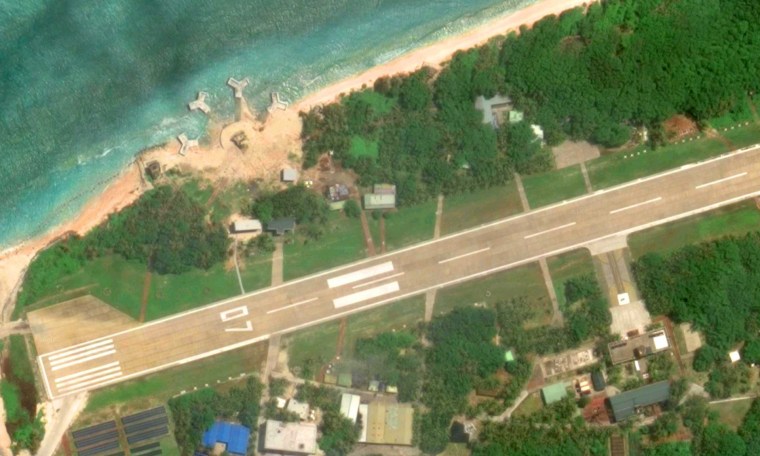
Currently, China is building what appear to be natural gas and fishing platforms in areas close to Japanese and South Korean EEZs, drawing protests from Tokyo and Seoul. The platforms near South Korea’s EEZ violate a 2001 China–South Korea agreement.
A much tougher response by Japan and its allies to the Chinese regime’s threatening behavior is warranted, but it is not yet in sight. Over the last few months, the regime appears to have significantly threatened Japanese and South Korean EEZs without much response.
Where are the U.S., Japanese, and South Korean economic sanctions on China for building these platforms?
Out-of-the-box ideas should also be considered, such as special forces that could demolish or disable any illegally built structures. This could then be denied to mitigate the risk of escalation.
There is no reason that the democracies should allow the world’s most dangerous dictatorship, because of its size and growing power, to continue to expand through incrementalist tactics. We need tougher and more creative defenses against the CCP if we are ever to contain its growing influence and power.
What's Your Reaction?
 Like
0
Like
0
 Dislike
0
Dislike
0
 Love
0
Love
0
 Funny
0
Funny
0
 Wow
0
Wow
0
 Sad
0
Sad
0
 Angry
0
Angry
0













Comments (0)