

"Don't Starve the Chicken": Top U.S. Commander Issues Blunt Warning to Taiwan on Defense Spending
The head of U.S. Indo-Pacific Command has issued a pointed warning to Taiwan: Washington cannot want Taiwan's defense more than Taiwan itself does. The remarks come as the island's $40 billion military budget remains locked in a political standoff – with potentially serious consequences for regional security.

.
A General Speaks Plainly
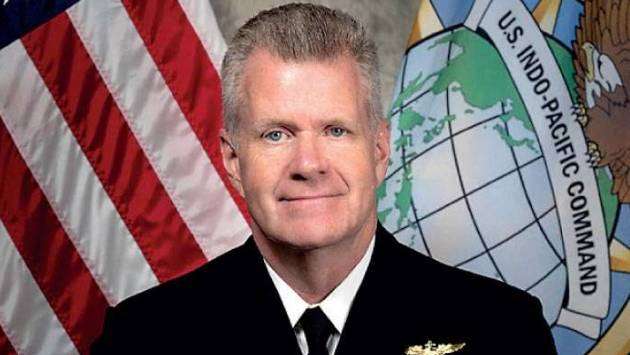
Admiral Samuel Paparo, commander of U.S. Indo-Pacific Command, didn't mince words when he appeared before the Senate Committee on Armed Services on Tuesday. Addressing the ongoing impasse over Taiwan's defense budget, he offered a vivid analogy: "It's not a chicken and the egg, because you're not going to get chicken or eggs if you starve the chicken."
The message was clear – Taiwan must fund its own defense if it expects to have one.
Paparo's remarks underline growing frustration in Washington over the prolonged failure of Taiwan's legislature to pass a major defense appropriations package proposed by President Lai Ching-te. "The United States can't want Taiwan's defense more than they want it itself," Paparo stated plainly.
A $40 Billion Package Stuck in Parliament
Taiwan's President Lai Ching-te introduced a sweeping special defense budget of approximately NT$1.25 trillion – roughly $40 billion – to be deployed over eight years, from 2026 through 2033. The package was designed to accelerate military modernization and is oriented significantly toward arms purchases from the United States, building on an initiative first announced in November 2025.
The plan would direct funds toward new missile defenses, long-range precision weapons, and unmanned systems. But it has run into a wall.
The defense spending proposal has been blocked more than ten times in parliament, creating a political deadlock that shows no signs of easing. The opposition, led by the Kuomintang (KMT) party and its ally the Taiwan People's Party (TPP), controls the legislature and has used that majority to stall the bill repeatedly.
The Opposition's Position
The KMT has framed its resistance as fiscal responsibility. Party leaders argue they will not sign "blank checks" without knowing exactly how the money will be spent. Opposition legislators have demanded that President Lai appear personally in parliament to answer detailed questions about the proposed purchases and their intended usage.
The KMT has also put forward a counter-proposal – but it is far smaller. The counterproposal would slash Lai's special defense budget request by almost 70 percent, omitting a number of capabilities considered critical to deterring a Chinese military attack.
At the same time, KMT Chairwoman Cheng Li-wun traveled to China, making a public appeal for peace – telling audiences that birds, not missiles, should fly in the skies over the Taiwan Strait. Ruling party lawmakers in Taipei responded with sharp criticism, accusing the KMT leadership of cosying up to Beijing while blocking the island's military preparations.
Washington Grows Impatient
The United States has not stayed silent. A group of 37 bipartisan U.S. lawmakers wrote to senior Taiwanese politicians in February, expressing concern about the parliament's continued stalling of the defense spending plan. A separate congressional delegation subsequently visited Taipei to deliver the same message in person.
A bipartisan group of four U.S. senators traveled to Taiwan in late March, reaffirming American support for the $40 billion budget and urging the legislature to pass it without delay.
U.S. Senator Roger Wicker, chairman of the Senate Armed Services Committee, expressed his disappointment publicly after the KMT's counter-budget emerged. Senator Dan Sullivan warned that "short-changing Taiwan's defense to kowtow to the CCP is playing with fire."
Despite the tension, there is some cautious optimism on Capitol Hill. A Democratic congressional aide who recently visited Taiwan told Reuters that private assurances had been secured from KMT leadership that a "robust defense package" would eventually be approved.
U.S. Commitments on the Table
Washington remains legally bound under the Taiwan Relations Act to provide Taiwan with the means to defend itself. American senators have signaled that a new round of U.S. arms sales – potentially worth up to $14 billion – is expected to be approved soon.
One Republican senator directly drew a parallel between Taiwan's situation and the Trump administration's own $1.5 trillion defense proposal, urging Taiwan's legislature to match that commitment with serious action of its own.
President Lai, for his part, has been unequivocal. He has told visiting U.S. lawmakers that Taiwan "loves peace" – but that only strength can secure it. "No engagement can come at the cost of sacrificing democracy, freedom, and national interests," he said.
The Bigger Picture
The stakes go far beyond parliamentary procedure. China, which views Taiwan as its own territory and has never renounced the use of force to bring it under control, has steadily increased military pressure on the island. Beijing refuses any official contact with President Lai, labeling him a "separatist."
Analysts who have studied the KMT's position say its motivations range from legitimate fiscal concerns to partisan obstruction – and, in some cases, possible direct influence from the Chinese Communist Party on individual party members.
With a potential Trump-Xi summit on the horizon and regional tensions running high, Taiwan's internal defense debate has taken on an urgency that reaches far beyond Taipei. Admiral Paparo's blunt analogy may be the clearest statement yet of where U.S. patience stands.
.
Sources:
- Reuters – "US commander warns Taiwan not to 'starve the chicken' on defense" (April 21, 2026): https://www.reuters.com/world/china/us-commander-warns-taiwan-not-starve-chicken-defense-2026-04-21/
- NPR – "Taiwan president's defense plan hits gridlock as China ramps up pressure" (January 22, 2026): https://www.npr.org/2026/01/22/nx-s1-5683130/taiwan-defense-spending
- South China Morning Post – "What next for Taiwan's Lai as US$37 billion defence boost frozen by KMT, allies?" (December 28, 2025): https://www.scmp.com/news/china/politics/article/3337851/what-next-taiwans-lai-us37-billion-defence-boost-frozen-kmt-allies
- The Hill – "China's threat looms as Taiwan's defense bill hits roadblock" (February 9, 2026): https://thehill.com/policy/defense/5727222-taiwan-defense-spending-stalemate-senate-concern/
- Global Taiwan Institute – "The Contents and Controversies of Taiwan's Special Defense Budget": https://globaltaiwan.org/2026/03/the-contents-and-controversies-of-taiwans-special-defense-budget/
- Taipei Times – "US senator urges legislature to pass stalled defense budget" (April 9, 2026): https://www.taipeitimes.com/News/taiwan/archives/2026/04/09/2003855309
- Military.com – "US Lawmakers Express Support for Stalled Taiwan Special Defense Budget" (March 30, 2026): https://www.military.com/daily-news/2026/03/30/us-lawmakers-express-support-stalled-taiwan-special-defense-budget.html
.
What's Your Reaction?
 Like
0
Like
0
 Dislike
0
Dislike
0
 Love
0
Love
0
 Funny
0
Funny
0
 Wow
0
Wow
0
 Sad
0
Sad
0
 Angry
0
Angry
0













Comments (0)