

The Silent Power Shift: How China Is Turning the West's Weakness Into Its Greatest Win
A string of European leaders has flown to Beijing in 2026 — each calling it pragmatism. But behind the diplomatic photo ops, China's Communist Party regime is executing a patient, long-term strategy: exploit Western divisions, lock Europe into dependency, and reshape the global order. The numbers tell a story that the warm handshakes do not.

A recent analysis of the situation, exclusively by Udumbara.net, on 14 April 2026
.
The New Parade on Tiananmen's Doorstep
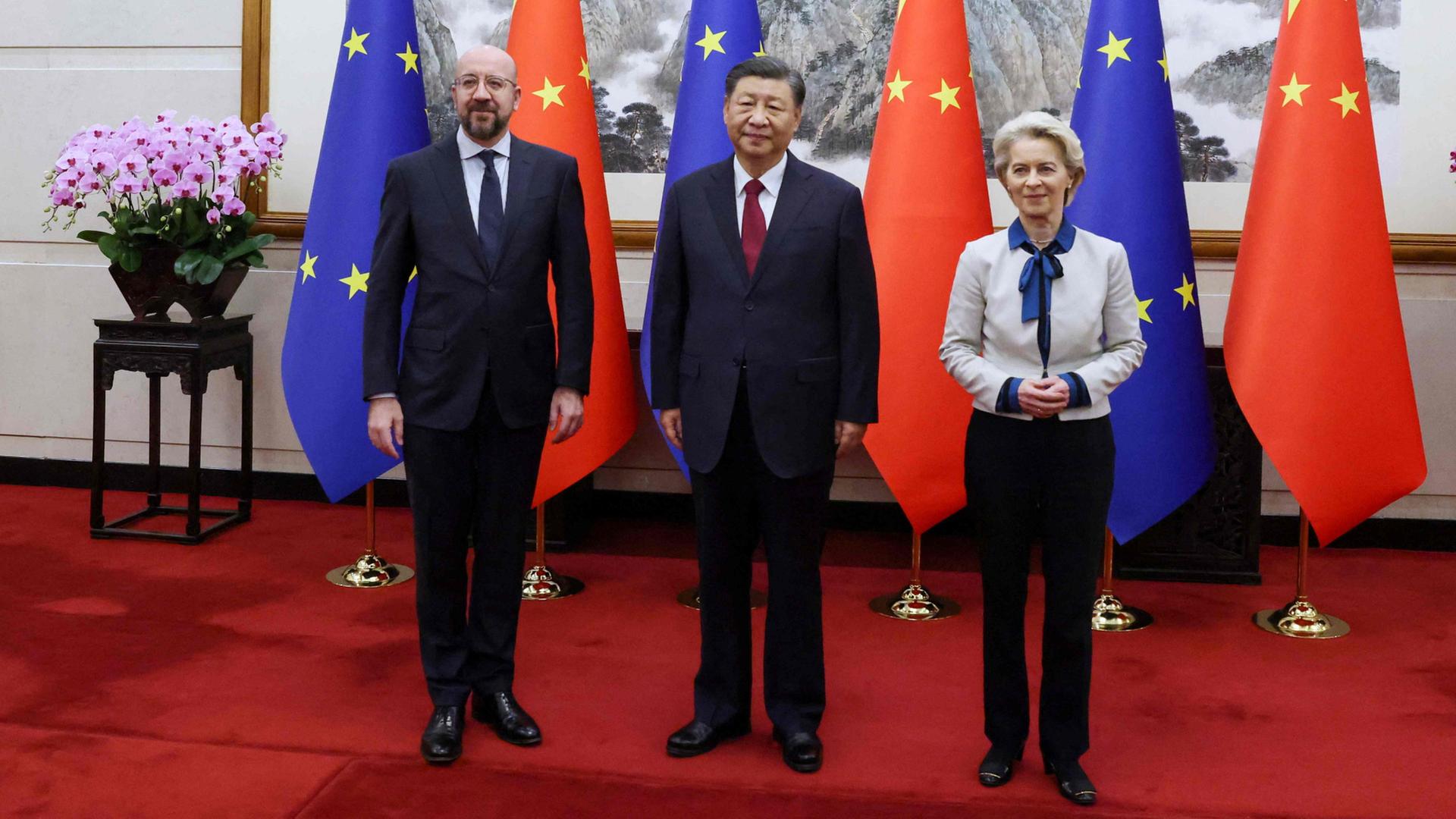
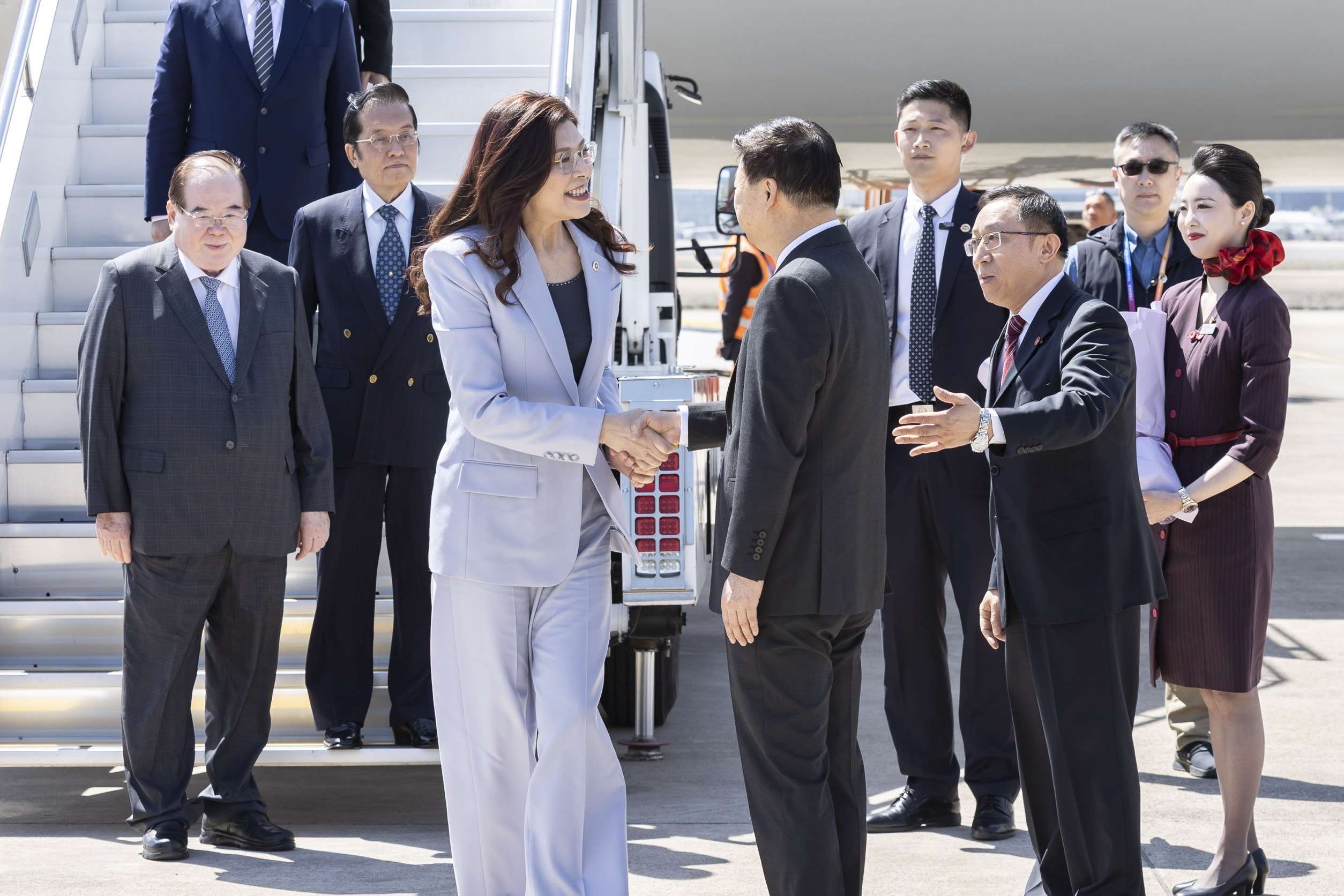
Something remarkable has happened since the beginning of 2026. In the span of just a few weeks, a procession of Western leaders arrived in Beijing: Ireland's Taoiseach, Finland's Prime Minister, Britain's Keir Starmer — the first UK visit in eight years — and Canada's Mark Carney, followed by Germany's Friedrich Merz. Now Spain's Pedro Sánchez has arrived for his fourth visit to China in four years. France's Emmanuel Macron made the trip in December. More are expected before the year is out.
Each leader framed the visit as a matter of economic necessity. Each cited the need for "pragmatic" relations. And each was received with great fanfare by Xi Jinping and the CCP leadership — which has every reason to be pleased.
What the revolving door of Western leaders signals to Beijing is exactly what the CCP wants the world to see: that the post-1945, U.S.-led international order is fracturing, and that China is filling the gap.
.
The Crack in the Western Wall
To understand why European leaders are flying east, you have to understand what has happened to transatlantic relations in the past year.
The second Trump administration rapidly scaled back U.S. engagement in global affairs, questioned support for Ukraine, pursued a rapprochement with Russia, and imposed tariffs on EU exports. These moves deepened political, economic, and security rifts between Washington and Brussels, prompting a strategic reassessment across Europe.
At Davos 2026, French Foreign Minister Jean-Noël Barrot put it bluntly: "The growing competition between the US and China threatens to drag Europe into a confrontation or force it to pick sides." The comment reflected a wider consensus that geopolitics is no longer confined to specific crises — it is reshaping global decision-making across every domain.
Some analysts go further, arguing that Trump's National Security Strategy appears designed to "weaken Europe as a geopolitical actor so that it cannot negotiate with a single voice on trade, technology and security." Whether that reading is accurate or not, the effect on European psychology has been real: leaders who spent years aligning with Washington are now hedging their bets.
Beijing has been watching — and waiting — for precisely this moment.
.
China's Strategy: Patience, Projection, and Pressure
The CCP's approach to Europe is not impulsive. It is calculated. And it has three distinct components.
First: project stability. Chinese state analysts have promoted Beijing as "the most predictable" major power in the world — a contrast to what they describe as the "unilateral bullying" emanating from Washington. This framing has proven surprisingly effective with audiences in European capitals searching for reliable partners.
Second: divide and rule. China does not pursue a unified "European policy." It cultivates individual member states, offers bilateral deals, and leverages economic dependencies to fracture EU consensus. Analysts at the China Observers network anticipated that 2026 would see divergent dynamics — with Brussels pulling back from Beijing while individual capitals drift closer — in a classic divide-and-rule play. That prediction has proven accurate.
Third: exploit the economic vacuum. As U.S. tariffs redirected Chinese export flows away from American markets, those goods had to go somewhere. They went to Europe. After Washington imposed tariffs of up to 145% on Chinese goods in April 2025, Beijing redirected exports that could no longer reach American markets toward Europe, where many Chinese goods still face tariffs of just 2 to 3 percent under WTO rules.
The result: European leaders arrive in Beijing complaining about trade imbalances while the imbalance keeps growing. That gap between rhetoric and reality is one China's Communist Party exploits masterfully.
.
The Numbers Europe Doesn't Want to Face
The diplomatic warmth between Europe and China would be less alarming if the economic foundations were balanced. They are not — and they are getting worse.
In 2025, the EU exported €199.6 billion in goods to China and imported €559.4 billion, producing a trade deficit of €359.8 billion. Compared to 2024, exports fell 6.5% while imports rose 6.4% — both moving in the wrong direction simultaneously.
Since 2015, EU imports from China have nearly doubled, rising 89%, while EU exports to China grew by just 37%. At the root of the problem is China's domestic demand crisis — its factories produce more than its citizens can buy, so the surplus is exported abroad.
The dependency runs even deeper in strategic materials. Europe sources 98% of its rare earth magnets from China — materials essential for electric vehicle motors, wind turbines, and weapons systems. That is not a trade statistic. It is a strategic vulnerability.
The Bruegel Institute, one of Europe's leading economics think tanks, warned in early 2026 that the EU trade deficit with China was heading toward €400 billion — more than double the pre-pandemic level. If Europe fails to adapt, the consequences will be continued deindustrialisation, accelerated job losses in strategic sectors, and a dangerous erosion of the manufacturing base required for technological sovereignty.
.
The "Second China Shock" No One Wants to Name
European Commission President Ursula von der Leyen has warned of a "second China shock" — a reference to the wave of Chinese manufacturing that swept through the West in the early 2000s, gutting industries and eliminating jobs. The first China shock, between 1999 and 2007, led to outsourcing of manufacturing jobs and a surge of Chinese exports. A second shock could be even harder to absorb, as Europe's market is already under an influx of Chinese goods that are becoming increasingly technologically advanced.
The pattern is visible in multiple industries simultaneously. In electric vehicles, green energy components, semiconductors, and now agricultural inputs, China's state-subsidized manufacturing machine is producing goods at prices European competitors simply cannot match. China now accounts for roughly one-third of total global value-added manufacturing, and its trade surplus hit nearly $1 trillion last year. The fierce price wars within China's own market have driven down profitability, and nearly a quarter of China's industrial enterprises are now operating at a loss — yet they keep producing, kept alive by state subsidies.
Beijing has also learned to calibrate retaliation surgically. When Macron's France criticized Beijing's trade practices, China's anti-subsidy measures landed on French agricultural products — targeting politically exposed domestic industries to concentrate pain on the governments that make the loudest noise. It is not free trade. It is coercion dressed up as commerce.
.
The CCP's Willing Guests
Against this backdrop, the parade of European leaders visiting Beijing looks less like bold diplomacy and more like an inadvertent gift to Xi Jinping.
Chinese foreign policy thinkers make no secret of the potential gains. Viewed from Beijing, the procession of Western leaders is a powerful sign that an era of talking about economic separation from China is waning, and that Western leaders are finally seeing China as a reliable partner — in contrast to the US under Trump.
The Atlantic Council has documented Beijing's long-standing strategy of sowing division within Europe — visiting its most accommodating member states, bypassing harder-line ones, and using the symbolism of bilateral summits to project an image of normalcy and partnership. Each visiting European leader, whatever their intentions, contributes to that narrative.
The CCP is not shy about what it wants. The head of the CCP's international affairs department wrote in the official party newspaper that China's modernization efforts break a "Western-centric" model and give developing countries a new choice. The message is clear: the Western-led international order is being replaced, and Beijing is positioning itself as the organizer of what comes next.
.
Strategic Autonomy or Strategic Illusion?
European leaders insist they are not abandoning Washington — they are simply diversifying. They call it "strategic autonomy." The concept has genuine merit as an aspiration. But its current execution raises serious questions.
The overall trend across Europe can be summarized as increased distrust toward the US, cautious and selective re-engagement with China, and a growing push for strategic autonomy. Yet the practical implementation of this principle remains deeply challenging. The difficulties in articulating a coherent economic security agenda reflect differing national priorities and positioning that continue to undermine collective EU action.
The core contradiction is stark: European leaders seek independence from the United States while depending on American security guarantees for their defense. They court Beijing while warning about Chinese overcapacity. They sign bilateral deals with Xi while Brussels passes new instruments to screen Chinese investments. The "third path" these leaders claim to be pursuing remains an uncertain experiment, constrained by a hard truth: while allies seek autonomy, they lack a realistic alternative to U.S. security protection.
Washington has not been quiet. Trump warned that any country seeking closer ties with China would be making a dangerous mistake, and threatened 100% tariffs on Canada if Ottawa "makes a deal" with China. Treasury Secretary Bessent warned that European markets risk becoming dumping grounds for Chinese goods that can no longer enter the United States. The warning deserves to be taken seriously — because the trade data already confirm it is happening.
.
What Beijing Gets — And What Europe Is Giving Away
The most sobering aspect of Europe's current course is not the trade numbers, though those are alarming enough. It is the structural nature of what is being conceded.
Analysts at Lazard identified Chinese rare earth export controls as a top strategic risk for 2026, warning that without diversified supply chain partnerships, China will retain leverage over critical input materials essential for European defense and clean energy sectors.
European manufacturers are increasingly losing out to lower-cost Chinese producers not just in Europe but in export markets too. Both EU and UK goods exports to China have fallen over the last three years — the promise of Chinese market access that European leaders keep flying to Beijing to secure has not materialized in any meaningful way.
Meanwhile, the CCP operates with a discipline and coherence that Europe's fragmented, multi-stakeholder governance model cannot match. When the EU invested political capital in EV tariffs, Beijing simply bypassed them via minimum price mechanisms — and Chinese EV sales in Europe climbed sharply through 2025, exceeding 400,000 units by 2024 alone. Instruments designed to protect European industry were negotiated away under pressure before they could take effect.
.
The Real Question Europe Is Not Asking
Every leader returning from Beijing speaks about "balance" and "pragmatism." What is rarely spoken aloud is a more uncomfortable question: what is Europe actually getting from these visits — and what is it giving away?
China views Europe as "leaderless and powerless," according to researchers monitoring Beijing's strategic communication. That perception has only deepened as individual European capitals rush to make bilateral accommodations that undermine the EU's collective bargaining position.
The CCP does not need to conquer Europe militarily. It does not need to win a war. It needs only to deepen economic dependencies, fracture political unity, acquire technology, and ensure that European leaders calculate that confronting Beijing is more expensive than accommodating it. On every one of those metrics, 2026 has been a good year for Xi Jinping.
The world is genuinely in the middle of a power transition. The question is not whether that transition is happening — it is. The question is whether the West recognizes what it is conceding, and whether it chooses to act before the leverage is gone.
As one analyst put it, without a strong transatlantic alliance, there is no way to constrain China's techno-economic expansion, limit unfairly produced Chinese imports, or build the advanced industries needed for long-term competitiveness. Damage that is allowed to compound over years may prove irreversible.
The parade to Beijing continues. And Beijing is counting every step.
.
Sources
- Atlantic Council — The Geopolitical Trends Shaping the EU's Policies on China (November 2025): https://www.atlanticcouncil.org/in-depth-research-reports/report/the-geopolitical-trends-shaping-the-eus-policies-on-china/
- Council on Foreign Relations — China in Europe: January 2026 (March 2026): https://www.cfr.org/articles/china-in-europe-january-2026
- CNN — As a Parade of US Allies Visit China, Beijing Claims a Win for Its New World Order (February 2026): https://www.cnn.com/2026/02/02/china/china-us-europe-allies-analysis-hnk-intl
- Eurostat — Trade in Goods with China in 2025 (April 2026): https://ec.europa.eu/eurostat/web/products-eurostat-news/w/ddn-20260410-2
- Courthouse News Service — EU-China Deficit Jumps 18% in 2025 as US Tariffs Divert Trade to Europe (April 2026): https://www.courthousenews.com/eu-china-deficit-jumps-18-in-2025-as-us-tariffs-divert-trade-to-europe/
- Bruegel Institute — Europe Needs a Broader Trade-Defence Toolkit Against a Mounting China Shock (February 2026): https://www.bruegel.org/newsletter/europe-needs-broader-trade-defence-toolkit-against-mounting-china-shock
- MERICS — China's Overcapacity and the EU (2026): https://merics.org/en/merics-briefs/chinas-overcapacity-and-eu-german-china-policy-under-merz-eu-china-trade
- Al Jazeera — Calculated Hypocrisy: Why Western Powers Court Beijing but Rely on US (February 2026): https://www.aljazeera.com/opinions/2026/2/18/calculated-hypocrisy-why-western-powers-court-beijing-but-rely-on-us
- World Economic Forum — Davos 2026: Five Key Geopolitical Takeaways (January 2026): https://www.weforum.org/stories/2026/01/geopolitics-took-centre-stage-davos-2026-5-key-takeaways/
- Real Instituto Elcano — Quest for Strategic Autonomy? Europe Grapples with the US-China Rivalry (September 2025): https://www.realinstitutoelcano.org/en/monographs/quest-for-strategic-autonomy-europe-grapples-with-the-us-china-rivalry/
- Lazard — Top Geopolitical Trends in 2026 (January 2026): https://www.lazard.com/research-insights/top-geopolitical-trends-in-2026/
- Euronews — In 2025, Global Trade Cracked as Europe Hurt by US Tariffs and New China Shock (December 2025): https://www.euronews.com/my-europe/2025/12/29/in-2025-global-trade-cracked-as-europe-hurt-by-us-tariffs-and-new-china-shock/
- CNBC — China and the UK Are Attempting to Reset Their Relationship (January 2026): https://www.cnbc.com/2026/01/30/china-beijing-trade-tariffs-trump-starmer-carney.html
.
What's Your Reaction?
 Like
3
Like
3
 Dislike
0
Dislike
0
 Love
3
Love
3
 Funny
0
Funny
0
 Wow
3
Wow
3
 Sad
0
Sad
0
 Angry
0
Angry
0











Comments (0)