

Taiwan Under Pressure: The Island at the Center of a Global Power Struggle
As U.S. President Donald Trump prepares to meet China's Xi Jinping in Beijing, Taiwan finds itself at the heart of one of the most consequential diplomatic moments in decades. Beijing is stepping up military pressure, dangling economic promises, and asserting territorial claims across the region — while Taipei stands firm, thrives economically, and quietly plants its flag where it counts.

A recent situation analysis from April 29, 2026, by Udumbara.net
.
A Summit Taiwan Wasn't Invited To
Next month, Donald Trump will sit down with Xi Jinping in Beijing for what may be the most consequential diplomatic meeting of 2026. Taiwan will not be at the table — but it will almost certainly be the main topic.
Beijing has made its priorities clear: the Taiwan question is at the top of the agenda. And unlike their previous meeting in South Korea, where Xi deliberately avoided the subject, China is now pushing hard to reshape the terms of the debate.
At the heart of Beijing's demand is a change in language. For decades, Washington has maintained a carefully calibrated "one China policy" — acknowledging, but not endorsing, Beijing's claim over Taiwan, while stopping short of supporting Taiwanese independence. China wants the U.S. to go further and formally state that it opposes Taiwanese independence. It's a subtle shift in wording, but analysts say the strategic implications would be enormous.
Taiwanese Deputy Foreign Minister Francois Wu did not mince words: "What we are most afraid of is to put Taiwan on the menu of the talk between Xi Jinping and President Trump."
Taipei's Mainland Affairs Council says it is in intensive contact with Washington and is monitoring every signal from the preparatory talks. The anxiety is real — and understandable.
Trump: Strong on Arms, Uncertain on Words
The Trump administration insists its Taiwan policy has not changed. There is evidence to support that. Trump approved more weapons sales to Taiwan in just over one year of his second term than Joe Biden did across his entire presidency. Senior U.S. officials have described American commitments under the Taiwan Relations Act as "rock solid."
But Trump's public statements have introduced uncertainty. Earlier this year, he told the New York Times it was "up to Xi" what China does with Taiwan — though he added he would be "very unhappy" if Beijing made a move. He also temporarily delayed a weapons package to Taipei after Xi raised the issue directly.
The White House has since sought to reassure allies. Former national security adviser Robert O'Brien declared that Trump would not become "the first American president to lose Taiwan." But in diplomacy, reassurances only go so far when the president himself sends mixed signals.
The stakes are not just political. Taiwan hosts some of the world's most advanced semiconductor factories — the backbone of the global technology supply chain. It also sits at the center of the western Pacific's military balance, and U.S. intelligence agencies operate critical radar and listening infrastructure on the island's mountains. Losing Taiwan would mean losing one of America's most valuable intelligence windows into China.
Beijing's Carrot-and-Stick Strategy
While pushing for language changes in Washington, China has been running a parallel campaign toward Taipei itself — combining economic promises with military intimidation.
On Wednesday, Beijing's Taiwan Affairs Office spokesperson Chen Binhua claimed Taiwan would enjoy "unprecedented opportunities" if it agreed to unify with the mainland — access to China's vast consumer market, new growth, new vitality. It is a pitch Beijing has been making with renewed intensity since late 2024.
Taiwan's response was brief and dismissive: not interested.
The reason is not hard to find. Taiwan's economy grew by 8.68% in 2025 — its fastest pace in 15 years — fueled by surging global demand for its advanced semiconductors. A further 11.3% expansion is projected for the first quarter of 2026. Taipei has little incentive to restructure its economic relationships around Beijing's terms.
President Lai Ching-te addressed the pitch directly when speaking to senior military commanders in Taipei on the same day. "Unification packaged as peace will inevitably bring endless troubles to our nation," he said. Taiwan's security, he argued, depends on building its own defense — not striking deals with the Chinese Communist Party.
Nobody in Taiwan needs to be told what happened to Hong Kong. Beijing offered the same "one country, two systems" framework there. After the crackdowns of 2019 and 2020, that model has zero political support in Taiwan.
Grey-Zone Warfare: The Pressure That Never Stops
Behind the economic messaging, China's military is sending a very different signal.
Taiwan reports near-daily so-called "grey-zone" operations — a strategic combination of military harassment, legal pressure, information warfare, and psychological tactics designed to exhaust an adversary without triggering open conflict. Two Chinese warships were spotted near Taiwan's Penghu Islands just days ago. Large-scale Chinese war games encircled the island as recently as December 2025, following a record U.S. arms package worth $11.1 billion.
Beijing insists its military activities are "entirely justified and reasonable." Lai Ching-te called it what it is: simultaneous intimidation and manipulation, designed to alter the status quo in the Taiwan Strait through a combination of military, legal, informational, and psychological pressure.
China has also turned to political maneuvering in the days before the Trump-Xi summit. Xi held a high-profile meeting with the leader of Taiwan's main opposition party, the Kuomintang, in Beijing — the first such encounter in nearly a decade — timed to coincide with the anniversary of the Taiwan Relations Act. The message was clear: dialogue is possible, but only on Beijing's terms. Taipei criticized the move. Washington was sharply critical of a separate incident in which Beijing allegedly pressured three African nations to block flight permits for President Lai's trip to Eswatini, forcing it to be cancelled.
Taiwan Plants Its Flag — Quietly, but Deliberately
Away from the diplomatic noise, Taiwan has also been making a quieter statement in the South China Sea.
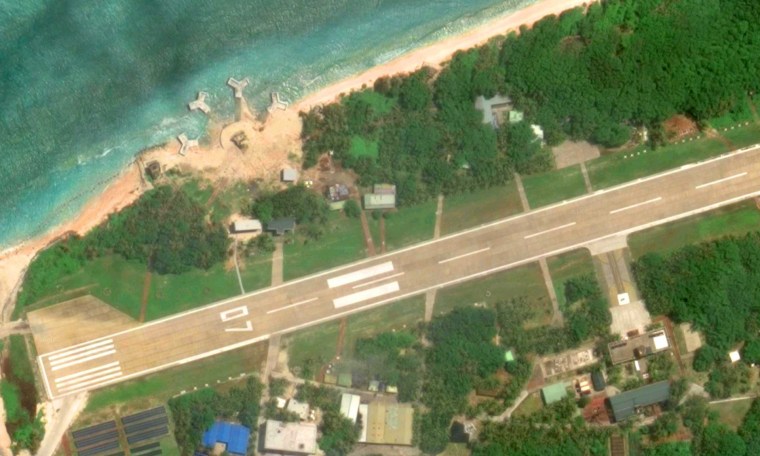
Ocean Affairs Council Minister Kuan Bi-ling made history last week as the first Taiwanese cabinet minister in seven years to visit Itu Aba — the largest island in the disputed Spratly archipelago, which Taiwan controls and calls Taiping Island. The trip included coast guard drills, armed special forces exercises, and simulated medical evacuations. The framing was civil and humanitarian. The message was strategic.
Then, on Wednesday, Kuan revealed she had gone further than initially reported — visiting the uninhabited Zhongzhou Reef nearby, where her team conducted a beach cleanup. A staff member was photographed holding a large Taiwan flag. "There, I personally witnessed marine debris that had drifted in from surrounding countries," Kuan wrote on Facebook, adding that the experience deepened her respect for Coast Guard personnel stationed there.
Vietnam filed a diplomatic protest. Kuan acknowledged it, but was unmoved. "Absolutely no backing down" on sovereignty, she said.
The South China Sea is one of the most contested stretches of water on Earth — roughly $3 trillion in global trade passes through it annually, and it is believed to hold significant oil and gas reserves. At least six governments hold overlapping territorial claims. China's approach has been the most aggressive, claiming around 90 percent of the sea through its "nine-dash line" — a boundary rejected by an international arbitration tribunal in 2016 and dismissed by most of the international legal community. Beijing has responded by continuing to build and militarize artificial islands, harass Philippine resupply missions, and pressure its neighbors.
Taiwan's posture is far more restrained — a handful of outposts, no new construction, no military expansion. But it is not passive. Sending a cabinet minister with cameras and a coast guard escort to islands most of the world barely knows exist is a deliberate act of presence. Taipei is signaling that it intends to hold what it has.
What Comes Next
Most analysts do not expect a dramatic shift in U.S. policy at the Trump-Xi summit. But experts at the Brookings Institution warn that Beijing will push for incremental gains — language adjustments, symbolic concessions, gestures of "sympathy" toward reunification — that gradually erode the foundations of the U.S.-Taiwan relationship. According to The Diplomat, China is not seeking a single breakthrough. It is playing a long game.
Trump's unpredictability makes precise forecasting impossible. His own aides, according to people familiar with internal deliberations, do not know — and do not pretend to know — exactly how the meeting will unfold.
What is certain: Taiwan is holding firm. Its economy is outperforming expectations. Its government is standing its ground — in diplomatic corridors, in military readiness, and on remote reefs in the South China Sea. And 23 million Taiwanese are watching closely as others decide how to talk about their future.
.
Sources
- Reuters – "Taiwan tops Beijing's agenda for Trump-Xi summit" (April 29, 2026): https://www.reuters.com/world/china/taiwan-tops-beijings-agenda-trump-xi-summit-2026-04-29/
- Reuters – "China again touts benefits of union with Taiwan, Taipei rebuffs" (April 29, 2026): https://www.reuters.com/world/china/china-again-touts-benefits-union-with-taiwan-taipei-rebuffs-2026-04-29/
- Reuters – "Taiwan alert after spotting two Chinese warships near its Penghu Islands" (April 2026): https://www.reuters.com/world/china/taiwan-alert-after-spotting-two-chinese-warships-near-its-penghu-islands-2026-04-27/
- Reuters – "Taiwan minister says she visited second islet in disputed South China Sea" (April 29, 2026): https://www.reuters.com/world/china/taiwan-minister-says-she-visited-second-islet-disputed-south-china-sea-2026-04-29/
- Brookings Institution – "Beyond trade: Issues in a Trump-Xi summit" (March 27, 2026): https://www.brookings.edu/articles/beyond-trade-issues-in-a-trump-xi-summit/
- The Diplomat – "China's Taiwan Calculus Ahead of the Trump-Xi Summit" (April 2026): https://thediplomat.com/2026/04/chinas-taiwan-calculus-ahead-of-the-trump-xi-summit/
- NPR – "China's Xi meets Taiwan opposition leader ahead of key summit with Trump" (April 10, 2026): https://www.npr.org/2026/04/10/nx-s1-5780605/china-xi-taiwan-opposition
- Council on Foreign Relations – Territorial Disputes in the South China Sea: https://www.cfr.org/global-conflict-tracker/conflict/territorial-disputes-south-china-sea
- Hong Kong Free Press – "Taiwan minister makes rare trip to disputed South China Sea island" (April 23, 2026): https://hongkongfp.com/2026/04/23/taiwan-minister-makes-rare-trip-to-disputed-south-china-sea-island/
- Taipei Times – "Taiwan fears it will be 'on menu' of Trump-Xi meet" (April 26, 2026): https://www.taipeitimes.com/News/taiwan/archives/2026/04/26/2003856264
.
What's Your Reaction?
 Like
2
Like
2
 Dislike
0
Dislike
0
 Love
2
Love
2
 Funny
0
Funny
0
 Wow
2
Wow
2
 Sad
0
Sad
0
 Angry
0
Angry
0












Comments (0)