

U.S. Launches Major Push to Ban Imports Made with Forced Labor — China's Xinjiang at the Center
The Trump administration is holding high-stakes hearings on forced labor in global supply chains. Human rights groups and industry representatives are calling for sweeping new import bans and tariffs — with China's Xinjiang region firmly in the crosshairs.

.
A Two-Day Hearing With Far-Reaching Consequences
Washington is sending a clear signal: the United States is no longer willing to tolerate goods made with forced labor entering its markets — and it wants its trading partners to follow suit.
On April 28, 2026, the Office of the U.S. Trade Representative (USTR) opened a two-day public hearing under the so-called "Section 301" framework. This legal tool allows the U.S. government to investigate and act against unfair trade practices by foreign countries. Around 60 witnesses are testifying, representing advocacy organizations, human rights groups, U.S. industries, and foreign governments.
The central question: Why are at least 60 countries failing to enforce meaningful bans on goods produced with forced labor — and what should the U.S. do about it?
Forced Labor as a Hidden Economic Weapon
One of the sharpest arguments heard at the hearing came from the Coalition for a Prosperous America (CPA), a group that advocates for domestic U.S. industries.
"Forced labor operates as a hidden production subsidy," said CPA senior economist Mihir Torsekar in his prepared testimony. When workers are paid nothing — or their wages are suppressed through debt, document confiscation, or state coercion — the resulting cost savings give those producers an unfair competitive advantage over companies that pay fair wages.
The CPA called on USTR to introduce new trade tools beyond tariffs, including import licensing requirements for high-risk supply chains, and mandatory proof from importers that their goods are free from forced labor before entering the U.S. market. It also proposed import quotas for sectors with documented forced labor risks — particularly solar panels, cotton textiles, and seafood.
Xinjiang: The World's Forced Labor Factory
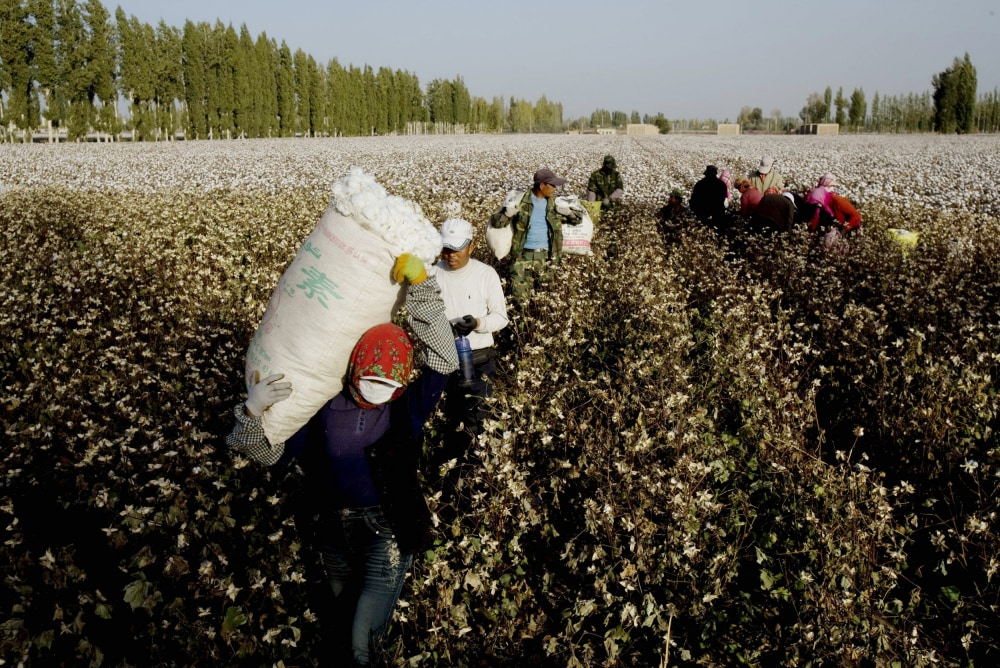
No region is more central to this debate than Xinjiang, a vast territory in northwestern China. It produces roughly one-fifth of the world's cotton and nearly half of all polysilicon — a critical raw material used in solar panels.
The U.S. government has accused the Chinese Communist Party (CCP) of systematically detaining millions of Uyghurs and other Muslim minorities in the region, forcing them to work in factories and fields under brutal conditions. In response, the U.S. passed the Uyghur Forced Labor Prevention Act (UFLPA), which effectively bans all imports from Xinjiang unless companies can prove their goods were not made with forced labor.
But the U.S. stands largely alone.
Samir Goswami, director of forced labor programs at Global Rights Compliance, told the hearing that most other countries have failed to adopt comparable measures. The United Kingdom's Modern Slavery Act, for instance, focuses only on corporate transparency reporting — it does not actually prohibit importing goods made with forced labor. The European Union has a stronger regulation in the works, but it won't be fully in force until 2027.
"Without tools comparable to the U.S. rebuttable presumption for high-risk regions like Xinjiang, authorities may face significant challenges identifying forced labor in opaque supply chains," Goswami warned. He urged the U.S. to push for enforceable forced labor bans as part of future trade agreements.
Not Just China — Allies Are Also Under Scrutiny
The investigation's scope is notably broad. While China and Russia face the heaviest scrutiny, the probe also covers U.S. allies — including Australia, Canada, the European Union, the United Kingdom, Israel, India, Qatar, and Saudi Arabia.
USTR chief Jamieson Greer has said he wants the investigation concluded by July 2026, when a temporary 10% tariff is set to expire. The findings could result in new tariffs, import restrictions, or other trade measures targeting any country found to be failing its forced labor enforcement obligations.
Industry Voices Urge Caution
Not everyone at the hearing favored aggressive new tariffs. The Consumer Technology Association (CTA), which represents electronics importers and tech startups, urged USTR to tread carefully.
CTA Vice President Ed Brzytwa argued that the central issue should be whether forced-labor goods are actually entering the U.S. market — not whether they are entering markets in other countries. He called on USTR to consider alternatives to tariffs, such as coordinated international efforts to help other nations build their own enforcement frameworks.
"USTR should avoid measures that shift costs onto workers rather than addressing the underlying practices of forced labor," Brzytwa said.
Background: Why This Probe Exists
This forced labor investigation is part of a broader effort by the Trump administration to rebuild trade leverage after the U.S. Supreme Court struck down his sweeping global tariffs in February 2026. Those tariffs had been imposed under a national emergencies law, but were ruled unconstitutional.
In response, the administration launched two parallel Section 301 investigations — one targeting forced labor practices, the other addressing excess industrial capacity in countries like China. Both probes are tools to justify new, legally defensible tariff measures.
What Comes Next
The outcome of the hearing will inform USTR's recommendations to the White House. If the investigation concludes by July as planned, new tariffs or import bans could take effect before the end of summer 2026.
For countries that have long looked the other way while goods produced under brutal conditions flooded global markets, the pressure from Washington is now unmistakably real.
.
Sources:
- Reuters – "Some groups ask US trade agency for new duties, import bans to fight forced labor" (April 28, 2026): https://www.reuters.com/world/us/some-groups-ask-us-trade-agency-new-duties-import-bans-fight-forced-labor-2026-04-28/
- U.S. Customs and Border Protection – Uyghur Forced Labor Prevention Act (UFLPA) Enforcement: https://www.cbp.gov/trade/forced-labor/UFLPA
- Human Rights Watch – "China: Xinjiang's System of Coercive Labor Transfers" (2020): https://www.hrw.org/news/2020/09/08/china-xinjiang-system-coercive-labor-transfers-expands
- Office of the U.S. Trade Representative – Section 301 Investigations Overview: https://ustr.gov/issue-areas/enforcement/section-301-investigations
- BBC News – "What is happening with the Uyghurs in China?": https://www.bbc.com/news/world-asia-china-22278037
.
What's Your Reaction?
 Like
1
Like
1
 Dislike
0
Dislike
0
 Love
1
Love
1
 Funny
0
Funny
0
 Wow
1
Wow
1
 Sad
0
Sad
0
 Angry
0
Angry
0













Comments (0)