

North Korea’s Illegal, Proxy Nuclear-Powered Submarine


.
North Korea’s new nuclear-powered ballistic missile submarine (SSBN), revealed as near ready for launch on Dec. 24, is an illegal nuclear weapon that threatens the United States and its allies and may be at the center of a covert skirmish with Russia, the apparent source of its nuclear power plant.
There are more than 20 United Nations resolutions that bar the sale or transfer of nuclear- and missile-related technologies to North Korea, and U.S. sanctions against North Korea take the form of at least five executive orders and six legislative acts.
This corpus of international decisions would help create the legal basis for prosecuting North Korean regime officials who maintain this SSBN and so many other nuclear weapons, as well as for prosecuting the international sources and networks supplying nuclear, missile, and SSBN technology to North Korea.
All of North Korea’s nuclear warhead-armed mobile intercontinental ballistic missiles (ICBMs) aimed at the United States ride on massive wheeled transporter-erector-launchers (TELs) derived from an original model transferred by the China Aerospace Science and Industry Corporation to North Korea in 2011.
While it’s very possible that Chinese engineering assistance contributed to North Korea’s new SSBN, it’s also possible that Russia provided the nuclear powerplant system that propels this single-propeller nuclear submarine.
On Dec. 28, the Spanish outlet La Verdad reported that the Russian cargo ship Ursa Major, which sank near Spain on Dec. 23, 2024, was carrying two nuclear reactors destined for North Korea.
This report further noted that Spanish authorities had identified the reactors as Soviet-era VM-4SG models, two of which were used by the Soviet Project 667B or “Delta” class SSBN.
It is not known how many reactors are used by the North Korean SSBN, but if Russian technical assistance was involved, it’s likely to employ a standard Soviet/Russian two-reactor design.
But as the first North Korean SSBN was likely in advanced stages of construction in December 2024, the second pair of Russian submarine reactors on Ursa Major were likely intended for the second North Korean SSBN.
This is a source of great concern, as up to 37 Delta-I/II/III/IV-class SSBNs have been retired, providing a substantial source of reactors for many more potential future North Korean SSBNs and for potential smaller, cruise-missile-armed North Korean nuclear attack submarines (SSGNs).
Adding intrigue to this incident, the La Verdad report noted that Spanish authorities concluded the Ursa Major was sunk by supercavitating torpedoes. The navies that could be equipped with such torpedoes include Russia, China, Iran, and possibly India and Vietnam.
What is strongly suggested is that a submarine-equipped state sought to prevent Russia from shipping more submarine nuclear reactors to North Korea.
The reasons that would have justified such overt military action include a requirement to stop Russian nuclear technology proliferation, potential North Korean nuclear submarine proliferation, and to prevent the emergence of a greater North Korean threat.
North Korean state media claimed their SSBN weighed up to 8,700 tons, which is close to the weight of the first-generation Chinese Type 031 “Xia” class SSBN (8,000 tons) and the first-generation Soviet/Russian Project 667 “Yankee” class SSBN (9,300 tons).
However, the North Korean SSBN is not configured like the Chinese or Russian SSBNs. Whereas both place their submarine-launched ballistic missiles (SLBMs) in banks aft of the submarine sail, the North Korean SSBN uses a much larger sail to encompass its SLBMs.
This is important because China has long practiced the use of unique shaping to conceal the origin of its exported weapons of mass destruction and would have generations of engineers familiar with SLBM sails for SSBNs.
The number of SLBMs carried by the North Korean SSBN is not clear. There appear to be five SLBM silo doors that open to the port and starboard side of the sail, and the sail height is close to the estimated 33 to 41 foot diameter of the hull, while the width of the sail at its top is close to 16 to 19 feet.
This would be a sufficient area to accommodate two rows of five SLBMs launched in 7.5-foot-diameter cold-launch tubes. However, a Dec. 24 image of North Korean leader Kim Jong Un standing atop the SSBN sail does not show a division between two SLBM rows.
Nevertheless, the estimate of two SLBM rows would accommodate the estimated 7.5-foot diameter of North Korea’s Pukguksong-6 SLBM, the latest North Korean SLBM revealed at North Korea’s April 2022 military parade, though it has not been reported to have been tested.
.
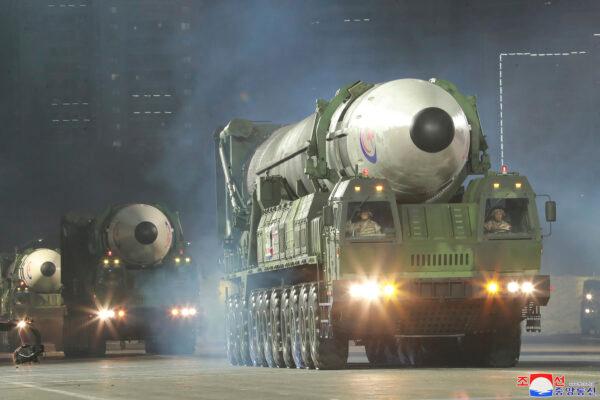
While the Pukguksong-6, revealed in 2022, appears to have two stages, similar to most other early SLBMs, the length of the North Korean SSBN silo, possibly up to 52 feet, exceeds the estimated 42-foot length of the Pukguksong-6. This suggests that a possible new three-stage, longer-range SLBM may equip the North Korean SSBN.
If this were the case, such a possible new North Korean three-stage SLBM might handily be able to reach targets in the Western Continental United States from protected SSBN “bastions” either on the North Korean west coast near China, or on its east coast near Russia.
An alternate explanation is that the silo is long enough to hold a new, shorter version of North Korea’s Hwasong-18 three-stage solid fuel ICBM, perhaps able to reach targets in the western half of the United States.
Another indication of its possible deployment in a bastion strategy is that the North Korean SSBN has very large flank sonar arrays, perhaps powerful sensors needed to hide from South Korean, Japanese, and American submarines that would hunt them.
A major danger arising from North Korea’s success with this first SSBN is that it is likely already seeking to export this submarine, which it can market as equipped with a reliable supply of Russian submarine reactors.
An early potential customer could be Pakistan, which, in a September 2025 alliance, committed its nuclear forces to the defense of Saudi Arabia.
A possible Saudi-funded North Korea–Russian SSBN would greatly increase the credibility of Pakistan’s ability to ensure nuclear deterrence for its ally Saudi Arabia, or to threaten Israel.
If the China- and Russia-supported dictatorship of Venezuela’s Nicolás Maduro had survived another two years, it is also possible that his regime would have been an early customer for a North Korean SSBN.
In addition, as an illegal and likely proxy nuclear-powered and nuclear-armed SSBN, do the United States, South Korea, and Japan have the legal authority—in addition to the political and military justification—to sink North Korea’s SSBN should it venture far enough out to sea?
What's Your Reaction?
 Like
0
Like
0
 Dislike
0
Dislike
0
 Love
0
Love
0
 Funny
0
Funny
0
 Wow
0
Wow
0
 Sad
0
Sad
0
 Angry
0
Angry
0















Comments (0)