

China Ramping Up Nuclear-Powered Submarine Production: US Naval Intelligence


.
China has “dramatically increased” domestic submarine production and is undergoing a shift “to all-nuclear construction,” according to testimony prepared by Rear Adm. Mike Brookes, commander of the Office of Naval Intelligence, for a congressional panel on March 2.
The U.S.-China Economic and Security Review Commission is hosting hearings on March 2 about China’s growing maritime capabilities, which the commission’s chair, Randall Schriver, stated were testing the global order both on the seas and beneath it.
“China is advancing a growing fleet of increasingly capable submarines, unmanned underwater vehicles, seabed sensors, and sophisticated oceanographic mapping programs,” Schriver said.
Brookes said in his opening testimony that China currently operates more than 60 submarines, one of the world’s largest fleets. Of the 60, six are nuclear-powered attack submarines, at least two are nuclear-powered guided missile submarines, and six are nuclear-powered ballistic missile submarines. Then there are 50-plus diesel-electric vessels.
According to his testimony, China made major investments in three shipyards beginning in 2010, allowing production to significantly accelerate.
“These expansions include the construction of expansive facilities that have tripled construction hall capacity, enabling higher production rates for conventional submarines, while upgraded infrastructure now accommodates the construction of larger diameter, advanced submarines across all three facilities,” he said.
Brookes said the shift to nuclear was a strategic and significant one, pointing to the development of a low-power nuclear submarine with greater endurance than a conventional submarine, which could be used to increase regional presence and patrols more economically.
The ballistic missile submarines could target the United States “from within the first island chain,” as the Chinese Navy’s long-range precision strike capability has been enhanced in recent years, Brookes said.
He detailed a few models, including two expected to go into production in the late 2020s and through 2030.
.

A man looks at a submarine during a media tour by the PLA Naval Museum in eastern China's Shandong province, on June 25, 2025. Pedro Pardo/AFP via Getty Images
.
“These submarines will incorporate substantial advancements in nuclear reactor design, sensor performance, weapons integration, and noise quieting technologies,” the statement reads. “The Type 096 SSBN equipped with JL-4 SLBMs will be able to target large portions of the U.S. from protected waters, fundamentally enhancing strategic deterrence credibility.”
China has also spent more than 20 years investing in unmanned undersea vehicles, and Brookes said Beijing is pursuing large vessels for “long-range mine countermeasures.”
Beijing is also developing autonomous undersea integrated sensors, weapons systems, and vehicles, he said, while building “layered undersea surveillance networks.”
Brookes estimated China’s submarine fleet would grow to 70 by 2027, 80 by 2035, with half of them nuclear-powered.
The commission also looked at China’s efforts to gain economic and strategic advantage undersea in addition to military and dual-use developments.
Brookes said that China holds the most seabed exploration contracts with the International Seabed Authority (ISA), where it can mine for critical minerals. He said that China already currently dominates the terrestrial critical mining supply chain; extending this to the seabed would only increase various nations’ dependency on China.
.
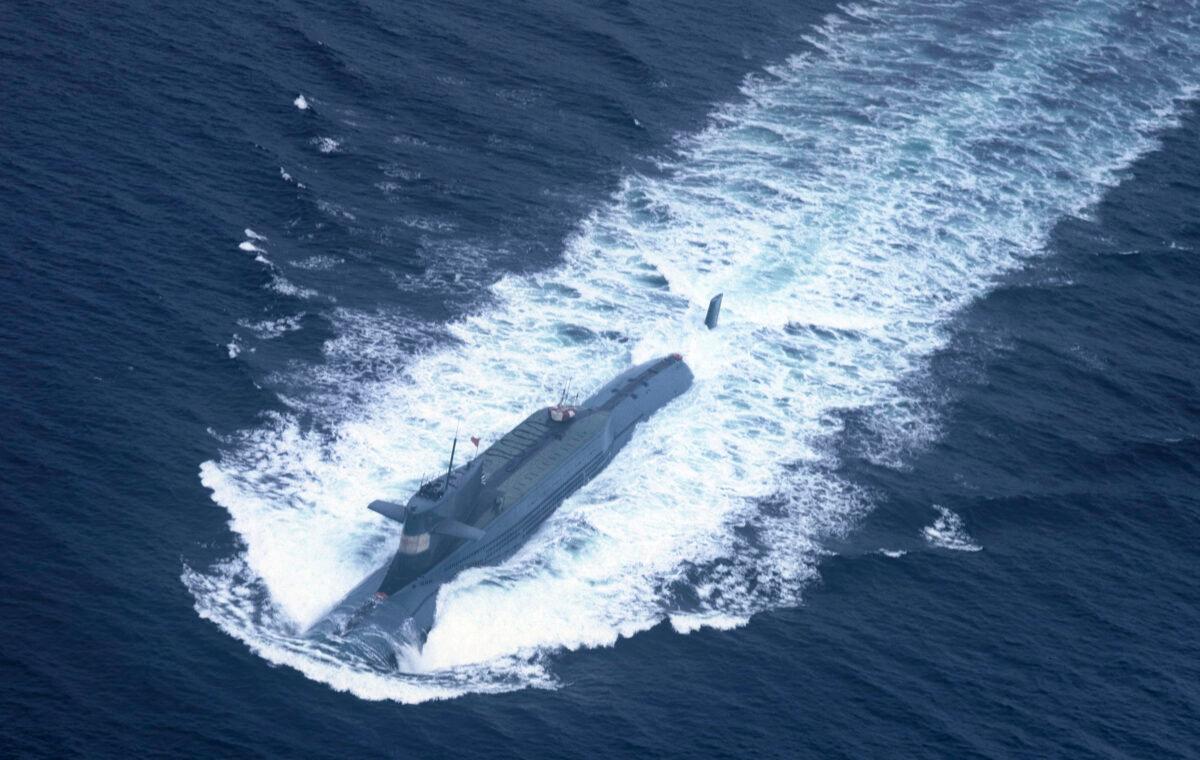
A nuclear-powered submarine of the People's Liberation Army Navy's North Sea Fleet prepares to dive into the sea on Oct. 29, 2013. AFP/AFP via Getty Images
.
He added that China is on the ISA council, makes major financial contributions to the ISA, and regularly hosts ISA events, giving it “significant influence over development of international seabed mining regulations” and decision-making. Beijing is also making deals with Pacific island nations to mine in their exclusive economic zones with an approach that “circumvents international regulatory frameworks while advancing its Belt and Road Initiative objectives.”
Chinese companies are simultaneously developing technology to advance undersea mining, including plans to test “collection vehicle maneuverability in water depths beyond 4,000 meters—the depth required for commercial mining operations in most target areas,” Brookes said.
He estimated that by 2040, the Chinese communist regime’s naval power “may credibly challenge U.S. regional maritime dominance, complicating crisis response, power projection, and allied defense.”
Brookes recommended the United States maintain its undersea advantages with increased investment, innovation, and strategic focus.
Both countries will “collaborate further through a shipbuilding working group” and “increase the number of U.S. commercial ships and combat-ready U.S. military vessels as quickly as possible, including the potential construction of U.S. vessels in the ROK,” the White House said in a Nov. 13 fact sheet.
“The United States has given approval for the ROK to build nuclear-powered attack submarines. The United States will work closely with the ROK to advance requirements for this shipbuilding project, including avenues to source fuel.”
South Korean President Lee Jae-myung said the submarines will help South Korea “track Chinese and North Korean submarines” and help the United States in the region.
.
What's Your Reaction?
 Like
0
Like
0
 Dislike
0
Dislike
0
 Love
0
Love
0
 Funny
0
Funny
0
 Wow
0
Wow
0
 Sad
0
Sad
0
 Angry
0
Angry
0















Comments (0)