

CCP Expels, Punishes Provincial-Level Official for Listening to Banned News Commentaries


.
The Chinese Communist Party (CCP) has expelled a provincial-level official from its ranks and referred him for judicial punishment for listening to banned political news programs.
Analysts told The Epoch Times that the CCP’s tightened control of its officials indicates that the regime is entering a final stage, which resembles the situation at the eve of the former communist Soviet Union’s collapse.
The Chinese communist regime’s Central Commission for Discipline Inspection and the National Supervisory Commission announced on March 2 that Jiang Deguo, former vice chairman of the Hebei Provincial Committee of the Chinese People’s Political Consultative Conference, had been expelled from the CCP and transferred to judicial authorities.
The first charge against Jiang listed by the Central Commission for Discipline Inspection in its statement was “losing ideals and beliefs, betraying his original aspirations and mission, privately listening to and retaining audio materials with serious political problems, and resisting organizational review,” followed by corruption charges.
Jiang was also the vice governor of Hebei Province, which is at the heart of the country surrounding Beijing. In early 2017, he became vice chairman of the Hebei Provincial Committee of the Chinese People’s Political Consultative Conference, and retired a year later.
Tightened Control
Banned material that has serious “political problems” under the CCP’s rule usually refers to content addressing the Tiananmen Square Massacre in 1989, the Hong Kong protests that were squashed by the Chinese regime in 2019, the suppression of ethnic minorities, and the CCP’s persecution of Falun Gong.In addition, materials that expose the private lives of CCP top leaders, their overseas assets, inside stories of power struggles within the CCP leadership, and articles and programs produced by overseas Chinese-language media outlets that are critical of the CCP, such as The Epoch Times and NTD, are also banned in mainland China.
The internal political struggle within the CCP’s top echelon is extremely fierce right now, as officials try to assess what’s really going on at the top to ensure their own safety, Wang He, a U.S.-based China affairs commentator told The Epoch Times.
“Since the CCP is a black box political system, even within the CCP, unless you reach a certain level, there are many things you simply don’t know,” he said.
Officials need to know certain information, and under this situation, they usually have two ways to obtain information, according to Wang: “On is that they try to understand what’s going on through their personal connections within the system; the other is that they consume overseas media’s reports and analyses of Chinese politics.”
Many of these analyses strongly contradict official CCP pronouncements and rhetoric, and the CCP considers them to be illegal political publications and wants to strictly prohibit them, Wang said. “If everyone is listening to the different opinions from the outside world, how can the CCP maintain thought control over its officials and ensure their loyalty to the Party?”
Currently in China, Xi Jinping is thought to be on edge, very worried that many people will betray him, and is trying his best to guard against all possible events, Shen Ming-shih, research fellow at the Division of National Security Research at Taiwan’s Institute for National Defense and Security Research, told The Epoch Times.
The charges against officials for reading or listening to foreign media indicate that “the Chinese regime is very worried about peaceful evolution, or that their own subordinates may develop rebellious thoughts due to changes in the external environment,” he said.
.
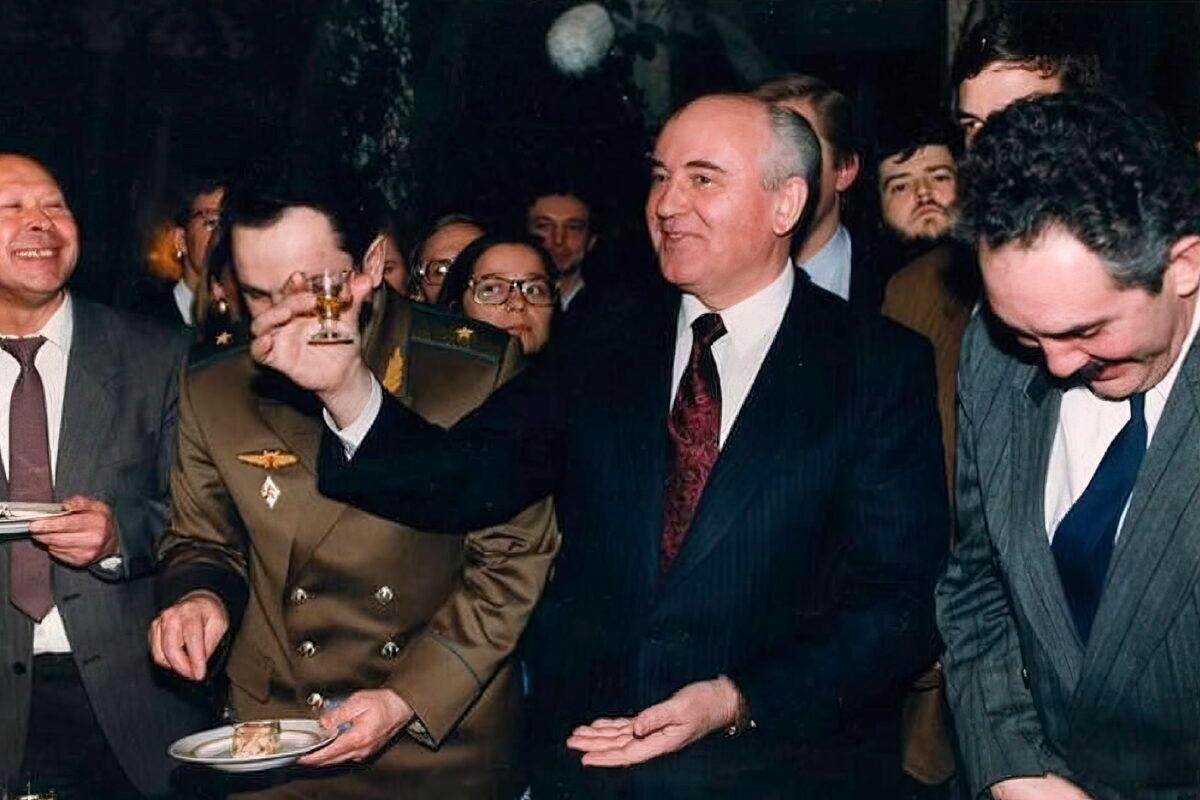
Former Soviet Union leader Mikhail Gorbachev toasts with a small glass of lemon-flavored vodka at a going-away party for his staff, in Moscow on Dec. 26, 1991. Alexander Zemlianichenko/AP Photo
.
Similarity With Soviet Union
In fact, this offense previously had not been considered very serious, and many people bought a lot of banned books when passing through Hong Kong in the past, Shen noted. The fact that the regime listed it as top charge against the officials shows that it is indeed somewhat like the late Soviet Union, he pointed out. “When you can no longer trust anyone, it means that there are crises everywhere. For Xi Jinping, this is certainly a very serious situation.”One of the reasons for the former Soviet Union’s collapse was a revolution at the top, Wang said. “There’s no safety in a communist regime. In order to pass on their wealth to their sons and grandsons, a tacit understanding and consensus formed among the top Soviet officials to abandon the Communist Party,” he said.
“Within the CCP, nobody believes in communism anymore. Their personal safety has become a major issue. Many officials have lost their vast fortunes when being investigated. Many officials actually want to abandon the Communist Party system and jump ship.”
In the Soviet era, the crime of listening to enemy radio stations was relatively easy to detect, but officials watching videos or reading banned books in China are usually reported by people around them, Shen said.
.

Members of the People's Armed Police March in Tiananmen Square after providing security for the opening session of the National People's Congress at the Great Hall of the People in Beijing, on March 5, 2026. Kevin Frayer/Getty Images
.
“It could be a secret infiltration agent, or someone specifically tasked with monitoring or surveillance [of] the officials’ actions,” he said, adding, “It also shows that before the CCP’s top meeting the Two Sessions—the Fifth Plenary Session and the 21st National Congress—that are ongoing, these vice-ministerial or vice-provincial-level officials were all living in fear.”
“Listing the ideological issue charge first is also covering up the CCP’s internal power struggles and officials making accusations against each other, which is a reflection on the current state of the CCP.”
The CCP has made many adjustments, such as “the opening up and reform” in economic aspects, Wang said, “but its fundamental purpose remains the same: to maintain its rule. This has not changed. And its control over [CCP] members and officials—political and ideological control—has not changed either.”
What's Your Reaction?
 Like
0
Like
0
 Dislike
0
Dislike
0
 Love
0
Love
0
 Funny
0
Funny
0
 Wow
0
Wow
0
 Sad
0
Sad
0
 Angry
0
Angry
0













Comments (0)