

US–Israel Strikes on Iran Send Shockwaves to Chinese Regime


.
The United States and Israel launched military operations against Iran on Feb. 28, known as “Operation Epic Fury” by the United States and “Operation Roaring Lion” by Israel.
Elite U.S. and Israeli forces, equipped with top-tier weaponry, executed a devastating multi-domain strike—from space and air to land, underground, sea, and seabed—aimed at dismantling Iran’s authoritarian regime. The operation is unmatched in scale and sophistication.
Precision Strikes Targeting Top Leaders
The Tang Dynasty Chinese poet Du Fu wrote: “To capture the bandits, first catch the ringleader”—striking at the head for swift victory.U.S. President Donald Trump and Israeli Prime Minister Benjamin Netanyahu may not have read Du Fu, but their strategy in this operation reflected it.
On the first day of the war, U.S.–Israeli forces killed Supreme Leader Ayatollah Ali Khamenei and 47 other top Iranian military and intelligence officials.
Israeli Defense Minister Israel Katz vowed to eliminate all successors in a March 4 post on X: “Every leader appointed by the Iranian terror regime to continue and lead the plan to destroy Israel, to threaten the United States and the free world and the countries of the region, and to suppress the Iranian people—will be an unequivocal target for elimination. It does not matter what his name is or the place where he hides.”
The success of these precision strikes depended not only on who was targeted but also on how the United States and Israel gathered accurate intelligence about Iranian leaders’ locations. In addition to high-tech methods, the crucial element was insiders around these officials providing real-time classified information to the CIA and Mossad.
Incalculable Economic Losses
First, China is the largest buyer of Iran’s discounted crude.In 2025, China imported about 1.38 million barrels of Iranian oil per day—accounting for over 80 percent of Iran’s shipped exports and 13.4 percent of China’s seaborne crude imports, according to Reuters. Iran is China’s second-largest oil supplier, after Saudi Arabia, Politico recently reported. As U.S.–Israeli forces ramp up attacks, disruptions to Iranian supplies could lead China to buy more costly oil elsewhere.
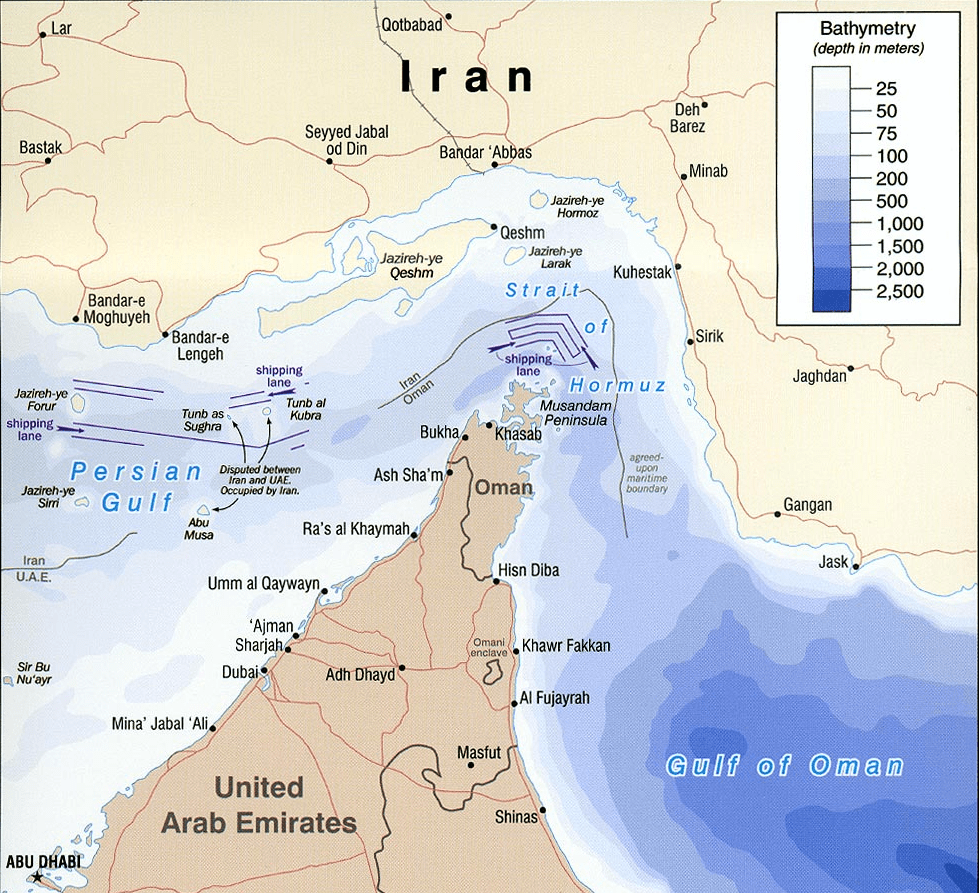
The Strait of Hormuz, between Iran and Oman—the only waterway connecting the Persian Gulf to the Arabian Sea and a major global oil chokepoint—is now blocked. This risks cutting off more than 7 million barrels per day of China’s Middle East crude imports.
Second, China has huge investments in Iran, which is a key node in Beijing’s Belt and Road Initiative.
In 2021, China and Iran signed a 25-year strategic partnership, with Beijing promising $400 billion over that period across sectors such as banking, telecom, ports, railways, health care, and information technology. However, Iran’s political turmoil could make that commitment worthless.
Furthermore, Chinese companies have multiple large-scale projects in Iran, including energy and railways, all now at risk of failure.
Humiliating Military Losses
The Iran war has exposed the inefficiency of Chinese weaponry.According to Taiwan’s SET News, Iran supplied its forces with advanced Chinese warning systems, such as the JY-26 long-range anti-stealth radar, touted as a stealth fighter, and the JY-10/JY-14 air defense command systems, but they all failed catastrophically during the U.S.–Israel assault.
The Iranian regime’s nuclear threat has also been backed by the CCP. As early as 1990, Beijing signed a nuclear pact with Tehran. In 1991, China exported uranium to Iran. On Sept. 10, 1992, both countries inked a 15-year nuclear cooperation deal. Iran’s largest nuclear research complex, the Isfahan (Esfahan) Nuclear Technology Center, was built with Chinese assistance.
Before the U.S.–Israel strikes, Iran allegedly warned the United States about possessing nuclear weapons. U.S. Middle East Special Envoy Steve Witkoff recently told Fox News that during negotiations with Iranian officials, they said the regime had 460 kilograms of 60 percent enriched uranium and used it as a bargaining chip, claiming it could produce 11 nuclear bombs.
.
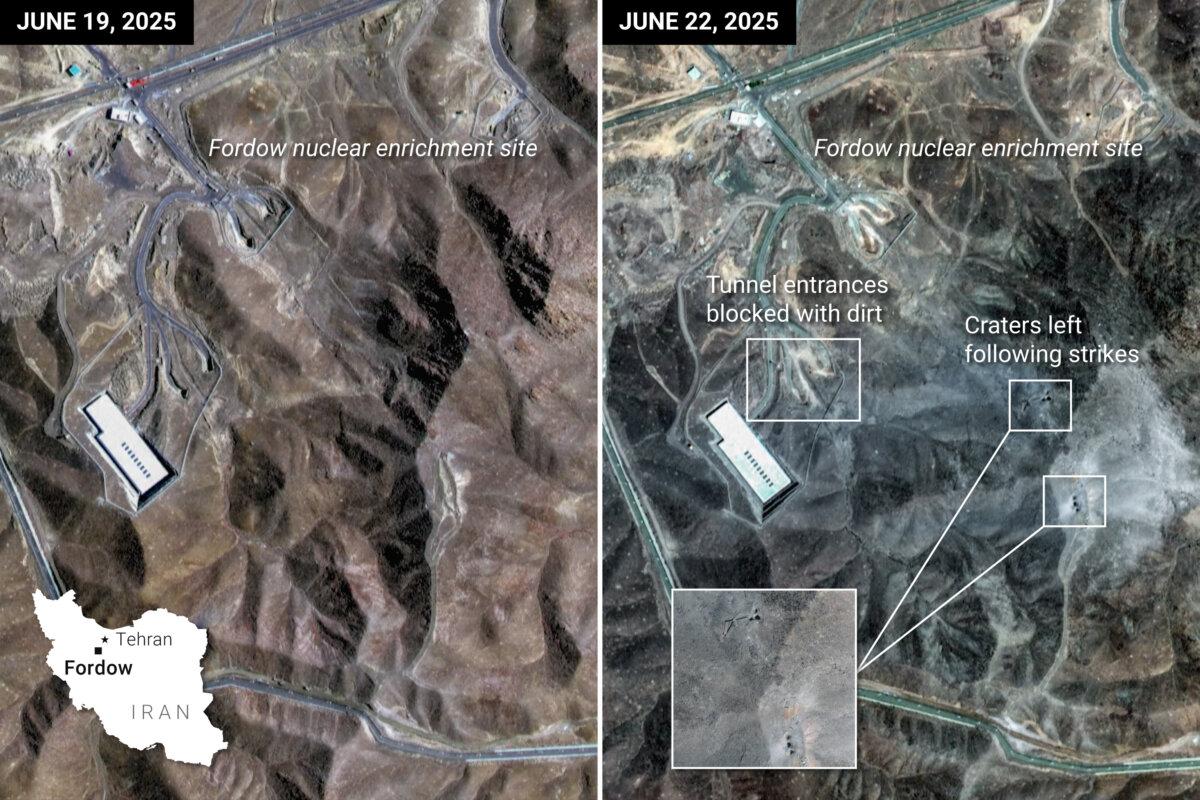
Before and after the June 21 U.S. bombing of the Fordow uranium enrichment site, north of Qom, Iran. Illustration by The Epoch Times, Reuters, Shutterstock
.
Given the nuclear threat from Iran, the primary goal of this U.S.–Israel military operation is to completely eliminate Iran’s nuclear program. Last June’s U.S. Operation Midnight Hammer and this recent joint campaign have already dealt heavy blows to all major Iranian nuclear facilities.
Iran’s missile systems, also deeply linked to China, were hit hard by the recent joint strikes.
According to Riboua, Iran plans to produce 5,000 missiles by 2027, potentially 10,000 by the decade’s end, which she calls a “catastrophe.”
Removal of the CCP’s Key Strategic Foothold in the Middle East
Iran is Beijing’s crucial anti-U.S. pivot in the Middle East and is the biggest backer of terrorist groups—such as Hamas in Gaza, Hezbollah in Lebanon, Houthis in Yemen, Palestinian Islamic Jihad, and Shiite militias in Syria and Iraq—targeting Israel and the United States.For years, Iran’s support for terrorism has distracted the United States from focusing on China, tying America up in Middle East conflicts. This benefited the CCP immensely, positioning Iran as its top Middle East ally in anti-U.S. efforts.
The unprecedented U.S.–Israeli strikes are transforming the Middle East’s geopolitical landscape. This campaign is likely to topple Iran’s dictatorship, potentially resulting in a new Iran that is aligned with U.S. and Israeli interests.
End of Iran War Marks the Start of the CCP’s Worst Nightmare
Based on the current momentum, this war won’t turn into a prolonged war of attrition and will conclude in total victory for the United States and Israel.On March 3, U.S. Secretary of State Marco Rubio said to the press: “We’re going to unleash Chiang,” adding that the U.S. and Israeli air forces would “take apart this terroristic regime and defang it and take away its ability to threaten its neighbors or hide behind a zone of immunity that allows them to develop their nuclear ambitions.”
“Unleash Chiang” is a Cold War slogan from the 1950s, meaning “unleash Chiang Kai-shek”—to lift restrictions and allow the Republic of China (Taiwan’s official name) forces to counterattack mainland China.
Rubio’s message is clear: Enable U.S.–Israeli forces to operate without restrictions in Iran and give them full authority to accomplish their mission.
Concluding Thoughts
Since the start of the U.S.–Israel operations, Beijing may be in a state of panic. Foreign Minister Wang Yi has called for an immediate cease-fire.Peter Schweizer, president of the U.S. Government Accountability Institute, told Fox News that the U.S.–Israel strikes on Iran caused “tidal waves” of impact on the CCP. “They are in a panic,” he stated.
The CCP fears that it might be the next target.
What's Your Reaction?
 Like
0
Like
0
 Dislike
0
Dislike
0
 Love
0
Love
0
 Funny
0
Funny
0
 Wow
0
Wow
0
 Sad
0
Sad
0
 Angry
0
Angry
0












Comments (0)