

The Sequential Elimination of China’s Cheap, Sanctioned Oil Sources


.
In recent weeks, the United States has disrupted two of China’s major sources of deeply discounted, sanctions-constrained crude in rapid succession.
The first shock came when then-Venezuelan President Nicolás Maduro was captured in a U.S. raid on Caracas on Jan. 3, followed by an intensified U.S. blockade targeting sanctioned vessels moving Venezuelan oil. The disruption interrupted deliveries to China and prompted some refiners to halt purchases.
The second shock came from U.S.–Israel strikes on Iran. The strikes killed Iran’s Supreme Leader Ayatollah Ali Khamenei, and a leadership council took over amid continued military assaults.
China has been the principal buyer of Iranian crude under sanctions. In 2025, it purchased more than 80 percent of Iran’s shipped oil, averaging about 1.38 million barrels per day. That volume represented roughly 13.4 percent of China’s seaborne crude imports, according to Kpler data.
In February, Iran offered discounts of $10 to $11 per barrel on its light crude to Chinese buyers, about 16 percent below the Brent benchmark, amid intensifying competition with Russian oil. These discounts helped secure market share among independent Chinese refiners amid tightening sanctions and mounting unsold cargoes.
In the short term, Russia has filled much of the Venezuelan gap. Vortexa data show China received an average of 2.07 million barrels per day of Russian oil in February, 370,000 barrels per day more than in January, closely matching Venezuela’s average exports to China in 2025. However, Moscow holds its own leverage over Beijing and does not offer the same structural pricing advantage that sanctioned Iranian and Venezuelan crude once provided.
The Iran crisis has placed the Strait of Hormuz at the center of the conflict, compounding China’s vulnerability regardless of the fate of the Iranian regime’s oil. U.S.–Israel military strikes on Feb. 28, followed by Iranian retaliatory attacks across Gulf states, have triggered a de facto closure of the strait, a chokepoint that handles roughly 20 million barrels per day, or about 20 percent of global petroleum liquids consumption.
Iran, an OPEC member producing about 4 million barrels per day in 2023, controls the waterway, which also carries roughly one-fifth of global LNG trade, much of it from Qatar. Saudi Arabia, the United Arab Emirates, Iraq, Kuwait, and Qatar rely heavily on Hormuz for exports, and alternative pipeline infrastructure can bypass only about 2.6 million barrels per day. A full closure would therefore disrupt approximately 18 million barrels per day of crude flows, with few immediate substitutes.
Although U.S. and Israeli strikes have degraded much of the Iranian navy’s surface fleet, Iran has shifted to area-denial tactics using land-based anti-ship missiles and drone swarms. Even without a formal blockade, these threats have driven major shipping companies such as Maersk to suspend transits as war-risk insurance has become prohibitively expensive or unavailable.
Kpler vessel tracking shows limited traffic continuing through the strait, primarily Iranian and Chinese-flagged vessels, while most commercial operators and insurers have withdrawn. Insurance premiums have reached six-year highs, creating a de facto closure for much of the global shipping community.
Another critical chokepoint is the Strait of Malacca, the world’s most significant oil-trade corridor, handling even greater volumes than the Strait of Hormuz. In 2023 and 2024, daily oil flows through the strait averaged an estimated 23.7 million barrels per day, accounting for roughly one-third of all seaborne oil traded globally.
The Malacca dilemma refers to China’s heavy reliance on oil and trade shipments passing through this narrow waterway, which could be blockaded or disrupted by the U.S. Navy in a crisis. In a Taiwan-invasion scenario, Chinese leader Xi Jinping would have to weigh the risk that U.S. forces could sever China’s maritime energy lifeline, threatening its economy and ability to sustain a prolonged war.
To mitigate that vulnerability, China has invested heavily in overland energy corridors. The $62-billion China-Pakistan Economic Corridor (CPEC) was designed to move Middle East oil from Gwadar Port overland to Xinjiang, explicitly envisioning discounted Iranian crude flowing through Pakistan beyond the reach of U.S. interdiction.
Beijing also signaled willingness to finance an Iran–Pakistan natural-gas pipeline under the CPEC framework, aligning the project with its broader String of Pearls strategy to expand commercial and potential dual-use assets across the Indian Ocean.
.
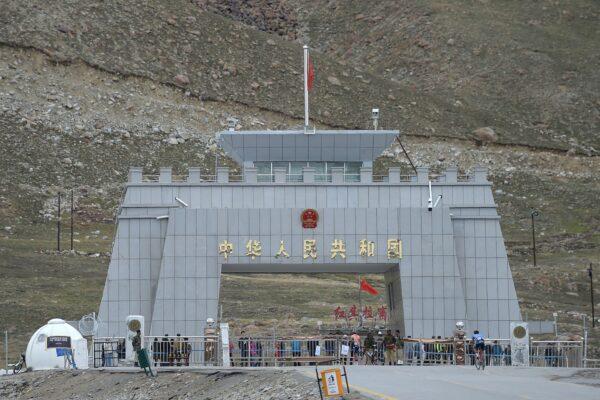
A Pakistani cyclist (R) rides past the Pakistan–China Khunjerab Pass, the world's highest paved border, during the Tour de Khunjerab, one of the world's highest altitude cycling competitions, on June 30, 2019. Aamir Qureshi/AFP via Getty Images
.
A second overland route runs through Burma (also known as Myanmar). The China-Myanmar Economic Corridor (CMEC) includes the Myanmar-to-Yunnan oil pipeline linking the Bay of Bengal to China’s interior. Yet even at full capacity, it carries about 440,000 barrels per day, a small fraction of the roughly 9 million barrels per day China imports via the Malacca Strait. Both corridors face logistical, security, and diplomatic constraints, limiting their ability to replace maritime flows.
Both CPEC and CMEC are strategies that also depend on continued access to discounted Iranian supply. A U.S.-aligned or transitional government in Tehran would be unlikely to prioritize preferential overland exports to China, and strike-related damage could further reduce volumes. In that scenario, the energy rationale for Gwadar and related pipeline infrastructure would weaken significantly.
China can replace lost barrels on the global market in peacetime, but likely at a higher cost. In a Taiwan-war contingency, the risk would extend beyond higher prices to physical interdiction, insurance spikes, shipping withdrawals, and routing constraints that could tighten supply faster than Beijing could offset it. The cumulative erosion of cheap, sanctioned oil sources would therefore weigh directly on Xi Jinping’s strategic calculus.
What's Your Reaction?
 Like
0
Like
0
 Dislike
0
Dislike
0
 Love
0
Love
0
 Funny
0
Funny
0
 Wow
0
Wow
0
 Sad
0
Sad
0
 Angry
0
Angry
0













Comments (0)