

China’s ‘Golden Week’ Holiday Shows Weak Consumption Amid Economic Slowdown


.
China’s “golden week” holiday consumption has fallen short of expectations, according to official data. Meanwhile, Chinese business owners and residents shared their experiences with The Epoch Times, revealing an even bleaker situation.
According to data released on Oct. 5 by the Ministry of Commerce, sales at key retail and catering enterprises in mainland China increased by 3.3 percent year-over-year during the first four days of the National Day holiday, which runs from Oct. 1 to Oct. 8.
Oct. 1 marks the anniversary of the founding of communist China in 1949. This year’s holiday overlapped with the Mid-Autumn Festival holiday, which was observed on Oct. 6 and is one of the most important holidays in the country. Chinese media referred to this period as “super golden week.”
The number is below market expectations for double-digit growth and falls short of last year’s 4.5 percent for the same period, despite the holiday lasting the usual length of seven days. This suggests that China’s domestic consumer market remains weak, and holiday periods are insufficient to stimulate the economy, which has been sluggish since the end of the COVID-19 pandemic.
This year, Beijing has introduced a number of stimulus measures aimed at boosting consumer spending, expanding domestic demand, and ultimately driving economic growth.
Data from the Ministry of Transport show that domestic travel reached a new record high during the first half of the holiday week, totaling approximately 1.24 billion trips, with a daily average of more than 310 million trips.
However, many domestic tourists opted to camp on the street rather than stay at hotels, according to Chinese media and social media reports, making the “golden week” a “budget week” for spending.
Social media posts showed that many young people in Wuhan, Hubei Province, and Zhangjiajie, Hunan Province, who identify as “budget travelers,” chose to sleep in tents on the streets rather than staying in hotels to save money for food.
Meanwhile, the ruling Chinese Communist Party’s (CCP’s) mouthpiece, People’s Daily, published seven consecutive articles from the Central Financial and Economic Affairs Commission during the National Day holiday, stating that the overall positive economic situation shouldn’t be overlooked, just because some businesses and individuals are facing challenges.
In response, one netizen wrote in a post, “Just because farmers receive 200 yuan [$28] per month in pensions, it doesn’t mean we shouldn’t dismiss the tens of thousands of yuan in pensions for the retired cadres within the CCP system.”
Another said in a post that what the series of articles suggests is that “just because ordinary people are suffering from widespread unemployment, heavy debt, and can’t afford to buy houses or spend money, we can’t deny that the economy [is good].”
“Within the CCP system, aren’t the civil servants, bureaucrats, and wealthy businessmen who have connections with the regime living just fine? They don’t sense the economy is failing,” the post reads.
Zhang Tianliang, a professor of Chinese history at New York-based Fei Tian College, pointed out in his Chinese-language YouTube program that the head of the Central Financial and Economic Commission is CCP leader Xi Jinping.
Malls ‘Unusually Quiet’
During this year’s holiday, business districts in China’s commercial hubs—such as Yiwu and Shaoxing in Zhejiang Province; Shenzhen in Guangdong Province; and Xiamen and Quanzhou in Fujian Province—saw a significant decline in foot traffic.Several shop owners and residents told the Chinese-language edition of The Epoch Times that this year’s holiday week was “unusually quiet,” a significant departure from previous years.
All the interviewees provided only their surnames due to fear of reprisal from the authorities.
.
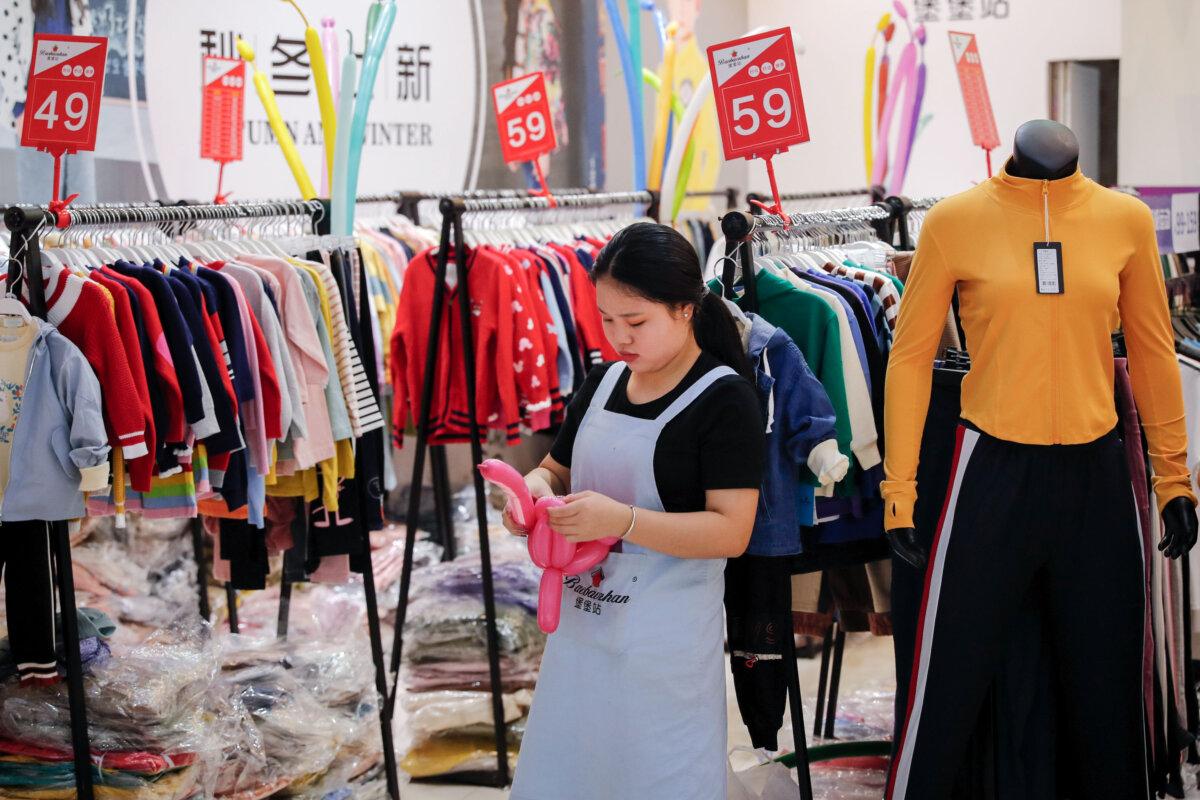
Ms. Huang, who works at a large shopping mall near the Yiwu Small Commodities Wholesale Market, said “there was no one there from the very first day” of the holiday.
“In all the years, whether it was a seven-, eight-, or even six-day holiday, it was never this quiet. This year is truly unusual,” she said.
Ms. Huang also noted that in previous years, the mall was crowded at this time, with peak sales extending into mid-October. However, this year, not only are customers scarce, but business at nearby restaurants is also “noticeably down,” she said.
Ms. Wen, a resident of Xiamen city, said that “the streets are deserted and many shops are closed during the National Day holiday.”
“It’s harder to run a business this year than in previous years, not because companies are doing poorly, but because the external environment is so bad,” she said.
Ms. Li, who works for a central state-owned enterprise, said that her company “hasn’t paid wages for two months.”
She also pointed out that employees of public institutions in some counties and districts “have only been receiving basic wages in recent months, with benefits and bonuses suspended.”
“I used to think jobs at state-owned enterprises and public institutions were relatively stable,” she said. “But now they’re starting to feel the pinch.”
What's Your Reaction?
 Like
0
Like
0
 Dislike
0
Dislike
0
 Love
0
Love
0
 Funny
0
Funny
0
 Wow
0
Wow
0
 Sad
0
Sad
0
 Angry
0
Angry
0










Comments (0)