

The Two Faces of China: How Beijing Shapes a World on Its Own Terms
On the same day China's top diplomat addresses 140 nations about global cooperation, Western intelligence agencies warn of systematic espionage, and the U.S. maintains punishing tariffs on Chinese goods. This is not a contradiction – it is a strategy. An analysis of how Beijing pursues influence, integration, and control all at once.

.
A comprehensive analysis of the current situation as of April 23, 2026, by Udumbara.net
.
A Scene Worth Noting
On Wednesday, April 22, 2026, Wang Yi – one of China's most powerful diplomats and a senior member of the Communist Party's Political Bureau – stood before representatives from more than 140 countries in Beijing. The occasion was the Third High-Level Conference of the Forum on Global Action for Shared Development, hosted by China's International Development Cooperation Agency. His message was clear and confident: China will take "proactive steps to deepen cooperation" and remain a "promoter and contributor to global development."
It was a carefully staged moment of multilateral goodwill. It was also happening on the same day the United States maintained sweeping tariffs on Chinese goods, while intelligence agencies across the Western world continued to warn about Chinese cyber intrusions, espionage networks, and covert influence operations targeting democratic institutions.
The question is not which version of China is real. Both are. The more interesting question is how they fit together.
.
Level One: The Cooperative China
To understand China's global strategy, you first have to take it seriously on its own terms.
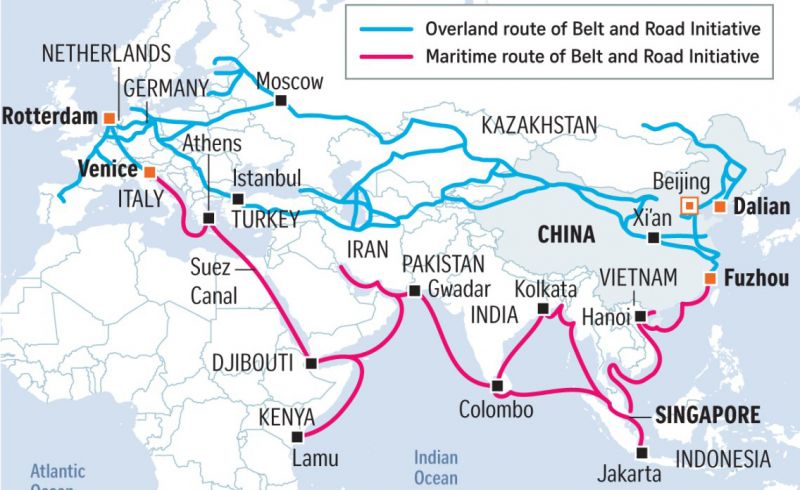
Under the leadership of the Chinese Communist Party (CCP), Beijing has built one of the most extensive diplomatic and development architectures the world has ever seen. The Belt and Road Initiative (BRI), launched in 2013, now spans more than 140 countries and has funded ports, railways, highways, power plants, and fiber-optic cables from Southeast Asia to East Africa to Latin America. New data from Griffith University shows that BRI project values hit $213.5 billion in 2025 – actually surpassing their 2016 peak, despite years of Western predictions that the program was in decline.
Beyond infrastructure, Beijing has rolled out a cascade of global initiatives in recent years: the Global Development Initiative (GDI, 2021), the Global Security Initiative (GSI, 2022), the Global Civilization Initiative (GCI, 2023), and – most recently – the Global Governance Initiative (GGI), announced by President Xi Jinping in September 2025. Together, these form a coherent framework that Beijing presents as an alternative to a Western-dominated global order – one built on what it calls "sovereign equality," "multilateralism," and "people-centered development."
For many countries in the Global South, this offer is genuinely attractive. China's exports to developing economies grew roughly 39 times between 2000 and 2024, while U.S. exports to the same countries roughly doubled over the same period. In Africa, Chinese-financed hydropower alone now accounts for nearly a quarter of the continent's installed capacity. In 2026, China is hosting APEC, commemorating 70 years of diplomatic ties with Africa, and finalizing a China-Gulf Cooperation Council free trade agreement. The engagement is real, the money is real, and for many recipient countries, the alternatives have not always been better.
This is not propaganda. It is a record.
.
Level Two: The China the West Watches Warily
Then there is the other set of facts.
The U.S. Federal Bureau of Investigation (FBI) has described the counterintelligence threat from the CCP as its single highest counterintelligence priority. According to the FBI, intellectual property theft linked to China costs the American economy an estimated $600 billion per year. The agency notes that the threat "comes from the programs and policies pursued by an authoritarian government" – not from Chinese people as such.
Western security agencies have been sounding alarms with increasing urgency. In 2025, NATO issued a formal statement of solidarity with the Czech Republic after a cyberattack attributed to Chinese state-linked actors. Canada, Finland, France, Germany, Sweden, and Switzerland have all warned about Chinese hacking campaigns targeting critical infrastructure. A massive cyber operation known as "Salt Typhoon," attributed to China's Ministry of State Security (MSS), reportedly penetrated telecommunications networks in multiple countries to harvest sensitive data.
In the United Kingdom, parliamentary researchers, lobbyists, and others with policy access have been the subjects of counterintelligence investigations linked to Beijing. In the United States, the FBI describes a systematic effort to recruit individuals inside government, academia, and business – through online platforms, professional networking sites, and talent recruitment programs – to gather intelligence and shape policy outcomes.
The Observer Research Foundation, one of Asia's leading think tanks, published an analysis in April 2026 arguing that China's new Global Governance Initiative is not merely a diplomatic project. It documents how Beijing uses multilateral institutions – including UN bodies like ECOSOC – to embed surveillance-friendly technology standards and expand the adoption of Chinese AI governance models across developing nations. Framed as South-South cooperation, it is also, the report concludes, a systematic effort to normalize Beijing's preferred norms from the ground up.
The same Belt and Road Initiative that builds roads in Kenya also creates financial dependencies. The same digital infrastructure investments that expand connectivity in Africa can embed Chinese technological ecosystems in ways that are difficult to reverse. Outright rejection risks real economic losses for partner governments. Unquestioning acceptance may cost them sovereignty.
.
The Core Thesis: Not a Contradiction, But a Design
Here is where the analysis matters most.
China's behavior is not incoherent. It is not the result of different factions pulling in different directions or of rhetoric outpacing reality. It is a coherent dual strategy: pursue deep economic integration while simultaneously building political leverage, institutional influence, and intelligence advantages that give Beijing options if integration ever falters.
Call it selective openness with strategic depth. China opens its markets, funds infrastructure, and presents itself as a partner for development – while reserving the right to use those relationships as instruments of pressure when its core interests are at stake. The BRI is no longer simply a development program; analysts at Foreign Policy described it in April 2026 as having become "a sophisticated extension of China's industrial policy," routing Chinese manufactured goods and investment around U.S. tariffs through strategic third countries.
This is what political scientists sometimes call "sharp power" – not the soft power of culture and attraction, and not the hard power of military force, but the systematic use of economic interdependence and institutional presence to shape outcomes without open confrontation. The goal is not to defeat the existing global order. It is to inhabit it, reshape it from within, and gradually reorient it toward a set of norms more favorable to an authoritarian, single-party state.
The CCP is transparent about this in its own internal documents. Wang Yi stated at the end of 2025 that China's diplomacy in 2026 must "ensure that we continue to have the strategic and overall initiative amid intense international competition." The language of cooperation and the logic of competition coexist, quite deliberately, in the same policy framework.
.
How the Pieces Connect
On the trade front, the picture is equally layered. After a dramatic tariff escalation in 2025 – which briefly pushed U.S. duties on Chinese goods to 145 percent and Chinese counter-duties on American products to 125 percent – both sides pulled back from the brink. A truce in May 2025 brought some relief, but the fundamental tensions remain unresolved. The U.S. Supreme Court struck down some of the Trump administration's emergency tariffs in February 2026, but the bulk of trade measures against China remain in place.
Beijing's response has not been to retreat. Instead, China has done what its leaders always said they would: it diversified. Chinese firms are now routing exports through third countries, investing in manufacturing facilities in Morocco, Nigeria, Hungary, and Mexico to access markets where tariffs are lower. The BRI has been quietly retooled into a market-building mechanism, helping China develop consumer bases and supply chain dependencies in the Global South as the U.S. market becomes less accessible.
The ITIF – a leading Washington-based technology and innovation think tank – published a major report on April 6, 2026, documenting how China's share of Global South imports has grown by more than 21 percentage points since 2000, while the American share has fallen by 10 points. The displacement is sharpest in strategic sectors: telecom equipment, electric vehicles, electrical machinery, and pharmaceuticals. This is not a coincidence. It is the result of deliberate industrial policy, sustained state investment, and long-term strategic planning of the kind that Western democracies – constrained by election cycles and market logic – have generally struggled to match.
Meanwhile, the Western response remains fragmented. The United States under President Trump has pursued an aggressive tariff strategy, but unilateral tariffs are a blunt instrument that also raise costs for American consumers and businesses. Europe has moved more cautiously, still dependent on Chinese supply chains for its green energy transition and unable to fully align with Washington's harder line. Japan and South Korea, deeply integrated into U.S.-China supply chains, are watching anxiously from the middle. The multilateral alternatives to Chinese development finance – including the EU's Global Gateway program – are only now beginning to attract serious scrutiny over their own lack of transparency and accountability.
.
An Open Question, Not a Simple Answer
So will China's dual strategy succeed?
The honest answer is: nobody knows yet. The BRI has created real infrastructure but also real debt problems in fragile economies. Chinese technology ecosystems are spreading, but so is awareness of the strings attached. Western security agencies are increasingly alert to CCP influence operations, making the covert dimension of China's strategy harder to execute. And the trade war, while damaging for both sides, has accelerated a partial decoupling that Beijing did not want and cannot entirely reverse.
What is clear is that the world is not simply dividing into a Chinese camp and a Western camp. Most countries in the Global South are playing both sides, taking Chinese investment while maintaining ties with the West, participating in BRI while joining multilateral frameworks Beijing did not design. This is rational behavior for smaller states caught between great powers. But it also means that the contest over global norms, institutions, and technological standards is far from decided.
The deeper question is whether liberal democracies can develop a coherent, sustained, and attractive alternative – not just a reaction to China, but a positive vision of their own. So far, the record is mixed at best.
What is being built right now, quietly and without a single moment of rupture, may well determine the shape of the global order for decades. The construction is happening one infrastructure contract, one AI governance resolution, one debt renegotiation, one talent recruitment at a time.
That is worth watching closely.
.
Sources:
- Xinhua – Wang Yi at Third High-Level Conference of the Forum on Global Action for Shared Development, April 22, 2026: https://english.news.cn/20260422/24b8dd25d21b4f6b81f6b605cf019ad8/c.html
- Observer Research Foundation – "China's Global Governance Initiatives: Diplomacy-Intelligence Convergence," April 2026: https://www.orfonline.org/research/china-s-global-governance-initiatives-diplomacy-intelligence-convergence
- ITIF – "The Global Trade Battleground: US-China Competition in the Global South," April 6, 2026: https://itif.org/publications/2026/04/06/global-trade-battleground-us-china-competition-in-the-global-south/
- Foreign Policy – "China's BRI Reinvention Accelerated By Western Tariffs," April 3, 2026: https://foreignpolicy.com/2026/04/03/china-belt-and-road-initiative-reinvention-trade/
- Council on Foreign Relations – "The U.S.-China Trade Relationship," updated April 16, 2026: https://www.cfr.org/backgrounders/contentious-us-china-trade-relationship
- Small Wars Journal – "China's Expanding Global Intelligence Footprint In The Digital Age," March 9, 2026: https://smallwarsjournal.com/2026/03/09/chinas-expanding-global-intelligence/
- FBI – "The China Threat" (counterintelligence priority overview): https://www.fbi.gov/investigate/counterintelligence/the-china-threat
- China-Global South Project – "Why the Belt and Road Is Back in a Big Way," February 2026: https://chinaglobalsouth.com/podcasts/belt-and-road-initiative-investment-surge-2025/
.
What's Your Reaction?
 Like
1
Like
1
 Dislike
0
Dislike
0
 Love
1
Love
1
 Funny
0
Funny
0
 Wow
1
Wow
1
 Sad
0
Sad
0
 Angry
0
Angry
0












Comments (0)