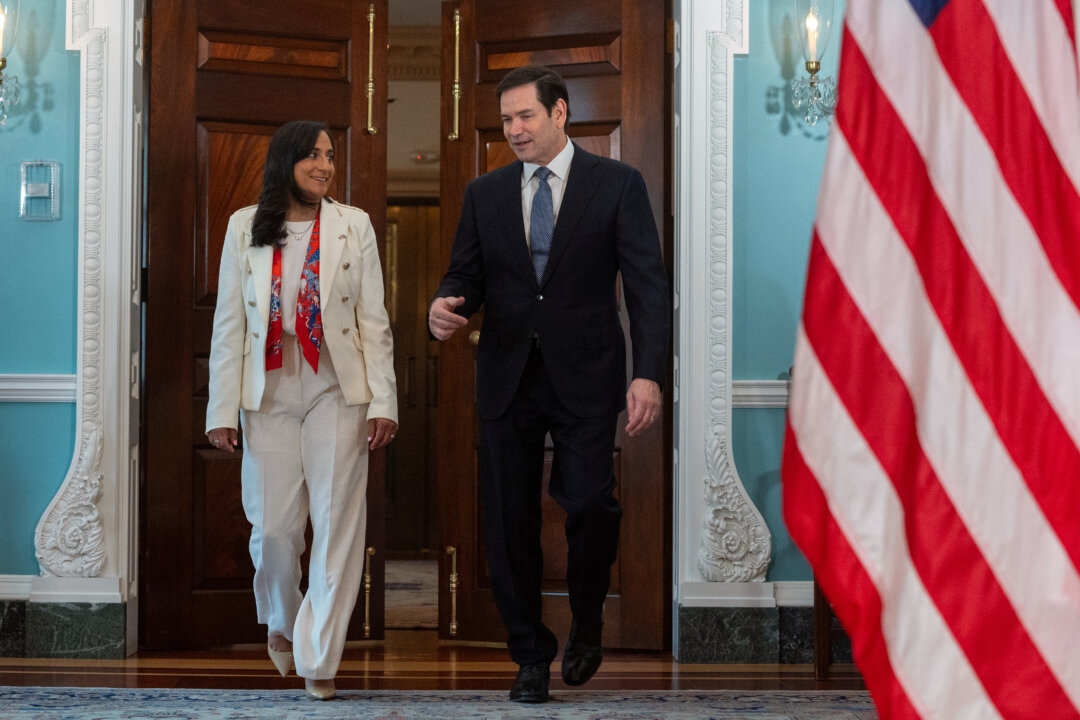
Canada’s Foreign Affairs Minister Anita Anand and U.S. Secretary of State Marco Rubio have reaffirmed their alignment on key international issues, including the need to push back against Beijing’s “coercive activity” on the global stage, Rubio says.
Rubio made the comments in an Aug. 21 social media
post, following a meeting with Anand the same day at the U.S. State Department in Washington. He said the two officials found common ground on key issues facing the international stage.
“We agreed on the need to support Haiti, end Hamas’ efforts to stand in the way of peace in Gaza, and to counter China’s coercive activity in our hemisphere,” Rubio wrote.
A
readout of the meeting from Rubio’s office says they also discussed peace negotiations to end the Russia-Ukraine war and explored mechanisms to “strengthen our hemisphere’s response” to the threat posed by Beijing.
Global Affairs Canada did not respond to The Epoch Times’ request for comment by publication time.
Rubio has been a vocal critic of the Chinese regime, raising the alarm over its human rights abuses, efforts to expand global market influence, and what he has called China’s “aggressive” actions in the South China Sea, particularly in relation to Taiwan.
“Communist China has been able to get away with a campaign of widespread evil,” Rubio
said in July 2024.
“From committing acts of genocide against religious and ethnic groups, to spearheading forced sterilization and abortions, as well as dominating crucial minerals and technologies, and impeding the sovereignty of several regional partners, the U.S. will not tolerate these practices.”
Canada, which is currently navigating tariff
tensions with Beijing, has
shifted some of its Asia-Pacific policy, but not much has been revealed on how it plans to deal with Beijing going forward. In its
Indo-Pacific Strategy, published in late 2022, Ottawa calls China an “increasingly disruptive global power,” noting that Canada’s approach is to cooperate with Beijing in certain areas while challenging it in others.
.
“In areas of profound disagreement, we will challenge China, including when it engages in coercive behaviour–economic or otherwise–ignores human rights obligations or undermines our national security interests and those of partners in the region,” the
strategy says.
Beijing-Ottawa relations began to deteriorate in 2018, when China
arbitrarily detained Canadians Michael Spavor and Michael Kovrig in apparent retaliation for the detention of Huawei executive Meng Wanzhou in Vancouver, following a U.S. extradition request.
.
Tensions rose further after intelligence leaks were reported by Canadian media outlets starting in late 2022 about extensive interference by Beijing in Canada’s democracy. The issue prompted a public inquiry into foreign interference, which ultimately
identified China as the “most active perpetrator of foreign interference targeting Canada’s democratic institutions.”
Ottawa has also
condemned China’s human rights violations, issuing sanctions last year against Chinese officials involved in the oppression of Falun Gong practitioners and ethnic minorities, including Tibetans and Uyghurs.
Prime Minister Mark Carney
said in June that he and Chinese Premier Li Qiang had agreed to “regularize” high-level talks between the two countries, following their first official call since Carney took office.
.
Meanwhile, during a federal leaders’ debate ahead of this year’s election, Carney
called China “the biggest security threat to Canada.” At a later campaign stop, he expanded on the remark,
describing China as a major source of foreign interference and adding that Ottawa is actively working to counter it.
.
Noé Chartier contributed to this report.
.



 Like
0
Like
0
 Dislike
0
Dislike
0
 Love
0
Love
0
 Funny
0
Funny
0
 Wow
0
Wow
0
 Sad
0
Sad
0
 Angry
0
Angry
0














Comments (0)