

Trump and Xi Exchange Letters Over Iran Weapons — Beijing Says It's Not Supplying Tehran
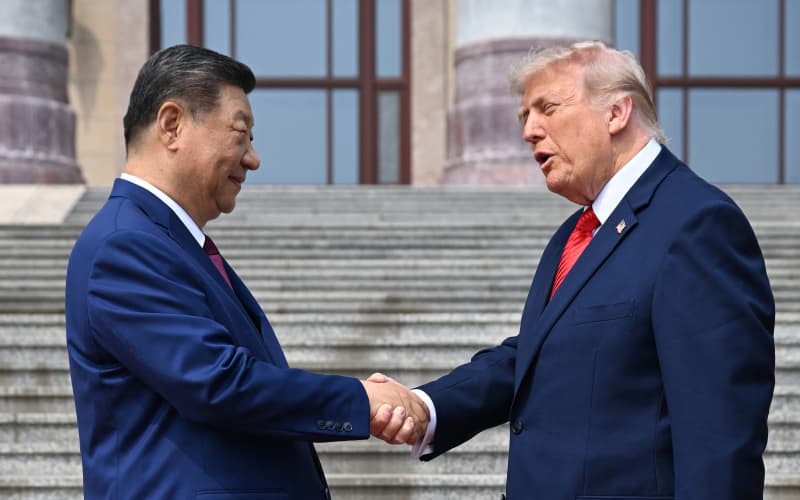
U.S. President Donald Trump has revealed that he personally wrote to Chinese President Xi Jinping, urging Beijing not to supply weapons to Iran. Xi reportedly wrote back, assuring Trump that China is not doing so. The exchange takes place against a backdrop of sharp tariff threats and a planned summit between the two leaders.


.
Here is an update on the article:
https://udumbara.net/trump-names-china-directly-50-tariff-iran-weapons-hormuz-blockade
.
A Personal Letter in a High-Stakes Standoff
The diplomatic standoff over Iran's weapons supply has taken a new and personal turn. In an interview aired on Wednesday on Fox Business Network, U.S. President Donald Trump revealed that he had written directly to Chinese President Xi Jinping — asking him not to transfer weapons to Iran.
Xi's response, according to Trump, was reassuring: Beijing denied supplying arms to Tehran.
"I wrote him a letter asking him not to do that, and he wrote me a letter saying that, essentially, he's not doing that," Trump told the program "Mornings with Maria," in remarks recorded on Tuesday.
Trump did not disclose when the letters were exchanged — or whether any verification mechanism is in place to confirm China's claims.
Background: A Threat That Was Already on the Table
This letter exchange didn't happen in a vacuum. As reported here previously, Trump issued a stark public warning just last week: any country supplying weapons to Iran would face an immediate additional tariff of 50 percent on all goods exported to the United States.
The message was widely understood as directed primarily at China — Iran's most significant economic partner and one of its few remaining diplomatic allies. Beijing has maintained substantial trade and energy ties with Tehran, even as Western sanctions have intensified pressure on the Islamic Republic over its nuclear program.
China's relationship with Iran is rooted in economics: Beijing is one of Tehran's largest oil buyers. Iran, meanwhile, has become a vital alternative supplier for China as it seeks to reduce dependence on Gulf oil — especially given growing tensions in the region.
Oil, Iran, and the Coming Xi Summit
During the same interview, Trump addressed how current events in the Middle East and Venezuela might affect his planned meeting with Xi Jinping — reportedly scheduled for next month.
He dismissed concerns that oil market disruptions could complicate the summit, drawing a clear line between American and Chinese interests: "He's somebody that needs oil. We don't."
The comment was pointed. The United States, now the world's largest oil producer, is largely insulated from Middle East supply disruptions. China, by contrast, imports roughly 70 percent of its oil — much of it from the Persian Gulf and, increasingly, from sanctioned nations like Iran and Russia.
Any escalation in the region — including a potential U.S.-Iran military confrontation or closure of the Strait of Hormuz — would hit China's economy hard, a fact that gives Washington significant leverage in ongoing negotiations.
Why China's Answer Matters — And Why It May Not Be the Whole Story
Beijing's denial that it is supplying Iran with weapons should be seen in context. China has consistently rejected accusations of direct weapons transfers to Iran. However, Western intelligence agencies and independent analysts have repeatedly flagged the role of Chinese companies in providing dual-use technology (goods with both civilian and military applications) to Iran — including components used in drone and missile production.
In February 2025, the U.S. Treasury Department sanctioned several Chinese entities accused of helping Iran acquire materials relevant to its weapons programs. While the Chinese government itself may not be handing over weapons directly, state-linked companies and middlemen have been implicated in circumventing sanctions.
Whether Xi's letter amounts to a genuine commitment — or a diplomatic maneuver to ease tariff pressure ahead of the summit — remains an open question.
A Delicate Dance Before the Summit
The letter exchange signals that both sides are, for now, choosing back-channel diplomacy over public confrontation. With a Trump-Xi summit reportedly on the horizon, both governments appear to have an interest in keeping tensions manageable — at least in the short term.
Trump's tariff threat remains on the table. His letter to Xi suggests he is giving Beijing the opportunity to respond before escalating further. Xi's reply — whether sincere or tactical — provides enough diplomatic cover to keep the summit track alive.
What happens next depends largely on developments in Iran, where U.S. pressure is intensifying. If evidence emerges that Chinese weapons or technology have reached Tehran's military, the current diplomatic calm could evaporate quickly.
For now, both leaders appear to be buying time — while the world watches the next move.
.
Sources:
- Reuters – Trump says he asked China's Xi not to give Iran weapons (April 15, 2026): https://www.reuters.com/world/china/trump-says-he-asked-chinas-xi-not-give-iran-weapons-2026-04-15/
- U.S. Treasury Department – Sanctions on Chinese entities tied to Iran: https://home.treasury.gov/news/press-releases/jy2799
- BBC News – China and Iran: the alliance that worries the West: https://www.bbc.com/news/world-middle-east-65043500
- Reuters – China's oil imports from Iran at record high: https://www.reuters.com/business/energy/chinas-iran-oil-imports-hit-record-high-2024-2025-01-21/
.
What's Your Reaction?
 Like
0
Like
0
 Dislike
0
Dislike
0
 Love
0
Love
0
 Funny
0
Funny
0
 Wow
0
Wow
0
 Sad
0
Sad
0
 Angry
0
Angry
0












Comments (0)