

U.S. Senators Reassure Taiwan: Arms Approvals Expected Within Weeks
A bipartisan group of U.S. senators has sent a formal letter to Taiwan's parliament, pledging that pending weapons sales — including counter-drone systems and air defense equipment — will be approved within weeks. The move comes just ahead of President Trump's planned visit to China, fueling fresh questions about Washington's long-term commitment to Taiwan's security.


.
Congress Sends a Clear Signal to Taipei
As President Donald Trump prepares for a high-profile trip to China scheduled for May 14–15, 2026, a group of U.S. senators from both parties stepped forward to reassure Taiwan that American military support remains firm. In a letter dated April 14 and addressed to Taiwan's parliament speaker Han Kuo-yu, the senators stated that pending U.S. weapons sales to the island are expected to receive formal approval within the coming weeks.
The letter was signed by Democratic Senator Jeanne Shaheen of New Hampshire — the senior Democrat on the Senate Foreign Relations Committee — along with Democratic Senator Jacky Rosen of Nevada and Republican Senators Thom Tillis of North Carolina and John Curtis of Utah. The bipartisan composition of the group sends a deliberate message: support for Taiwan in Congress is not a partisan issue.
What Weapons Are on the Table?
According to the senators' letter, the pending sales packages include counter-drone systems, an integrated battle command system, and medium-range munitions designed to strengthen Taiwan's air defenses. These are precisely the kinds of capabilities that defense analysts have identified as critical for Taiwan to deter — or survive — a potential military confrontation with China.
The 2026 National Defense Authorization Act already contains provisions supporting Taiwan, including $1 billion in military aid and a requirement for Washington and Taipei to cooperate on drone and counter-drone development. The new packages would build directly on this foundation.
The senators also urged Taipei to accelerate not only the purchase of American weapons but also the domestic production of so-called asymmetric capabilities — lower-cost, harder-to-target systems that could complicate any Chinese military operation against the island.
A Shadow Over the Trump-Xi Summit
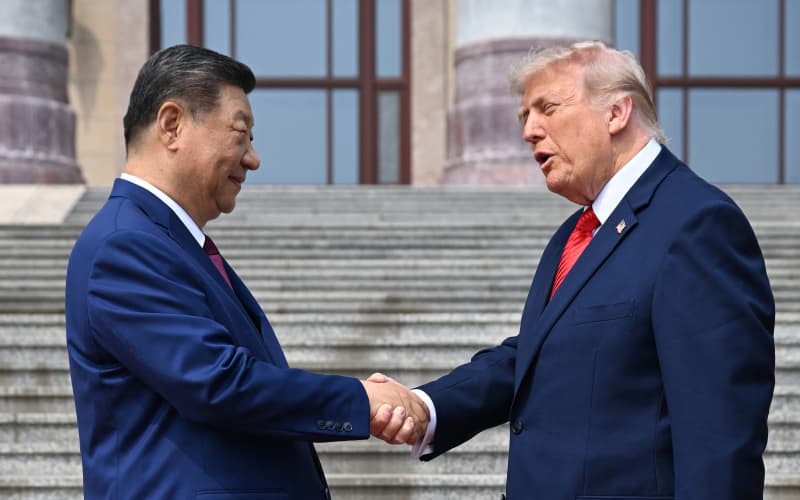
The timing of the senators' letter is no coincidence. For months, concerns have been growing in Washington and Taipei that Trump's desire to secure a favorable trade deal with Chinese leader Xi Jinping could lead him to dial back military support for Taiwan.
In February 2026, Trump stated that he had consulted with Xi Jinping over the specific issue of arms sales to Taiwan — a statement that fueled speculation he might agree to reduce weapons transfers in exchange for concessions from Beijing. Reports also emerged that the administration was deliberately delaying a multi-billion-dollar arms package to Taiwan to ensure Trump's Beijing visit goes smoothly.
From Beijing's perspective, Taiwan is its top priority agenda item at the summit. China is expected to press Washington for serious self-restraint on future arms sales and on the broader handling of U.S.-Taiwan relations.
Xi Jinping already told Trump in February that arms sales to Taiwan must be handled with "prudence" — a clear signal of Beijing's expectations going into the talks.
Taiwan's Defense Spending: A Political Deadlock
While Washington urges Taiwan to do more for its own defense, the island's domestic politics have complicated that goal. President Lai Ching-te last year proposed a $40 billion supplemental defense budget to run from 2026 to 2033, aimed at building up air defenses and acquiring modern weapons systems. However, the opposition Kuomintang (KMT) party — which holds significant power in parliament — has blocked the proposal in favor of a less expensive alternative.
Taiwan's annual defense budget has already been raised from roughly 2.4 percent of GDP to approximately 3.3 percent in 2026, with a stated goal of reaching 5 percent by 2030. Yet the larger supplemental spending bill remains stalled.
Adding to the tension, KMT Chairwoman Cheng Li-wun recently traveled to mainland China on what she described as a "peace mission" — a move that drew criticism from those who see it as undercutting Taiwan's bargaining position at a critical moment.
Background: The Biggest Arms Deal in History
The current political drama follows a landmark moment in December 2025, when the Trump administration approved what became the largest-ever U.S. weapons sale to Taiwan. The eight sales agreements totaled $11.15 billion, according to Taiwan's Defense Ministry, and included medium-range missiles, howitzers, and drones.
China's response was swift. Beijing issued "stern representations" and imposed targeted sanctions on U.S. defense firms involved in the deal. Chinese officials have long demanded a complete halt to U.S. arms transfers to Taiwan, viewing the island as Chinese territory that must eventually be reunified with the mainland — by force if necessary.
Taiwan's President Lai Ching-te has repeatedly offered direct talks with Beijing but has been refused. His administration maintains that only the people of Taiwan can determine the island's future — a position firmly rejected by the Chinese Communist Party (CCP).
What Comes Next?
Reuters has reported that additional weapons packages worth as much as $14 billion could be announced by the Trump administration following the China visit. The senators' letter suggests Congress intends to hold the administration to that trajectory regardless of what happens in Beijing.
Analysts argue that while arms sales to Taiwan under Trump may slow for tactical reasons tied to summit diplomacy, the overall trend is unlikely to reverse — and could even accelerate further during the remainder of his term.
For Taiwan, the message from Capitol Hill is clear: Congress has not forgotten the island, even if the White House appears to be juggling competing priorities. Whether that message reaches Beijing as a deterrent — or simply as one more point of tension — remains to be seen.
.
Sources:
- Reuters – U.S. senators reassure Taiwan on weapons approvals: https://www.reuters.com/world/us/us-senators-reassure-taiwan-weapons-approvals-coming-weeks-2026-04-16/
- Global Taiwan Institute – Will Trump Continue to Slow Arms Sales to Taiwan?: https://globaltaiwan.org/2026/04/will-trump-continue-to-slow-arms-sales-to-taiwan/
- Brookings Institution – Beyond trade: Issues in a Trump-Xi summit: https://www.brookings.edu/articles/beyond-trade-issues-in-a-trump-xi-summit/
- NPR – As Trump plans visit to China, arms package to Taiwan is delayed: https://www.npr.org/2026/03/04/nx-s1-5727608/as-trumps-plans-visit-to-china-arms-package-to-taiwan-is-delayed
- South China Morning Post – Record Taiwan arms deal casts shadow over Trump's 2026 Beijing visit: https://www.scmp.com/news/china/article/3337856/record-taiwan-arms-deal-casts-shadow-over-trumps-2026-beijing-visit
- The Diplomat – U.S. Arms Sales to Taiwan Signal Policy Continuity: https://thediplomat.com/2025/12/us-arms-sales-to-taiwan-signal-policy-continuity/
.
What's Your Reaction?
 Like
0
Like
0
 Dislike
0
Dislike
0
 Love
0
Love
0
 Funny
0
Funny
0
 Wow
0
Wow
0
 Sad
0
Sad
0
 Angry
0
Angry
0















Comments (0)