

War Clouds Over Canton: How the Iran Conflict Is Squeezing China's Export Machine
China's biggest trade fair is open for business — but the mood is anything but celebratory. The ongoing war in Iran is pushing up production costs, disrupting shipping routes and dampening demand from key Middle Eastern markets. For millions of Chinese factory workers and exporters, the stakes could not be higher.

.
Record Fair, Gloomy Faces
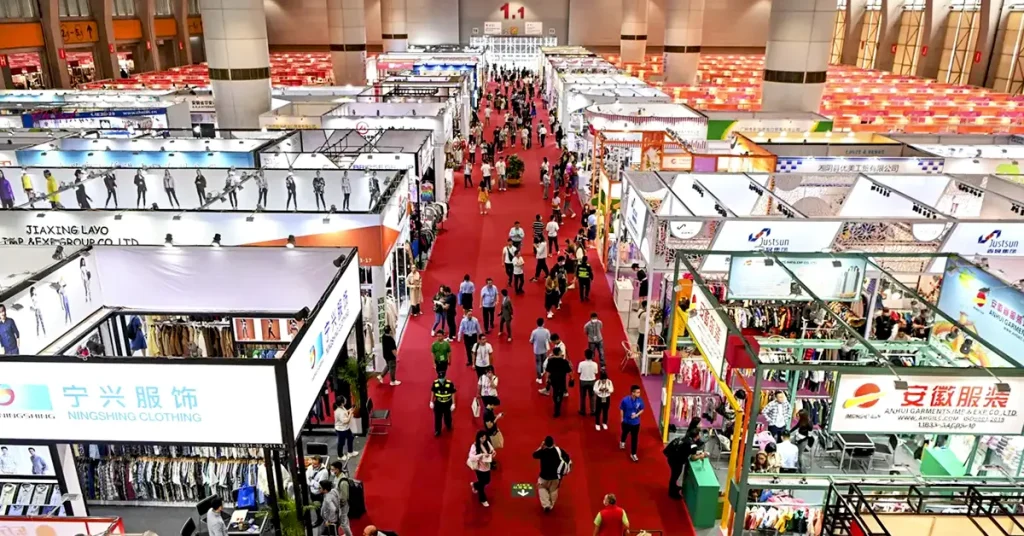
Every spring, Guangzhou transforms into the beating heart of global trade. The Canton Fair — officially the China Import and Export Fair — is the largest trade exhibition in the country and one of the most important in the world. This year's 139th edition has set new records: over 32,000 companies exhibiting across 1.55 million square meters of exhibition space, with nearly 76,000 booths packed with everything from kitchen appliances to electric vehicles.
But behind the gleaming product displays, a shadow hangs over the fairgrounds. The war in Iran — now in its seventh week — has rattled supply chains, sent raw material costs soaring and frozen orders from Middle Eastern buyers who simply cannot risk placing new shipments.
"For foreign trade companies like ours, things are difficult," said one plastics factory manager from eastern China, who has watched her profit margins fall by half since the conflict began. "We just hope the war will end as soon as possible."
The Cost Crunch: Factories Under Pressure
The Iran conflict has triggered a sharp energy shock that is feeding directly into Chinese factory floors. Raw material costs — including plastic, copper, aluminium and industrial fibres — have surged across sectors. One plastics manufacturer told reporters that input costs jumped roughly 20% after the war started, forcing the company to re-quote prices to foreign clients who are still hesitating.
For some exporters, passing on the higher costs to customers has been possible. For others, margins have been wiped out entirely. The manager of a rice cooker and kettle manufacturer said output had halved due to slower orders, and that the firm was selling products at a loss even after raising prices by 15%.
The situation is compounded by a stronger Chinese yuan and weaker global demand — a double blow for manufacturers already operating on razor-thin margins.
Shipping Chaos: The Strait of Hormuz Factor
One of the most damaging consequences of the Iran war has been the near-paralysis of maritime trade through the Strait of Hormuz — the narrow waterway through which a significant share of global energy and cargo normally flows. Since Iran effectively closed the route in response to U.S. and Israeli strikes that began on February 28, many cargo vessels have been stranded or forced onto far longer, costlier alternative routes.
For Middle Eastern buyers who traveled to the Canton Fair hoping to stock up on goods, the situation is agonizing. A Saudi Arabian business owner attending the fair told AFP that his shipping costs had risen between 50% and 70% — a burden he described as a major headache. Some buyers said they simply could not risk placing new orders while supply routes remained uncertain.
Fresh orders from the Middle East — a region that accounts for a significant share of Chinese export revenues — have largely dried up. One manufacturer of low-voltage electrical equipment said that up to 30 million yuan ($4.4 million) in expected first-half sales to the region were now on hold.
Export Data Confirms the Slowdown
The on-the-ground anxiety at the Canton Fair is backed up by hard numbers. China's export growth slowed sharply to just 2.5% in March compared to the same month a year earlier — a dramatic drop from the 21.8% growth recorded in January and February, according to data from China's General Administration of Customs. The March figure missed analysts' estimates by a wide margin.
China's economy did manage to grow 5% in the first quarter of 2026, beating expectations and outpacing the previous quarter's 4.5% growth rate. But economists warn that the strong start masks growing vulnerabilities. The International Monetary Fund has already trimmed its full-year growth forecast for China to 4.4%, citing the Iran war's drag on global demand.
"The lack of a speedy resolution to the Iran war is likely to dent global growth, which will negatively impact other economies' ability to absorb Chinese exports," said Eswar Prasad, a professor of economics and trade policy at Cornell University.
China's factory-gate prices — which measure what manufacturers charge for goods leaving the factory — rose in March for the first time in over three years, a warning sign that energy-driven inflation is seeping deeper into the world's manufacturing hub.
Adapting: Pivoting Away From the Middle East
Not every company at the fair is in despair. Some are adjusting. Producers of home appliances, automobiles and industrial machinery have begun redirecting sales efforts toward South America and Africa. Others are absorbing cost increases for up to six months in order to maintain relationships with existing customers, betting that the disruption is temporary.
Companies selling to the United States face a separate headache: tariffs. After a turbulent 2025 in which U.S. President Donald Trump raised duties to over 100% before partially reversing them following retaliatory measures from Beijing, many exporters are now operating under levies of roughly 40% on American sales. Some are accelerating plans to shift part of their production to Southeast Asia, where U.S. tariffs are lower and labor costs are cheaper.
A Trump Visit as a Sign of Spring?
Despite the gloomy atmosphere, one piece of news has offered exporters a flicker of hope: reports that President Trump may visit China as early as next month. For many at the fair, such a visit would signal a potential thaw in U.S.-China trade relations — and possibly lower tariffs ahead.
"If he really comes to China, for foreign trade companies like ours it would be a welcome sign, almost like the arrival of spring," said one factory manager.
Others are more cautious, noting that Washington's trade policy has been unpredictable. But the underlying sentiment is clear: Chinese exporters, battered by the Iran war and years of tariff uncertainty, are hungry for stability — and looking to any positive signal they can find.
What Comes Next
Analysts warn that if the Iran conflict continues without resolution, the second half of 2026 could be significantly more painful for China's export sector. Energy costs would remain elevated, global demand would continue to weaken, and supply chain disruptions could compound.
"China can likely weather short-term disruptions, but a protracted war and higher-for-longer energy prices would likely start to bite into growth by the second half of the year," said Lynn Song, chief economist for Greater China at Dutch bank ING.
For now, the Canton Fair remains open — and the world's factories are still taking orders. But the record-breaking attendance figures mask an uncomfortable truth: the global trade that has powered China's rise is under real and growing pressure.
.
Sources:
- Reuters – "Iran war drives up costs, spoils the mood at China's largest trade fair" (April 17, 2026): https://www.reuters.com/world/asia-pacific/iran-war-drives-up-costs-spoils-mood-chinas-largest-trade-fair-2026-04-17/
- AFP / Malay Mail – "At Canton Fair, Chinese exporters and Middle East importers fret over Iran war fallout on trade" (April 15, 2026): https://www.malaymail.com/news/money/2026/04/15/at-canton-fair-chinese-exporters-and-middle-east-importers-fret-over-iran-war-fallout-on-trade/216456
- South China Morning Post – "Canton Fair under Middle East cloud, but sets records, as high costs hit China's exporters" (April 15, 2026): https://www.scmp.com/economy/global-economy/article/3350200/canton-fair-under-middle-east-cloud-sets-records-high-costs-hit-chinas-exporters
- CNBC – "China economic growth accelerates to 5% in first quarter — but Iran war clouds outlook" (April 16, 2026): https://www.cnbc.com/2026/04/16/china-gdp-growth-first-quarter-exports-property-retail-sales-iran-war.html
- AP / Washington Post – "China's exports grew 2.5% in March in a sharp slowdown as Iran war raises uncertainty" (April 14, 2026): https://www.wsoctv.com/news/business/chinas-exports-grew/AINV5KPL5EZ5BI7KAWQOXCGMDQ/
- BNN Bloomberg / Reuters – "China's economy poised for Q1 rebound but Iran war jolts 2026 outlook" (April 16, 2026): https://www.investing.com/news/economy-news/chinas-economy-poised-for-q1-rebound-but-iran-war-jolts-2026-outlook-4616911
.
What's Your Reaction?
 Like
1
Like
1
 Dislike
0
Dislike
0
 Love
0
Love
0
 Funny
0
Funny
0
 Wow
1
Wow
1
 Sad
0
Sad
0
 Angry
0
Angry
0











Comments (0)