

Australia-Fiji a Step Closer to Major Security Deal Amid the CCP’s Pacific Expansion

.
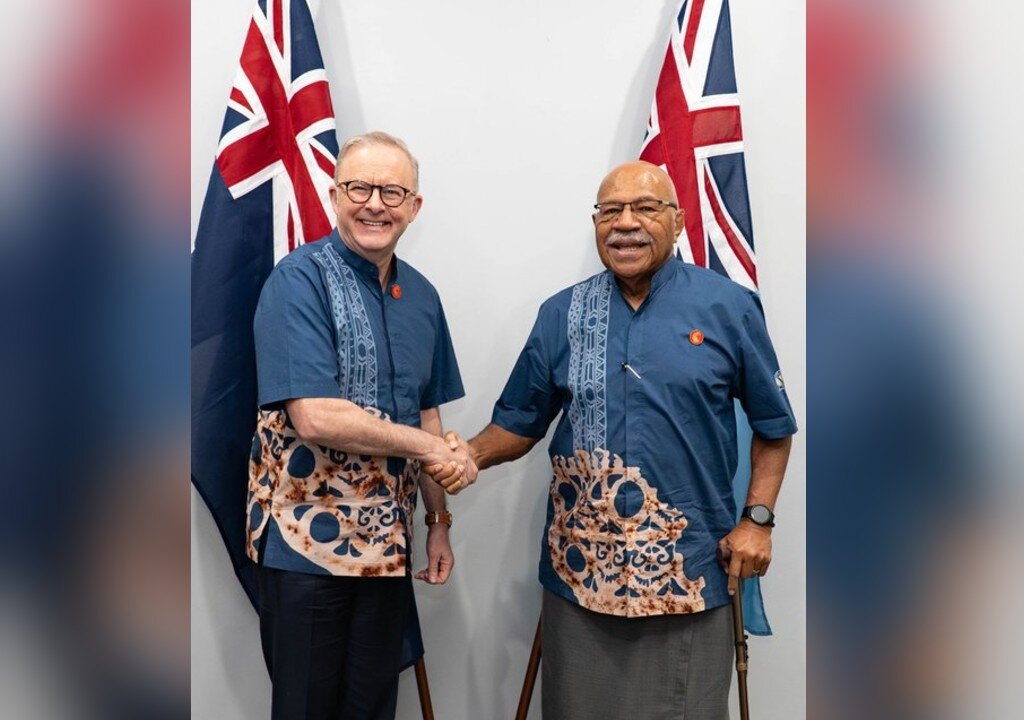
Australian Prime Minister Anthony Albanese is a step closer to signing off on a security deal with Fiji after a less than successful visit to Vanuatu a day earlier.
“Today we agreed to negotiate a new security treaty as part of our shared vision of a secure and prosperous Pacific. Thank you, Prime Minister [Sitiveni] Rabuka, for the productive discussions. I look forward to finding new ways to elevate our Vuvale Partnership.”
First signed in 2019, the Partnership commits both countries to closer cooperation, consultation, and friendship.
Albanese met Rabuka at the Pacific Islands Forum in Honiara.
In a bilateral meeting at the Forum, Albanese revealed the proposal to upgrade their nations’ security relationship had come from Rabuka.
Referencing his visit to Fiji in June, he said, “We had some really fruitful discussions then, and since then, you have written to me about the potential to upgrade our relationship even further, the Vuvale [Partnership) to a security treaty.
“We are certainly up for that, and I think we should get our officials working together to make sure we take this important relationship to the next level.”
Rabuka responded that the two nations had a “mutual concern for the trans-Pacific drug trafficking,” and apologised for the fact that shipments that got through to Australia.
Security Deal With Vanuatu Falls Through
A day earlier, Albanese left Australia hoping a $500 million (US$327 million) security agreement with Vanuatu Prime Minister Jotham Napat could be locked in.The agreement would have given Australia the power to veto any involvement from a third-party nation in Vanuatu’s critical infrastructure projects, effectively blocking future Chinese Communist Party (CCP) investments in its ports, airports, and the telecommunications network.
Yet a Vanuatu spokesperson admitted on the day that its completion was “uncertain.”
More recently, it has funded projects including a $95.4 million loan for road upgrades, with plans for a further loan of about $168 million for the Malekula Road Phase III project that could raise Beijing’s share of Vanuatu’s external debt to over 50 percent.
Vanuatu PM Concerned About Missing Out on Chinese Funding
Speaking to journalists after the two had met, Vanuatu PM Napat confirmed, “Some of my ministers and my MPs, they feel that it requires more discussions ... particularly on some of the specific wordings in the agreement.”Asked whether they were concerned that the deal could limit their ability to obtain funding from other countries for infrastructure, Napat replied, “Yes.”
Albanese said Australia respected the Pacific nation’s sovereignty.
“Australia was a great supporter of independence for Vanuatu. We respect its processes ... If that means people going through processes for a short period of time, then that is absolutely fine by us. And we don’t want to either do ... anything ... that undermines the sovereignty of Vanuatu.”
He would not be drawn on any conditions Australia might put on Vanuatu’s receipt of the $500 million, but cited “upskilling the policing capacity of nations throughout the Pacific,” increasing interoperability to combat transnational crime, and cybersecurity as some of the issues that it covered.
.
What's Your Reaction?
 Like
0
Like
0
 Dislike
0
Dislike
0
 Love
0
Love
0
 Funny
0
Funny
0
 Wow
0
Wow
0
 Sad
0
Sad
0
 Angry
0
Angry
0












Comments (0)