

Canada Opens Its Doors to Chinese EVs – But Who Made Them, and How?
Canada has struck a deal to import Chinese electric vehicles at drastically reduced tariffs. But experts, human rights groups, and even the United States are raising serious alarms: Are these vehicles built with forced labour – and is Canada doing nearly enough to stop such goods from crossing its borders?

.
A Trade Deal With Troubling Fine Print
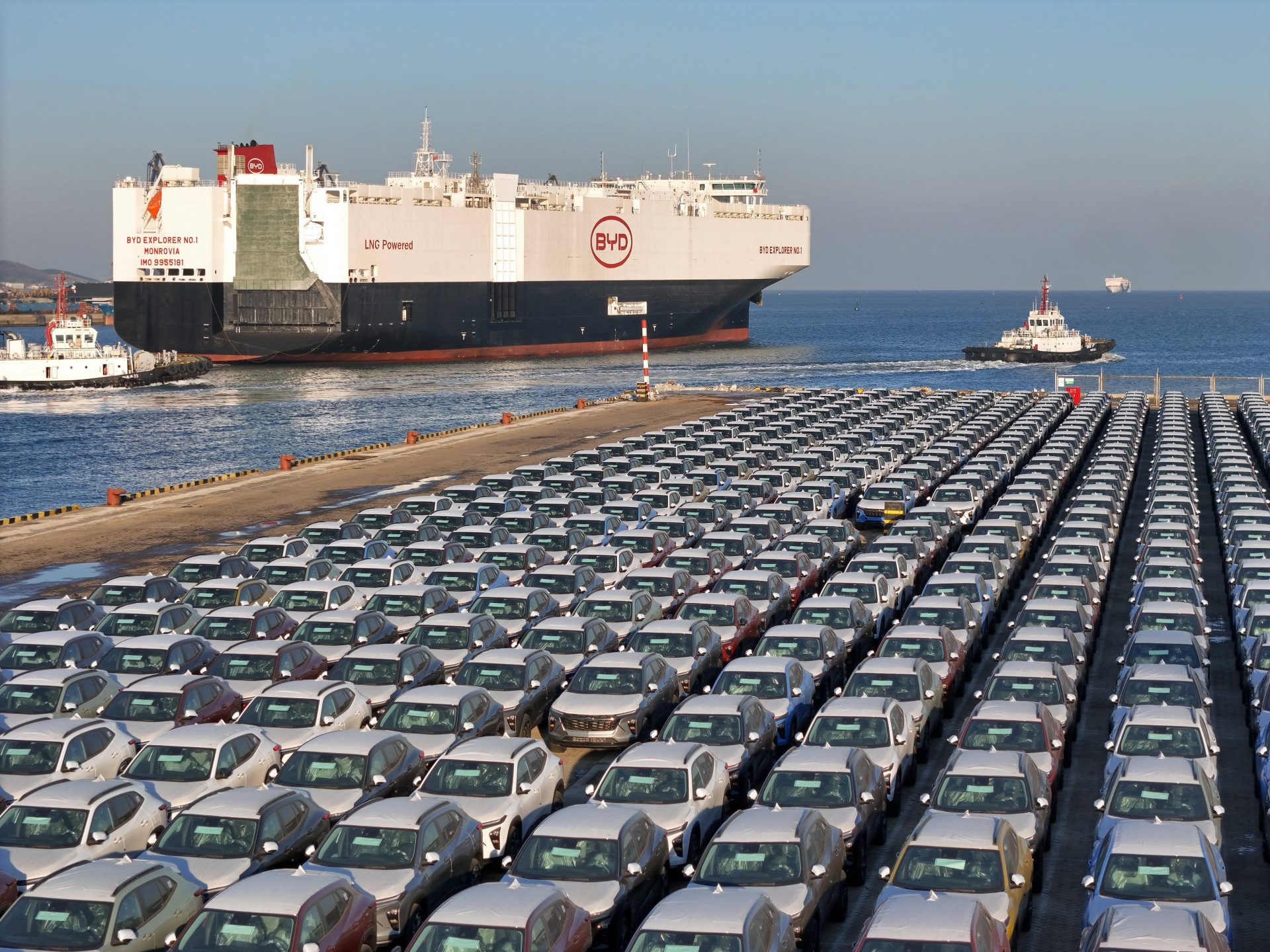
When Prime Minister Mark Carney traveled to Beijing in January, he returned with what his government called a win for Canada's green economy. Under the new agreement, tariffs on Chinese electric vehicles were slashed from 100 percent down to just 6.1 percent – applicable to up to 49,000 vehicles per year, rising to roughly 70,000 after five years. The stated goal: attract Chinese investment into Canada's auto sector.
But the deal came with immediate pushback. Human rights advocates, China policy experts, and opposition Members of Parliament warned that expanded trade with China carries serious risks – not only in terms of national security, but also regarding the conditions under which these vehicles are actually manufactured.
The Forced Labour Problem in China's Supply Chains
The concern is not abstract. Human Rights Watch, one of the world's leading international rights organizations, published a report in 2024 concluding that both Chinese automakers and Western manufacturers operating factories in China are failing to adequately address the risk of Uyghur forced labour in their aluminum supply chains.
Aluminum is a key material in electric vehicle production. The report found credible evidence – drawn from Chinese state media, corporate filings, and government documents – that aluminum producers in the Xinjiang region are utilizing forced labour.
"Car companies simply don't know the extent of their links to forced labor in Xinjiang in their aluminum supply chains," said Jim Wormington, senior researcher at Human Rights Watch, in February 2024.
The problem extends beyond the Uyghur population. According to the Washington-based Falun Dafa Information Center, practitioners of the traditional Chinese spiritual discipline Falun Dafa (also known as Falun Gong) face systematic persecution by Chinese authorities. Following arrest, many are sent to so-called "re-education through labour" camps, where forced labour is routinely used alongside other coercive methods intended to force detainees to abandon their beliefs.
Canada's own government has acknowledged the reality on the ground. Global Affairs Canada stated in 2021 that evidence points to forced labour affecting Uyghurs and other ethnic minorities not only in Xinjiang, but across China more broadly. In December 2024, Ottawa sanctioned Chinese officials specifically for their roles in persecuting Falun Dafa practitioners, Uyghurs, and Tibetans – noting that arbitrary detention and forced labour are among the documented methods of suppression used by the Beijing regime.
Canada's Border Agency: Active – But Outpaced
Canada does have laws on the books. Goods manufactured wholly or in part through forced labour are legally prohibited from entering the country. Canada is also bound by the United States–Mexico–Canada Agreement (USMCA) to enforce this prohibition.
The Canada Border Services Agency (CBSA) is the body responsible for enforcement. It advises importers when their goods carry an "elevated risk" of forced labour links – in August 2025, around 1,800 importers received such advisory notices.
But actual enforcement actions have been strikingly rare. Since the relevant legislation took effect in 2020, the CBSA has formally intercepted only two shipments determined to involve forced labour: a textile shipment in 2024 and a frozen seafood shipment in 2025. Both originated from China.
In 2023, the agency intercepted six shipments of Chinese auto parts on forced labour grounds – but all six were shipped back to China before any formal determination was made.
Compare that to the United States, which denied entry to nearly 23,000 shipments suspected of containing forced labour goods over a comparable period. The gap is stark.
Part of the explanation is legal. Under U.S. law, border officers can block shipments unless the importer proves otherwise. Canadian law does not allow this – CBSA officers must assess each shipment individually and build a case. Country of origin alone, the agency confirmed, is not sufficient grounds to block a shipment.
Washington Takes Notice – and Issues a Warning
The United States has formally flagged Canada's enforcement gap. In its annual report on foreign trade barriers, released March 31, the U.S. Trade Representative listed Canada's handling of forced labour as a new trade irritant.
The report states directly that Canada does not appear to be effectively enforcing its forced labour import ban – meaning goods produced under such conditions may be entering and competing freely in the Canadian marketplace.
The report also criticized Canada for insufficient measures to counter non-market practices by foreign states, including overproduction subsidies that distort fair competition.
The political optics grew worse shortly thereafter. On March 26, Liberal MP Michael Ma appeared to downplay or dismiss the existence of forced labour in China during a House of Commons committee session. When both Ma and Prime Minister Carney were pressed by reporters on whether they believe forced labour exists in China, both gave answers that critics found evasive – acknowledging it happens "around the world," with Carney adding only that certain parts of China are "higher risk."
Expert Voices: "We Can't Take China's Word for It"
Margaret McCuaig-Johnston, a China policy expert and former senior Canadian government official, testified before the House of Commons international trade committee that Canada cannot guarantee imported Chinese EVs are free from forced labour.
"Certainly, Chinese brands have to be assumed to include forced labour," she told MPs. "We can't take the word of the Chinese company that they don't have any forced labour."
Mehmet Tohti, executive director of the Uyghur Rights Advocacy Project – a Canada-based organization – went further, warning that deepening trade ties with China risks undermining Canada's alignment with the United States and other democratic allies.
"Engagement with China must not come at the cost of integrity or human dignity," Tohti said. "Canada's trade policy must be guided by principles, accountability, and security."
Labour Concerns Aren't Limited to China
A fresh investigation adds another dimension. In a report published April 14, the U.S.-based labor rights group China Labor Watch documented serious violations at the construction site of BYD's new electric vehicle plant in Szeged, Hungary. BYD is China's largest EV manufacturer and one of the brands targeted for the Canadian market.
Researchers found excessive working hours, manipulated wage structures that concealed overtime obligations, recruitment-related debt bondage, visa irregularities, inadequate medical care for injured workers, and documented intimidation of those who attempted to report abuses or resign.
"The labor practices observed at the Szeged project mirror patterns long documented in parts of China's domestic manufacturing sector," the report concluded – noting that legal protections exist on paper but enforcement gaps allow abuse to continue.
The findings are especially relevant to Canada given active discussions about opening Chinese EV assembly operations on Canadian soil. Reports have emerged that Stellantis and its Chinese partner Zhejiang Leapmotor Technology are in talks about resuming production at an idled plant in Brampton, Ontario – potentially using vehicle kits assembled largely in China and shipped to Canada for final assembly.
Ontario Premier Doug Ford called the alleged arrangement "unacceptable," arguing it would undermine Ontario autoworkers. Federal Industry Minister Mélanie Joly stated that any production resumption must meet proper labour standards, support the local supply chain, and ensure the software in vehicles is secure.
The Bigger Picture
Canada finds itself at a crossroads. The country wants to lead on clean energy and electric vehicles. It also faces economic pressure to diversify trade partnerships in a turbulent global environment. But the rush to embrace Chinese EVs is colliding head-on with the country's stated commitments to human rights, labour standards, and its obligations to allies.
The question is no longer just whether Chinese EVs are affordable or technologically competitive. The harder question – one that Canada's government has yet to answer clearly – is who made them, and at what human cost.
.
Sources:
- Human Rights Watch – Racing to Failure: Automakers and Uyghur Forced Labor in Aluminum Supply Chains (2024): https://www.hrw.org/report/2024/02/15/racing-failure/automakers-and-uyghur-forced-labor-aluminum-supply-chains
- China Labor Watch – BYD Hungary Plant Labor Violations Report (April 2024): https://chinalaborwatch.org
- Global Affairs Canada – Statement on Xinjiang Forced Labour (2021): https://www.canada.ca/en/global-affairs/news/2021/01/canada-joins-partners-statement-on-human-rights-violations-in-xinjiang.html
- U.S. Trade Representative – 2025 National Trade Estimate Report on Foreign Trade Barriers: https://ustr.gov/about-us/policy-offices/press-office/reports-and-publications/2025/2025-national-trade-estimate-report-foreign-trade-barriers
- Falun Dafa Information Center – Persecution and Forced Labour Documentation: https://faluninfo.net
- Reuters – Canada-China EV tariff deal coverage: https://www.reuters.com/business/autos-transportation/canada-china-ev-tariff-deal
.
What's Your Reaction?
 Like
0
Like
0
 Dislike
0
Dislike
0
 Love
0
Love
0
 Funny
0
Funny
0
 Wow
0
Wow
0
 Sad
0
Sad
0
 Angry
0
Angry
0













Comments (0)