

As China Buys Up Farmland Abroad, How Is Canada Responding?

.
The United States has recently introduced legislation at the state and federal levels to restrict land ownership by China and other adversarial countries, but similar action is lacking in Canada, which in part explains why the United States sees its northern neighbour as a security risk, says former high-ranking RCMP officer Garry Clement.
Clement recently investigated and co-wrote a book on the Chinese regime’s aggressive infiltration of Prince Edward Island, including the Chinese regime’s buying of farmland in part via proxies. But he says that while their recent investigation focused on the PEI, the Chinese Communist Party (CCP) is buying farmland and property in sensitive areas Canada-wide.
“It’s going across Canada. We’re seeing the Chinese trying to get into the Arctic,” Clement, former national director for the RCMP’s Proceeds of Crime program, told The Epoch Times.
“I believe that’s part of the reason the United States has taken such a strong stance against Canada.”
Michel Juneau-Katsuya, who formerly headed the Asia-Pacific unit at the Canadian Security Intelligence Service (CSIS), says the CCP’s current focus may be farmland in Canada, but it’s also targeting other security-sensitive property as well.
“Currently, it’s mainly farmland. But depending on who’s coming to Canada and what intention they have, they might go for industrial lands as well,” Juneau-Katsuya told The Epoch Times.
US Crackdown
Chinese land ownership has been on the rise in the United States in recent years. Based on information available in the public domain, Chinese individuals and entities owned an estimated 69,300 acres of U.S. agricultural land in 2011, and that figure rose to more than 277,300 acres in 2023, according to the American Farm Bureau Federation. While owners from other countries such as Canada and the UK may account for a higher share of foreign-owned farmland in the United States, China is among the handful of countries listed by the United States government as adversaries.
Andrew Harding, senior associate for National Security Coalitions at the Washington, D.C.-based think tank The Heritage Foundation, says China’s foray into buying farmland in the United States represents a serious national security and food security threat.
“No foreign adversary should ever have a strategic chokehold on American agriculture that can be weaponized against the American people,” Harding told The Epoch Times.

“We’re going to protect it by saying, ‘You can’t come. You can’t do it. We don’t want you buying our land. We don’t want you taking the land,’ and basically taking it off the market,” he said.
Canada’s Provincial Patchwork
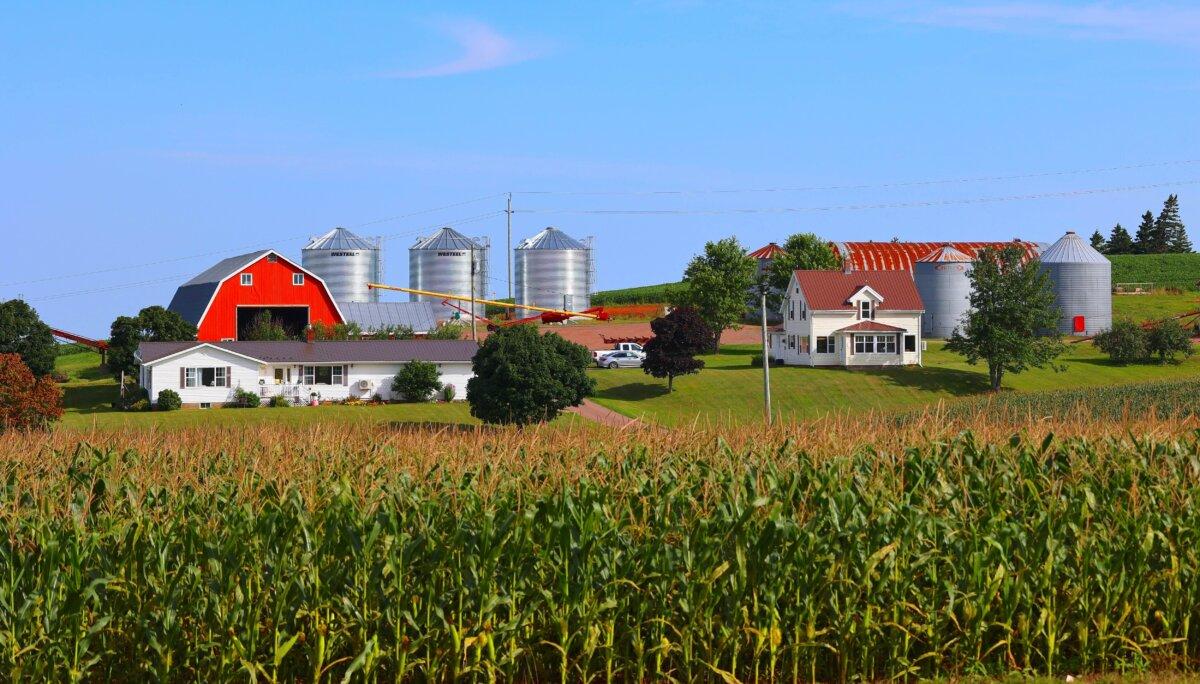
Canada has federal regulations requiring major foreign takeovers to undergo security reviews, but there is no general federal regulation specifically for farmland. Unlike the rising tide of proposed bans and restrictions in the United States, including at the federal level, Canada has taken no similar action, leaving farmland regulation entirely to the provinces. And while some provinces impose strict limits on foreign ownership, others leave the door wide open.Clement says farmland is of particular focus to the CCP because food and water are scarce resources.
“It’s great for eventual control of food supply, and I think that’s just one of the reasons, and we’re too naive to see it,” he said. More generally, he says, the CCP is after land in Canada for better control of natural resources to the Chinese regime’s advantage, and that explains the CCP’s interests in mines and other resource deposits in Canada.
Juneau-Katsuya says that as the CCP acquires land in Canada through various means, including by using private investors as “fronts,” it gains “tremendous influence.” This is because these enterprises become major employers, and then they can pressure the government to meet their demands—for example, by threatening to close operations if their requests are not granted, he says.
“They gain access to the circle of the political decision-making,” Juneau-Katsuya says.
Then-chief of CSIS David Vigneault also commented on the issue in 2023, telling CBS about cases the intelligence service had intervened in.
Vigneault made the remarks in the context of saying CSIS had blocked attempted land purchases by China in 2023, but declined to go into detail about what had been blocked.
.
Agriculture and Agri-Food Canada says that while regulation is left to the provinces, Ottawa’s position is that farmland should not be used as an investment vehicle.
“Provinces have jurisdiction over the ownership of farmland, including land-use planning and the policies related to designation and protection of land for agricultural purposes,” Agriculture and Agri-Food Canada spokesperson Stéphanie Blais wrote in a Sept. 25 statement to The Epoch Times.
In February, the grassroots organization Coalition for the Protection of PEI Lands also published an open letter addressed to PEI’s then-Premier Dennis King, urging the provincial government to investigate the impact of foreign and corporate ownership on soaring land prices and shrinking farmland.
Still, there is no centralized national registry of farmland ownership broken down by nationality in Canada. This makes it nearly impossible to say with certainty how much Canadian farmland is owned by Chinese entities today.Foreigners who want to invest in Canadian farmland usually have two main options. They can put money into a private equity fund that specializes in buying and managing Canadian farmland, which is open to certain qualified investors. Alternately, they can buy farmland directly in a province that allows non-Canadians to own agricultural land.
.
Cases of Chinese Farmland Purchases in Canada
Even without a national database to track Chinese ownership of Canadian farmland, a handful of high-profile purchases provide a glimpse into the scale of the matter.In one major purchase in 2011, Chinese investors bought some 40,000 acres of Canadian farmland and bush in Quebec and Ontario, along with 18,000 more acres in early 2012.
Local realtors and farmers often suspect that foreign money—including Chinese capital, is still finding its way into Canadian farmland through partnerships, via complex corporate structures, or by way of nominee owners. A nominee owner is someone who legally holds title to property on behalf of another party, called the beneficial owner. While the nominee appears as the official owner on paper, the beneficial owner retains the real economic interest, control, and benefits of the land.
Nominee ownership can be abused for tax evasion, money laundering, or hiding ownership of sensitive assets. For example, a Chinese company facing Canadian regulatory limits might use a trusted local nominee to hold farmland title while the company remains the beneficial owner in reality.
The Investment Canada Act and provincial agricultural land regulations oversee foreign investment in farmland and require disclosure of ultimate beneficial owners, and enforcement can include fines, forced sale, or invalidation of the transaction. Land registries and corporate structures are monitored to detect nominee arrangements intended to bypass rules, but the potential for serious abuse still exists.
.
Addressing the Risk
In January 2023, the federal government introduced a two-year ban preventing foreign nationals from buying homes in Canada, and when the measure expired, it was extended until Jan. 1, 2027, and could be renewed again, given its strong public backing, with a Research Co. poll finding that 76 percent of Canadians support restricting foreign home purchases. But this measure, limited to residential homes, was meant to cool down the housing market and keep it for Canadian residents.However, from a national security perspective, and especially when it comes to farmland and other types of high-security properties, Canadian officials need to come up with a strategy, says Juneau-Katsuya.
.
“We don’t want to prevent foreign investment to come in, but there has to be a certain logic as to why we accept certain foreign entities,” Juneau-Katsuya said.
“We need to be capable to have the safeguards in place into our policy regulations and in the logic of the analysis we do when we accept a foreign entity who wants to to buy the land here.”
Clement says Canada has for decades not been taking decisive action against the CCP’s threat. He says that’s part of the reason the United States has had security concerns with Canada.
Clement notes that U.S. concerns about Canada will persist if places like P.E.I. that are close to the Canada-U.S. border continue to have Chinese entities present that he says can act as a “listening post.”
“We’ve allowed it to keep going, but it'll come back and bite us,” Clement said.
Clement says that in order to ensure national security for Canadians, Canada needs to get serious about the CCP’s threat, including creating more legal tools and a more focused national law enforcement capability.
“We have to move a lot quicker,” he said.
What's Your Reaction?
 Like
0
Like
0
 Dislike
0
Dislike
0
 Love
0
Love
0
 Funny
0
Funny
0
 Wow
0
Wow
0
 Sad
0
Sad
0
 Angry
0
Angry
0















Comments (0)