

Your Mind Can Make Muscles Stronger, Here’s How

.
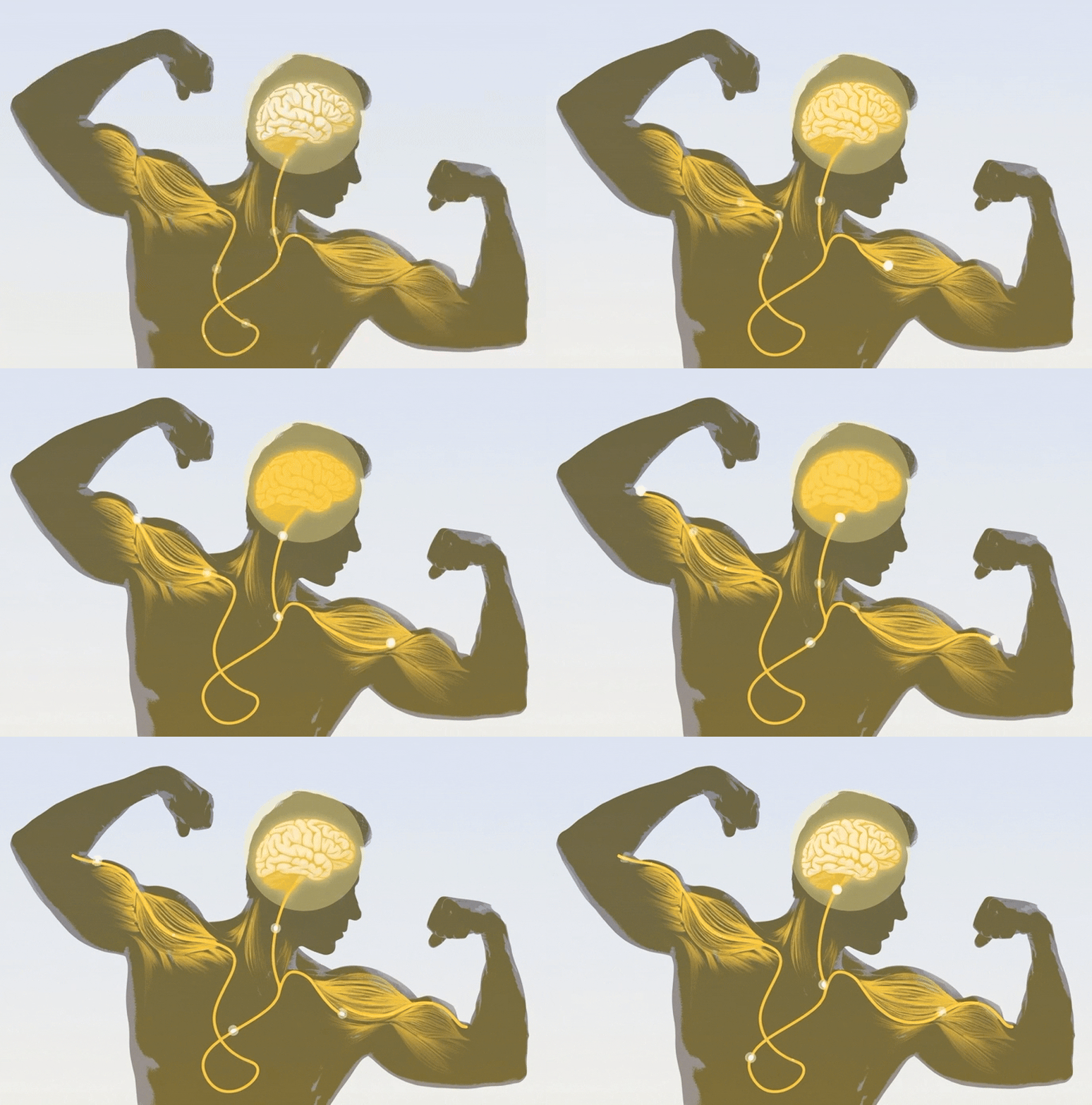
Arnold Schwarzenegger used to visualize his biceps growing “as big as mountains” before heavy lifting sessions. It wasn’t just for show. The bodybuilding legend was tapping into a now scientifically-backed phenomenon known as the “mind-muscle connection.”
The Mind Drives Initial Gains in the Gym
Studies have found that when a person begins a consistent resistance training routine, they usually see fast improvements in muscle growth and strength. These early gains come mostly from the nervous system, or the mind-muscle connection, rather than the muscles themselves.Over time, the muscles adapt to increased demand, becoming larger and stronger, and eventually the dominant contributors to growth and strength.
However, as many gym-goers have experienced, gains in growth and strength tend to plateau. Leveling off occurs because the mind and body have adapted to the current stress load, and it takes new or more intense workouts to signal the brain to begin teaching the muscles how to respond to the increased demand.
The mind-muscle connection functions much like an orchestra, Josh Schlottman, a certified strength and conditioning specialist and fitness coach, told The Epoch Times.
The brain is the conductor that directs the musicians (the muscles) when to play, how loud to play (the level of force generated), and the tempo (the speed of movement), he said.
A muscle contraction starts with an electrochemical signal sent from the brain, down the spinal cord to the motor neuron that connects to muscle fibers. The strength of the contractions is dictated by the quality and intensity of this signal, he added.
Since a strong mind-muscle connection depends on communication between the brain and muscles, people with certain injuries or health conditions, such as multiple sclerosis or stroke, may find it more challenging to tap into it.
“If the neurological connection between the brain and the muscle is damaged, then the ability to create a mind-muscle connection will be harder,” Eric Dallman, a chiropractor and certified functional strength coach, told The Epoch Times.
Psyching Up and Visualizing Boosts Strength
The practice of “psyching up,” or priming the mind before a workout, is just as important as physical preparation or technical skill. Done effectively, it can boost performance by up to 65 percent, according to a study published in the Journal of Sports Science & Medicine.Strategies to psych up for a workout include mental imagery, a technique that uses the imagination and senses to picture the planning, practice, and performance you want to achieve.

When a person is appropriately “fired up,” adrenaline and noradrenaline rise, reaction time improves, and the brain sends a stronger signal to working muscles, Dr. Rab Nawaz Khan, an internist specializing in neurology in the UK, told The Epoch Times. It also focuses attention and reduces perceived effort for a short time, allowing a person to commit fully to the movement.
“The key is the dose, too much [psyching up] can make technique sloppy and increase injury risk,” Khan said.
In addition to mental preparation, using visualization during a workout or competition can also help increase strength by activating the same brain regions and neural pathways involved in physical movement.
“Visualizing the muscle fibers contracting as you generate force and then stretching back out under control as you slow down and release significantly enhances the level of activation of the muscles involved beyond what mechanical repetition alone can achieve,” Meera Watts, a holistic yoga expert and founder and CEO of Siddhi Yoga International, told The Epoch Times.
In one example from Watts’s teaching practice, her team worked with a group of 25 students in their 200-hour certification class who were struggling to perform the crow pose, which requires significant engagement of the core muscles.
Get Stronger by Imagining Muscle Contractions
A person can build muscle strength by simply rehearsing movement in the mind without physically performing the exercise—a technique known as motor imagery.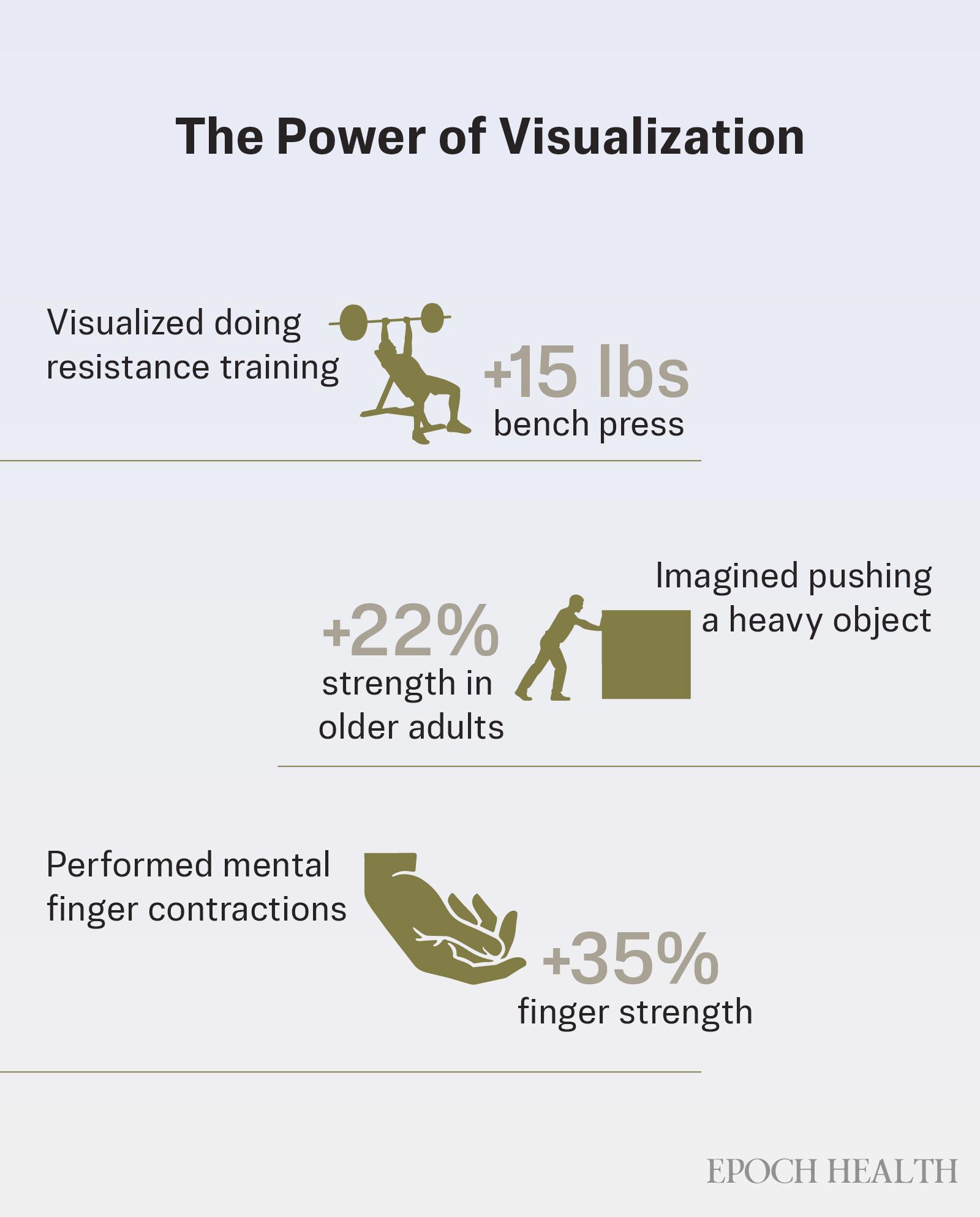
Mental rehearsal activates many of the same brain networks used for real movement, including motor planning areas and the primary motor cortex, Khan said. Repeating that activation can improve the brain’s ability to send a clean, strong signal down the motor pathway, even without muscle growth.
“In simple terms, you are practicing the wiring and timing, not building the muscle fibers. The gains are usually modest but real, especially early in training or during rehabilitation when physical loading is limited,” he added.
The brain can also transfer some of the strength gained during motor imagery training from one side of the body to the other—a phenomenon known as bilateral transfer.
How to Tap Into the Mind-Muscle Connection
Improving your mind-muscle connection involves training your nervous system to recruit more muscle fibers, activate them faster, and coordinate movements more efficiently.Having a pre-exercise routine can help the brain associate certain actions with physical activity, priming the nervous system to perform at its best. For example, a runner who feels tired before a run might suddenly feel energized just by putting on their running shoes.
During a workout, a person can use internal focus and visualization to strengthen their mind-muscle connection.
The ability to connect with and contract a certain muscle during a specific movement can help increase the output of the movement, Dallman said. “If someone can consciously connect with their quadriceps during the concentric phase of a squat, they should be able to complete the rep at a higher load.”
“You can increase the mind-muscle connection by visualizing the muscle’s behavior before and during a set,” he said.
Just like Schwarzenegger did.
- During the warm-up period, perform the movement without any weight, and focus on creating strong internal tension.
- Mentally rehearse a successful lift before approaching the weight. Clear the mind of any lingering doubts and visualize a positive result.
- While doing repetitions, imagine the muscle becoming tighter, which can force the target muscles to do most of the work, rather than the supporting muscles.
Mind Over Matter Has Its Limits
Everyone knows that working the muscles can make them stronger. Many also know that working out the body is also good for the mind. Learning how to engage the mind before and during exercise can make consistent physical movement even more effective.What's Your Reaction?
 Like
0
Like
0
 Dislike
0
Dislike
0
 Love
0
Love
0
 Funny
0
Funny
0
 Wow
0
Wow
0
 Sad
0
Sad
0
 Angry
0
Angry
0


















Comments (0)