

Xi’s Grip on China’s Military Falters Amid Sweeping Purge: Analysts


.
When the Chinese Communist Party (CCP) concluded the Fourth Plenum of its 20th Central Committee on Oct. 23, state media portrayed it as a routine policy meeting that approved the 15th Five-Year Plan. But behind the propaganda, an unprecedented purge was unfolding within China’s military leadership.
Prior to the plenum, nine military leaders, each personally promoted by CCP leader Xi Jinping, were dismissed on the same day, an extraordinary event even by the CCP’s opaque standards.
.
The personnel changes, accompanied by unusually severe political language, have led many observers to conclude that Xi’s hold on the military and the broader party apparatus is weaker than it appears.
Shockwave Through the Ranks
The expulsion of senior military leaders included top figures from the Central Military Commission (CMC), the Rocket Force, the People’s Armed Police, and the Eastern Theater Command, all of which are core players in China’s defense structure..
Since the CCP’s 20th Party Congress in 2022, 14 generals personally elevated by Xi have now been dismissed, a proportion unmatched in the Party’s modern history.
.
Ming Chu-cheng, emeritus professor of political science at National Taiwan University, said on the podcast “Democratic Taiwan Channel” that the language used in the military’s disciplinary notices with phrases such as “betrayal of loyalty” and “serious violation of the principle of Party control over the gun” is among the harshest in the CCP’s lexicon.
“The phrase ‘betrayal of loyalty’ carries far greater weight than any charge of corruption,” Ming said.
“It implies potential acts of defection, conspiracy, or at minimum, deep policy dissent, possibly over the [CCP’s] Taiwan strategy.”
.
Particularly notable were the expulsions of He Weidong and Miao Hua. Both were from a group once seen as personally loyal to Xi. Their speedy rise to power was followed by a swift fall, marking some of the shortest tenures ever for Politburo members and CMC vice chairmen.
.
According to Ming, the timing and scale of the purge were deliberate. It was a show of force meant to remind the military of absolute obedience, he said.
.
Yet, he said, the scale of the corruption and disloyalty uncovered—by some estimates encompassing nearly half of all serving generals underscores the depth of systemic rot, undermining morale and combat readiness, particularly in frontline units responsible for Taiwan.
.
Even as Xi tightened the screws on the military, the sole promotion announced at the plenum raised new questions about how far his authority truly extends.
.

Getty Images, Baidu, Namuwiki, Public Domain, CCTV
.
Promotion With Limits
Zhang Shengmin was promoted to CMC vice chairman. Zhang, a career disciplinary official who previously headed the military’s anti-corruption apparatus, rose rapidly through the ranks. Yet, in a striking departure from Party norms, he did not receive the customary seat on the CCP’s powerful Politburo..
China current affairs commentator Zhang Tianliang said on his podcast, “Tianliang Times,” that the move is a sign of deliberate constraint.
.
“By [the CCP’s] tradition, every vice chairman of the CMC is also a member of the Politburo, enjoying deputy national-level rank,” Zhang said.
.
“Although Zhang Shengmin was promoted, his power has been clearly constrained. This represents a deliberate effort to restrain and balance the influence of the ‘iron-fisted enforcers’ who carry out the regime’s dirty work, preventing their authority from expanding beyond control.”
.
In his view, Xi’s decision to promote a hardline enforcer like Zhang Shengmin while withholding full political elevation reveals both his need for a loyal watchdog and his fear of overmighty servants. He said that the arrangement is designed to divide authority within the CMC and ensure that no single general can dominate the armed forces.
Is Xi Losing Military Control?
U.S.-based physician and China current affairs commentator Tang Jingyuan offered his observation of the reshuffle. In his podcast program “JingYuan Talk,” he observed that Zhang Shengmin’s concurrent roles as CMC vice chairman, secretary of the CMC’s Commission for Discipline Inspection, and his roles in the Political Work Department give him control over both disciplinary oversight and personnel, the two most sensitive levers of military power..
“[This] creates a de facto power bloc,” Tang said. “After the plenum, the CMC’s leadership, excluding Xi Jinping himself, consisted of three generals—Zhang Youxia, Zhang Shengmin, and Liu Zhenli. None of the three is considered Xi’s core loyalist. Some even believe they may have fallen out with him.”
.
Even more significant, Tang noted, is Zhang Shengmin’s exclusion from the Politburo, a near-unprecedented break from the Party’s unwritten principle that “the Party commands the gun.” The absence of a Politburo seat could signal reduced direct intervention by Xi’s faction, potentially granting the new vice chairman greater autonomy and hinting at an erosion of control at the top of the military.
.
He also pointed out that the current CMC, composed of only four members, is the smallest in CCP history, a possible indication that the purge is still incomplete.
.
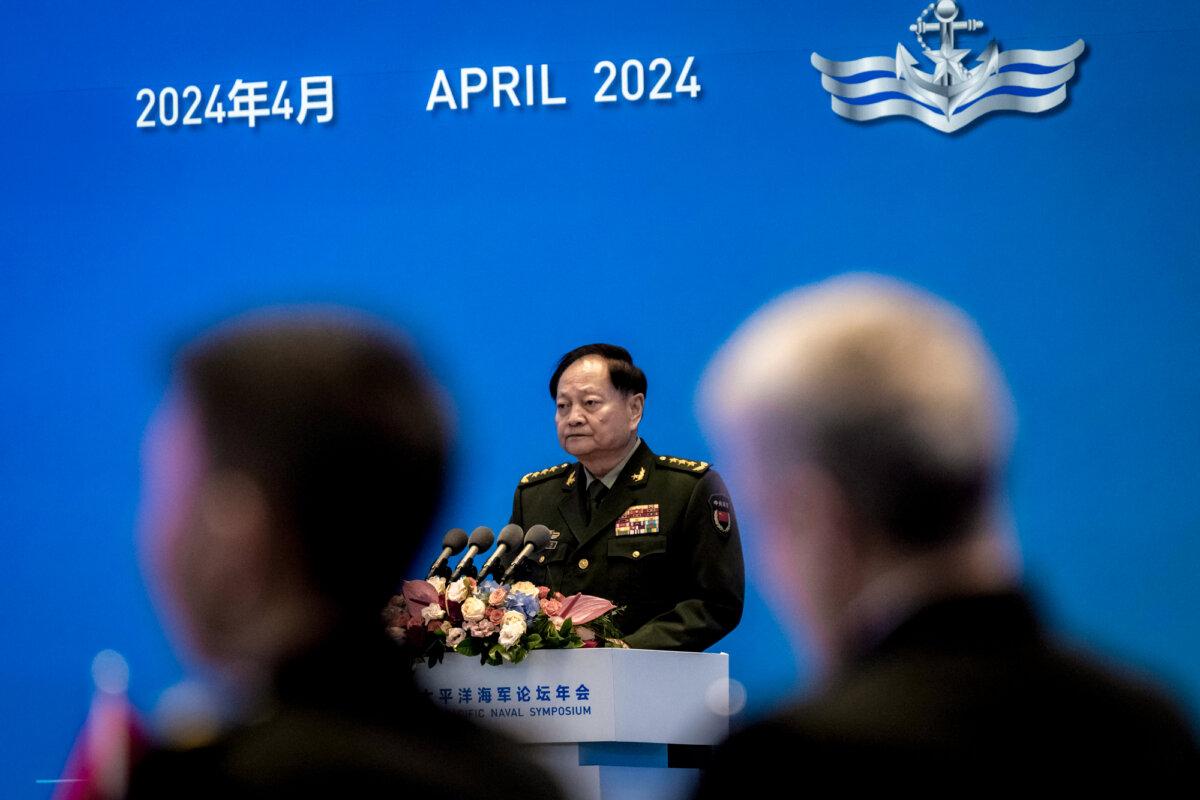
Gen. Zhang Youxia, vice chairman of the Central Military Commission, speaks at the opening of the Western Pacific Naval Symposium in Qingdao, China, on April 22, 2024. Zhang and Xi Jinping have diverged on significant policy issues in recent years, according to insiders. Kevin Frayer/Getty Images
.
Leadership in Limbo
Other analysts see the turbulence not merely as factional maneuvering but as a symptom of a deeper institutional breakdown..
Chen Pokong, a U.S.-based Chinese political commentator, described the fourth plenum as a meeting held under “semi-paralyzed” conditions. He noted in his livestream on YouTube that the closing session, traditionally held at Beijing’s Jingxi Hotel, was abruptly moved to the Great Hall of the People, a change reminiscent of the emergency relocation during the 2019 plenum, when a Central Committee member allegedly died by suicide.
.
According to Chen, such irregularities suggest that the CCP’s upper echelons of power are in turmoil.
“Only one person, Zhang Shengmin, was promoted, while numerous vacancies on the Politburo and Central Committee remain unfilled,” he said. “Roughly 20 percent of Central Committee seats are empty, a level of dysfunction unseen since the ‘reform and opening up’ era began [in the late 1970s].”
.
In addition, the attendance rate, 168 out of 205 Central Committee members, was the lowest in nearly half a century. Many absentees are believed to be under investigation but not yet publicly disciplined. Chen argues that this reflects both the breadth of the current purge and growing resistance to Xi’s personnel decisions.
“Xi’s ability to dictate appointments has eroded,” he said. “The leadership is fractured, and his authority is no longer absolute.”
Eroding Foundations
Canadian Chinese independent analyst Terence Shen said on his podcast “Mr. Shen” that the deeper significance of the plenum lies not in its personnel decisions but in what is revealed about the Party’s governing logic.“Xi’s focus has shifted from eliminating political rivals to purging those he deems incompetent or insufficiently obedient,” he said.
.
Shen said that the CCP’s mid-level and local cadres, once the engines of policy execution, are now demoralized and distrustful of the Xi regime’s repeated purges at all levels of government. In his view, Xi has prioritized loyalty as the main criterion for personnel decisions.
“The constant purges have created a culture of fear and paralysis, reminiscent of Mao’s Cultural Revolution,” Shen said.
.
Although the plenum’s communiqué reaffirmed the Party’s commitment to economic development, Shen believes this rhetoric merely masks an overriding obsession with “stability maintenance” to keep the CCP in power.
Taken together, the sweeping military purge, the constrained promotion of Zhang Shengmin, and the internal power struggles within the CCP all point to a leadership under strain, according to the analysts.
.
Li Jing contributed to this report.
.
What's Your Reaction?
 Like
0
Like
0
 Dislike
0
Dislike
0
 Love
0
Love
0
 Funny
0
Funny
0
 Wow
0
Wow
0
 Sad
0
Sad
0
 Angry
0
Angry
0













Comments (0)