

Xi Elevates Anniversary for Pro-Democratic Chinese Official Amid Rising Elite Friction


.
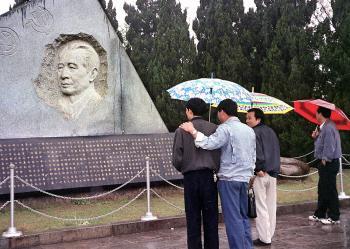
The Chinese Communist Party (CCP) held an unusually high-profile ceremony this week to mark the 110th anniversary of the birth of Hu Yaobang, a former leader whose legacy involved embracing pro-democratic reforms, which eventually led to the 1989 Tiananmen Square pro-democracy protests.
Xi Breaks With Precedent
On Nov. 20, the CCP held a commemorative symposium for Hu at the Great Hall of the People in Beijing. Xi personally attended and delivered remarks praising Hu for extraordinary contributions in advancing China’s modernization.This was a notable shift from the past. Previous anniversaries of Hu’s birth and death had been deliberately low-key due to Hu’s embrace of political reform in the 1980s.
Hu’s death in April 1989 triggered student marches on Tiananmen Square, which eventually led to mass pro-democracy protests and the Tiananmen Square Massacre on June 4 that year. The student protesters viewed Hu as a reformist and called for his legacy to be honored in a push for comprehensive democratic reforms, which led to the brutal crackdown from Deng Xiaoping’s faction that favored maintaining the CCP’s totalitarian rule. This made Hu’s legacy particularly sensitive in public discourse in China.
Xi’s speech sidestepped several politically sensitive elements of Hu’s career, including Hu’s resistance to the 1983 “campaign against spiritual pollution,” his advocacy for separating the Party and government, his push to abolish lifetime tenure for senior officials, and the connection between his death and the Tiananmen Square protests that followed.
U.S.-based China current affairs commentator Tang Jingyuan noted that the CCP traditionally commemorates 10-year anniversaries as routine. “Yet, this was treated as if it were a 50-year commemoration,” he said.
Why Elevate Hu Now?
Australia-based Chinese dissident and legal scholar Yuan Hongbing told The Epoch Times that Xi’s unusually prominent tribute was driven by immediate political needs.According to Yuan, Xi faces pressure from two main groups: the elite families linked to former leaders Deng Xiaoping and Jiang Zemin, who want to restore a more market-oriented, quasi-oligarchic system, and the intellectuals who view Hu Yaobang as a symbol of political openness.
.
Attendance by ‘Red Elite Families’
Chinese state media reported that Hu’s relatives and family representatives attended the meeting, which was significant because Hu’s family was often monitored or restricted in the past years.Television footage showed Hu’s son, Hu Deping, seated in the third row with a visibly tense expression. Liu Yuan, the son of former state president Liu Shaoqi, appeared in military uniform with a stern demeanor. Xi’s brother, Xi Yuanping, also attended.
These visuals quickly drew public attention to the fraught relationship between Xi and the “red second generation,” which are the descendants of the Party’s founders and former elites.
Yuan said the tension between Xi and the red elite families plays out on two interconnected levels. The first involves political direction. Within the red elite, some figures believe the Party should maintain one-party rule while returning to the more market-oriented economic path of the Deng Xiaoping era during the 1980s, which they see as crucial for China’s stability and growth. Others advocate for gradual political reform, a position that directly conflicts with Xi’s increasingly hardline approach to stay in power.
In other words, Xi is using the anniversary of Hu’s birthday to embrace the economic liberalization from the 1980s, although the move may be purely symbolic.
The second level concerns the distribution of power. Yuan argued that Xi aims to consolidate power in a manner reminiscent of former CCP dictator Mao Zedong, leaving little room for other influential political families to retain or share power. This drive for total control, he said, has put Xi at odds with a significant portion of the red elite, many of whom now find themselves in deep conflict with the current leadership.
The History Behind the Sensitivity
Hu Yaobang’s political downfall and death were inseparable from the events of 1989.In late 1986, college students across China launched demonstrations calling for political reform and protesting corruption. The movement soon spread to campuses in Beijing and Shanghai. CCP hardliner Deng Xiaoping blamed Hu for allowing “bourgeois liberalization” to flourish.
In January 1987, Hu reportedly endured days of harsh criticism in the Party’s internal meetings and was accused of major wrongdoings. He was forced to resign as general secretary that month. Yet, he was viewed as a reformist at the time.
When Hu died suddenly of a heart attack in April 1989, students at China’s top universities posted wall posters mourning him. The mourning quickly evolved into mass protests, leading to the brutal military crackdown on June 4. Zhao Ziyang, who succeeded Hu, was purged for refusing to support the use of force and spent the rest of his life under house arrest.
The sensitive background of Hu led to the CCP limiting discussions surrounding his legacy, with his reformist policies being nearly wiped out from public discourse in China.
.

Official Tributes vs. Public Memory
Yuan argued that Beijing’s official tribute to Hu has little to do with Hu’s pro-reform legacy. Instead, Xi’s commemoration simply serves his political goals, which are to relieve internal pressure and stabilize elite politics.“Public commemorations of Hu Yaobang are motivated by a pursuit of freedom and democracy, whereas the official commemorations directed by Xi Jinping are, in fact, part of his political scheme,” he said.
Yuan believes that Xi is unwilling to give up his iron grip on power, nor can he alter the country’s current totalitarian rule. “As for the idea that Xi might reverse course or shift China’s political direction, that is pure nonsense,” he said.
What's Your Reaction?
 Like
0
Like
0
 Dislike
0
Dislike
0
 Love
0
Love
0
 Funny
0
Funny
0
 Wow
0
Wow
0
 Sad
0
Sad
0
 Angry
0
Angry
0












Comments (0)