

US Tightening Shipments to Chip Factories in China Will Slow Beijing’s Advances, Analysts Say


.
Washington is closing a loophole that let a handful of foreign-owned chipmakers ship most U.S.-origin tools, software, and technology into their China fabrication plants without licenses—a fast-track privilege no U.S.-owned fab ever had.
Analysts say the move could slow advancement in Chinese fabs and further inflame the U.S.–China tech rivalry. As Beijing applies “case-by-case” screening over rare-earth exports, they say, Washington will now apply the same logic to chip tools bound for China.
Under the change, former VEU participants must obtain licenses for every shipment of U.S.-origin equipment and technology to their China fabs. BIS says it will prioritize approvals needed to keep existing lines running but is unlikely to approve applications tied to capacity expansion or technology upgrades in China.
Taiwanese economist and TV commentator Edward Huang called it a reset of the rules.
“[Foreign fabs operating in China] are being forced off a highway and onto a narrow dirt path,” he told The Epoch Times on Sept. 4.
He said Washington’s target remains cutting China off from sub-14-nanometer manufacturing—“not the absolute cutting edge, but strategically important.”
In chips, smaller process nodes mean higher performance and lower power use, which are critical for advanced computing and AI. China can reliably produce mature-node chips around 14 nm and above; cutting-edge 7 nm and below remain out of reach.
Huang said the new licensing regime aims to preserve that gap by restricting the tools and know-how required to move beyond mature nodes.
Routing around the rules will be difficult, he added, because “core suppliers of semiconductor components are highly concentrated in the U.S. Many products that look like they come from other countries still incorporate U.S. technology.”
He also framed the move as counter-leverage against Beijing’s weaponization of rare-earth exports.
Advanced chipmaking, he noted, depends not only on equipment but on a culture of rigorous research, steady innovation, and disciplined execution.
China’s industry has long leaned on reverse engineering and adoption rather than fundamental breakthroughs—an approach that limits the homegrown innovation needed at the leading edge, he added.
.
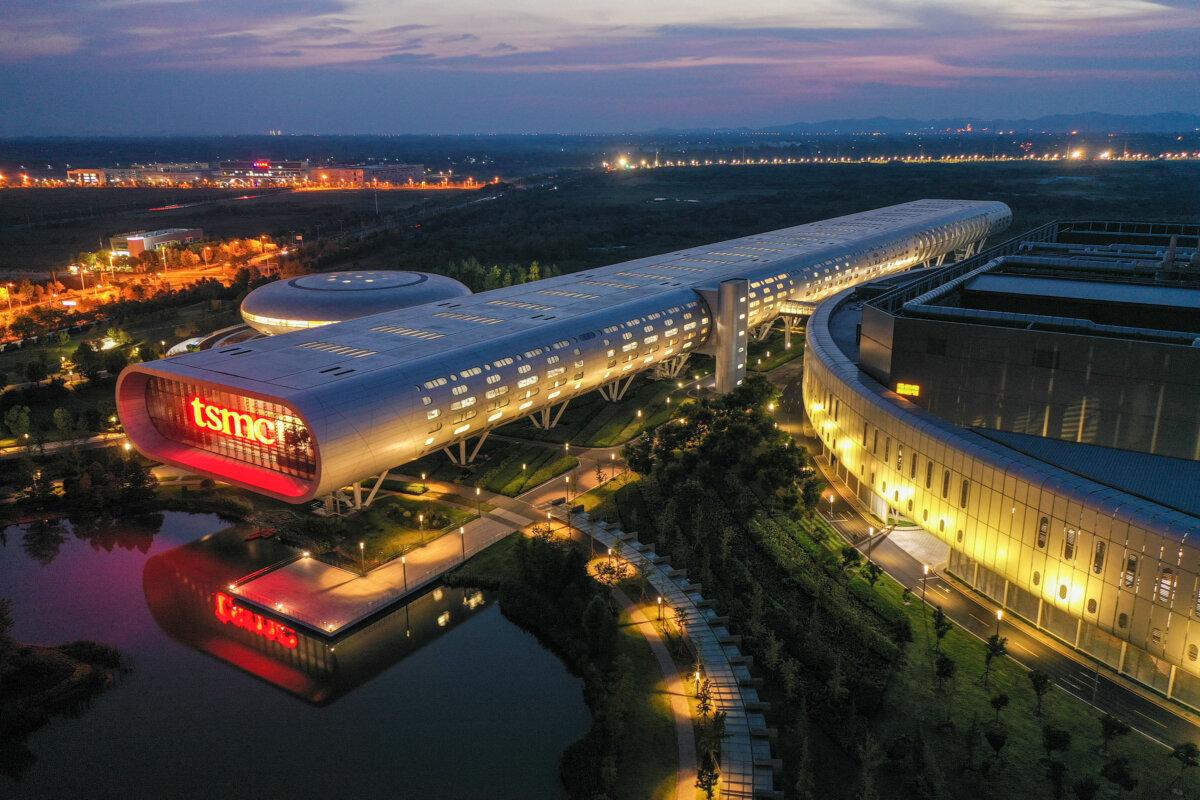
Impact on TSMC, Samsung, and SK Hynix
For TSMC’s fab in China, the hit is real but contained, according to Sun Kuo-hsiang, professor of international affairs and business at Taiwan’s Nanhua University.“After the VEU revocation, every U.S.-controlled tool, part, and chemical at TSMC’s Nanjing plant will require separate export approval,” he told The Epoch Times. “This could slow equipment maintenance, upgrades, and expansion significantly, while raising overall supply chain costs.”
The Nanjing fab mainly produces at 16/12 nm and 28/22 nm nodes—“not the most advanced, but essential for auto chips, telecom components, and consumer system-on-chips, with solid commercial demand,” Sun said.
Losing VEU will squeeze expansion timing, upgrade speed, and operational predictability, he added.
For now, the Nanjing site is the only TSMC facility in China subject to BIS controls and accounts for about 3 percent of TSMC’s global capacity, making the direct impact relatively limited, Taiwan’s Minister of Economic Affairs (MOEA) said on Sept. 3.
Possible Next Moves
Huang linked the VEU decision to the upcoming Section 232 investigation into semiconductors.“It’s a preemptive move,” Huang said. “A 232 probe could lead to tariffs, with differentiated rates by country and product.”
He suggested the Trump administration may reprise its Nvidia approach: “Impose a 15 to 20 percent ‘security fee’ on chips going to China, then use it as a bargaining chip in broader U.S.–China negotiations.”
From the factory floor, the risk is more immediate, Sun said.
If case-by-case licensing slides into routine denials, he said, companies may struggle to obtain spare parts for critical maintenance, undermining yields and delivery reliability.
“When compliance costs outweigh the benefits of staying,” Sun said, “rational withdrawal will become the only choice.”
He added that such exits may not be what Washington wants: The U.S. aim appears to be freezing China’s leading-edge progress while keeping some commercial engagement that maintains Chinese reliance on foreign chipmakers.
What's Your Reaction?
 Like
0
Like
0
 Dislike
0
Dislike
0
 Love
0
Love
0
 Funny
0
Funny
0
 Wow
0
Wow
0
 Sad
0
Sad
0
 Angry
0
Angry
0
















Comments (0)