.
After years of stalled trade since the COVID-19 pandemic, U.S. officials on a rare visit to Beijing said a deal being negotiated could see China commit to purchasing more Boeing jets.
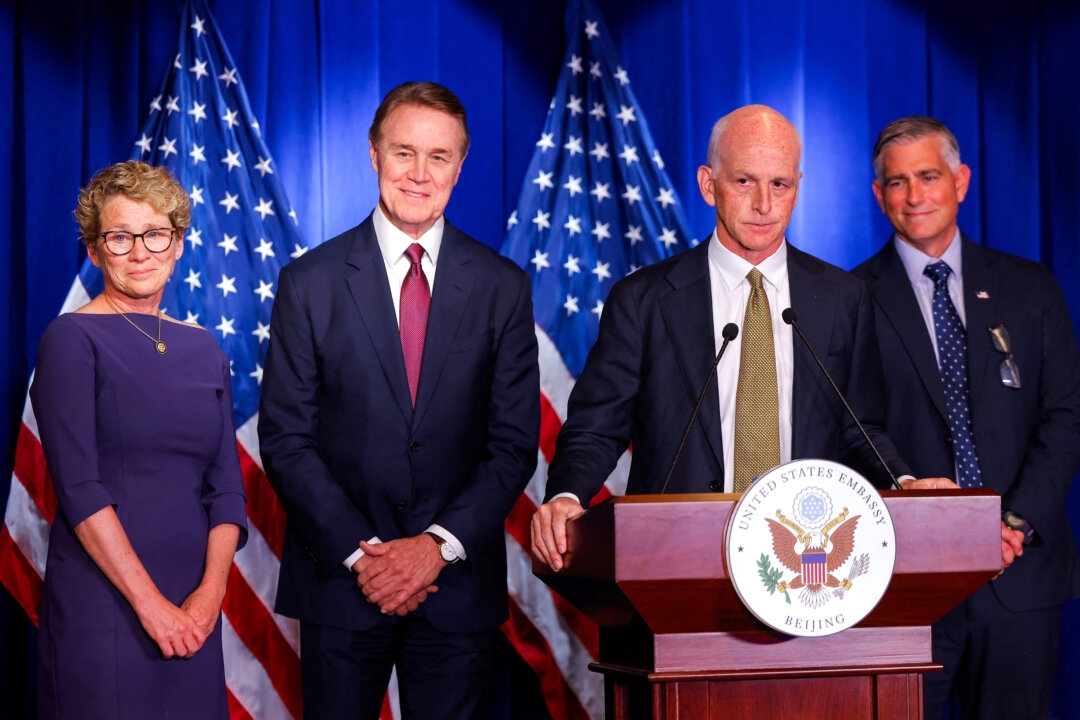
Speaking at a press conference on Tuesday, U.S. Ambassador to China David Purdue said he believed the negotiations had entered their last days or weeks, adding that the deal is “very important” to President Donald Trump and Boeing.
“I think it’s very important to China,” he added. “I think that we’re in the last days of that, weeks of that negotiation, and we’re hopeful that will turn out to be the case.”
Rep. Adam Smith (D-Wash.), ranking member of the Armed Services Committee that oversees the U.S. Defense Department and armed forces, said that China’s deal with Boeing had come up in discussions with Beijing.
China had, during the first Trump administration in 2017, agreed to purchase 300 Boeing jets for $37 billion under a U.S.–China trade deal signed during a Trump visit. But it was also only partially fulfilled amid growing trade tensions with Trump’s first round of China
tariffs in March 2018, which were followed by the grounding of Boeing 737 MAXs in response to two fatal crashes in October 2018 and March 2019, and a further souring of relations due to the pandemic that disrupted jet deliveries to Chinese airlines thereafter.
China also had turned to Boeing’s European competitor
Airbus to order more jets, while touting its own progress with
production of its own passenger jet, the widebody C939 airliner by the state-backed Commercial Aircraft Corporation of China (Comac).
A new deal with Beijing could see China recommit to buying more Boeing jets.
“It’s been a while since Boeing airplanes have been sold here in China. We’d like to get that deal done,” Smith said. “It’s good company, good product. Hope to get back to them selling airplanes to China.”
Need for ‘Lines of Communication’
Smith added that the U.S. priority during the Beijing visit was to reestablish communications with Beijing in order to
avoid unnecessary military escalation.
“It is absolutely the case that we have disagreements but everybody has disagreements,” Smith said of the U.S.-China relationship. “You have to set up mechanisms for being able to talk about those disagreements and resolve them in the most reasonable way possible. And I feel strongly that there has not been enough communication between leaders in the U.S. and leaders in China.
“We want to work to fix that problem to open up the lines of communication and begin that dialogue,” he added.
Purdue said: “Our purpose this week is to open the dialogue between the great country of China and the great country of the United States. One of the problems we’ve had is after COVID, we have not had a lot of interaction. And so this week is a great opportunity for us to open those doors and channels of communication.”
The visit, which began Sept. 21, consisted of a
bipartisan delegation that also included Reps. Chrissy Houlahan (D-Pa.), Michael Baumgartner (R-Wash.), Ro Khanna (D-Calif.). It marks the first House of Representatives delegation to China since the coronavirus pandemic started in 2019, which saw U.S.–China relations deteriorate further due to the ruling Chinese Communist Party’s lack of cooperation and transparency to minimize damage from the deadly outbreak that started in Wuhan.
.
The lawmakers met China’s second-ranking official Li Qiang on Sunday, with the country’s economy tsar He Lifeng and Defense Minister Dong Jun on Monday, and foreign minister Wang Yi on
Tuesday, raising the need for more military dialogue and action to curb the flow of fentanyl precursors to the United States.
Boeing is one of the largest U.S. exporters and has historically sent around a quarter of its planes to China.
Purdue said he visited Boeing’s plant in Tianjin last week, a city 95 miles southeast of the Chinese capital.
Trade Talks Continue
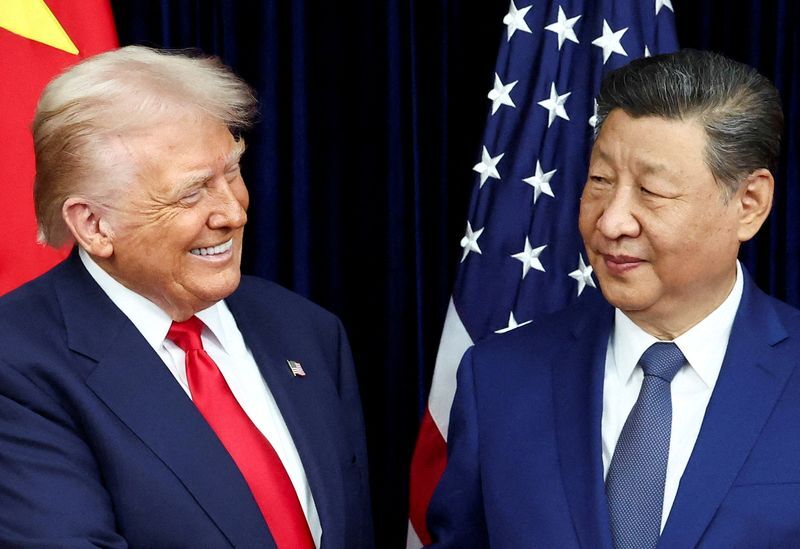
Trump on Sept. 19 had a
call with Chinese leader Xi Jinping as the two nations look to address
trade tensions following Trump’s April announcement of tariffs on U.S. trading partners.
Since then, the U.S. tariff on China has reduced from 145 percent to an average of 51.1 percent. At the time of the higher tariff rate, Trump
said that China had reneged on a deal to receive its orders of Boeing planes.
.
“Boeing should default China for not taking the beautifully finished planes that China committed to purchase,” the president
said in a post on Truth Social in April. “This is just a small example of what China has done to the USA, for
years. … And, by the way, Fentanyl continues to pour into our Country from China, through Mexico and Canada, killing hundreds of thousands of our people, and it better stop, now!”
.
Trump’s predecessor President Joe Biden also attempted to secure an aircraft order with Xi at the San Francisco
summit in 2023, but that ended without a formal deal.
Boeing stock rose 2 percent on Tuesday on news of an
$8.5 billion deal with Uzbekistan Airways to purchase more planes, and the potential deals with China as well as Turkey. Shares have fallen nearly 8 percent this month after a five-month rally since April. They remain up 25.8 percent since the start of the year.
.
Reuters contributed to this report.
.