

Trump’s Call for a Hormuz Escort Tests the CCP and Gives Taiwan an Opportunity: Analysts

.
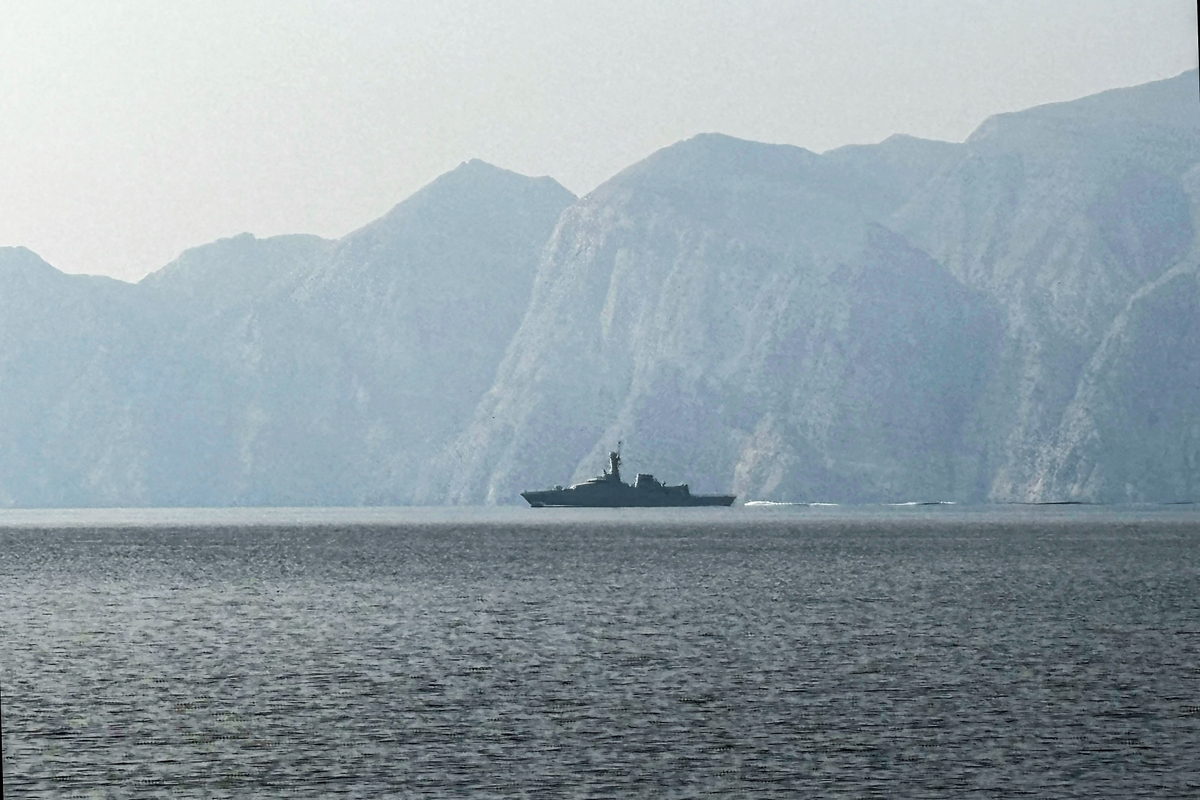
As the Iran war puts shipping in the Strait of Hormuz near a complete halt, President Donald Trump has called on countries to join a naval escort to reopen the crucial passage. The Chinese communist regime’s response exposes its true intent, while Taiwan has an opportunity to better position itself on the international stage, according to analysts.
About 20 percent of the world’s oil supply and 20 percent of its supply of liquefied natural gas pass through the Strait of Hormuz. Iran’s disruption of shipping in the waterway has a serious impact on global energy supplies, especially in Asian countries.
According to public data, China accounts for 37 percent of the crude oil transported through the strait, followed by India at 14.7 percent, South Korea at 12 percent, and Japan at 10.9 percent. Approximately 70 percent of Taiwan’s crude oil imports and 38 percent of its natural gas supply transit the waterway.
China has immense interests in the strait. More than half of its crude oil originates from the Middle East—approximately 45 percent of which must pass through Hormuz—while roughly 30 percent of its liquefied natural gas imports go through the strait.
On March 14, Trump called upon countries to join an escort to help reopen the key waterway.
“The Countries of the World that receive Oil through the Hormuz Strait must take care of that passage, and we will help — A LOT!“ Trump wrote in a Truth Social post. ”The U.S. will also coordinate with those Countries so that everything goes quickly, smoothly, and well.” He specifically mentioned that he hoped China, France, Japan, South Korea, the UK, and others would send ships to the area.
On March 16, China’s Foreign Ministry spokesperson Lin Jian said that China once again “calls upon all parties to immediately cease military operations.”
Trump has since postponed his visit to China originally scheduled for late March, citing the war in Iran as the reason.
China’s Role
Regarding the postponement of Trump’s visit to China, retired Taiwanese Maj. Gen. Yu Tsung-chi, an adviser to the Formosa Republican Association, told The Epoch Times that the core reason for the delay is closely linked to security issues in the Strait of Hormuz. Of the U.S. request that Beijing send warships to join the escort, he said China “appears to have no willingness” to do so.Fang Wei, a U.S.-based senior journalist, told The Epoch Times that the United States believes that since China also benefits from the maintenance of navigation rights in the Strait of Hormuz, it’s obligated to participate in the naval escort. If the ruling Chinese Communist Party (CCP) fails to take action, Fang said, “it would demonstrate that the CCP is, in reality, in league with Iran.”
“President Trump would likely reason that given the CCP is siding with an adversary of the United States, the United States would subsequently have ample justification to deal with the CCP after defeating Iran or securing control of the Strait of Hormuz,” he said.
Sheng Xue, a Canada-based writer and activist, told The Epoch Times that Iran is a sphere of influence that the CCP has cultivated for many years. “Were the CCP to dispatch troops to provide escorts, it would amount to an indirect acknowledgment of the legitimacy of U.S. and Israeli military actions, and would effectively mean a complete rupture in relations with the Iranian regime,” she said.
.
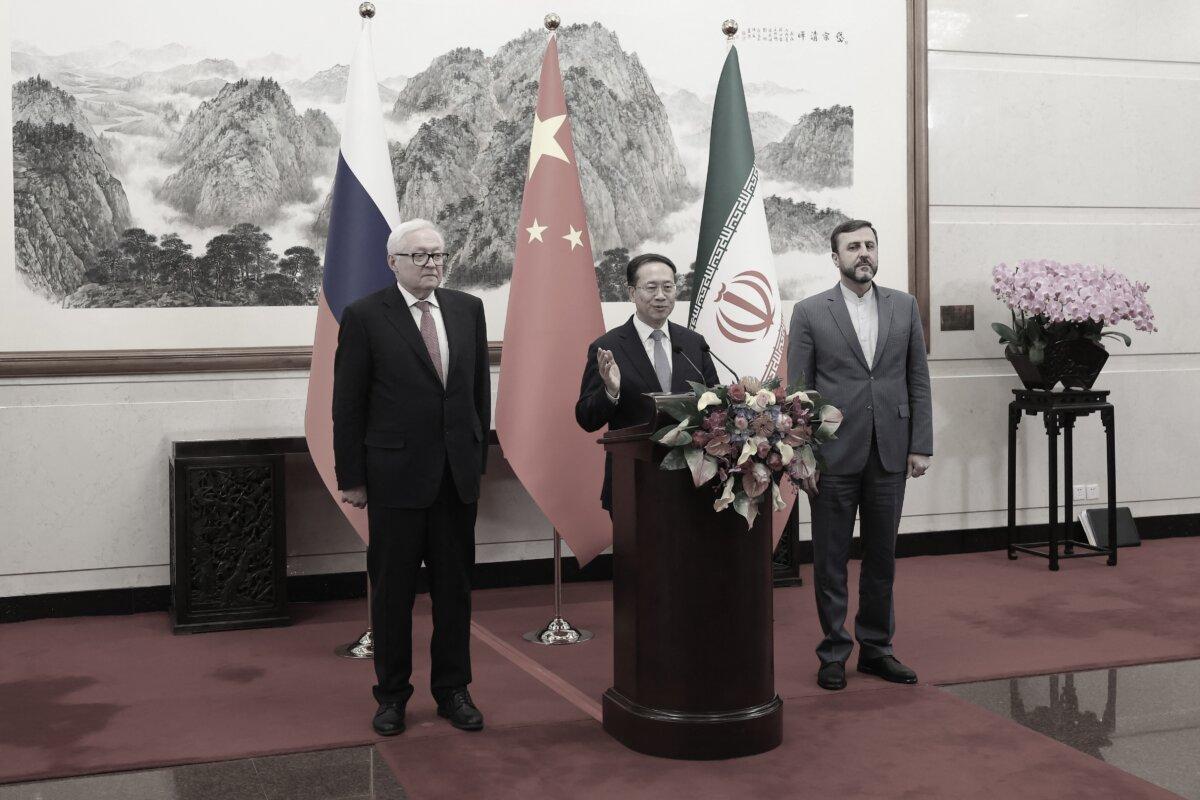
(L-R) Russia's Deputy Foreign Minister Sergei Ryabkov, China's Executive Vice Minister of Foreign Affairs Ma Zhaoxu, and Iran's Deputy Foreign Minister Kazem Gharibabadi hold a press conference in Beijing on March 14, 2025. Lintao Zhang/Pool/AFP via Getty Images
.
Opportunity for Taiwan
Taiwan’s dependence on imports passing through the strait renders it significantly vulnerable.Since the U.S. war on Iran started, the Chinese regime had halted its almost daily military aircraft and warship activities around the self-ruled island nation, formally known as the Republic of China. But Beijing has restarted its air force and naval activities to intimidate Taiwan in recent days.
Despite the war, U.S. Deputy Assistant Secretary of State for Political-Military Affairs Stanley L. Brown reaffirmed on March 18 that arms sales to Taiwan remain unchanged, and that U.S. policy toward Taiwan has not shifted.
.
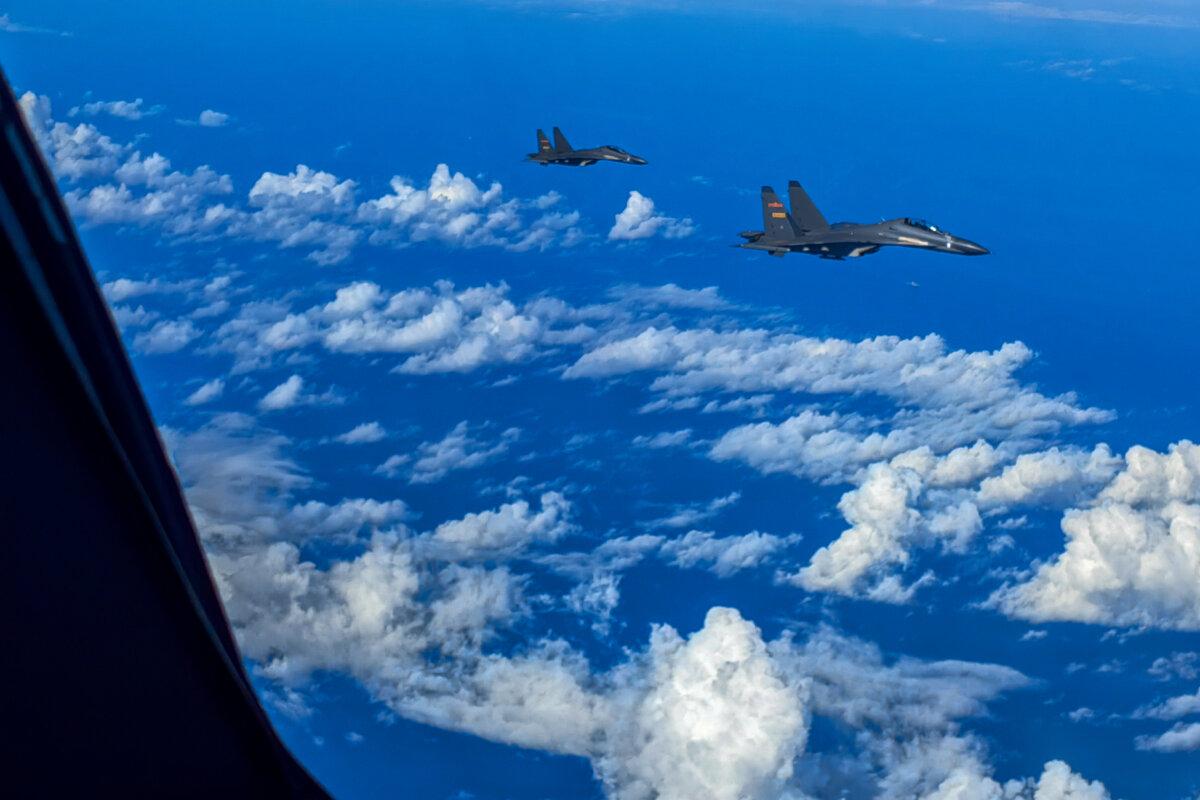
Fighter jets of the Eastern Theater Command of the Chinese People's Liberation Army (PLA) conduct joint combat training exercises around Taiwan on Aug. 7, 2022. Gong Yulong/Xinhua via AP
.
Akio Yaita, a former senior Japanese journalist based in Taiwan and executive director of the Indo-Pacific Strategy Think Tank, suggested in a Facebook post that Taiwan could respond to Trump’s call by expressing its willingness to participate within its capabilities—a move designed to strike a balance between risk management and the enhancement of its international role, which has high value.
He wrote that given Taiwan’s current naval capabilities, it could—in theory—execute escort missions in the strait, adding that “the Republic of China’s navy has prior experience with long-range training exercises and extended-duration deployments.”
He pointed out that “simply making one clear statement is enough” to demonstrate support for the United States, secure Taiwan’s own interests, and elevate its international standing.
Hu Chen-tung, former general manager of Raytheon in Taiwan, told The Epoch Times that Taiwan should actively demonstrate strategic support. “Even if such support is merely a political gesture, it would still help deepen its security relationship with the United States.”
He added that “as long as Taiwan can proactively express its willingness to cooperate, I believe that is sufficient.”
What's Your Reaction?
 Like
0
Like
0
 Dislike
0
Dislike
0
 Love
0
Love
0
 Funny
0
Funny
0
 Wow
0
Wow
0
 Sad
0
Sad
0
 Angry
0
Angry
0












Comments (0)