

The Return of Taiwan: How Beijing’s Collapsing Influence Opens the Door to Taipei


.
Taiwan could be poised to benefit from the declining fortunes of the People’s Republic of China (PRC) to conceivably begin expanding once again the number of nations with which it has diplomatic relations.
Panama may be first on the list, but others in Oceania, Africa, and Latin America could follow.
Panama had long been a diplomatic partner of the Republic of China—Taiwan’s official name—and the PRC had worked assiduously to undermine this relationship, succeeding in 2017. Subsequent PRC influence over the Panama Canal’s operations was seen as deeply threatening to U.S. maritime and naval strategic interests, as well as spearheading Beijing’s influence campaign to bring the Americas south of the United States under greater PRC influence.
U.S. President Donald Trump campaigned strongly during the 2024 presidential election on the basis that the United States needed to restore its influence over the Americas, particularly over the Panama Canal, which had once been part of U.S. territory. He took office for the second time on Jan. 20, 2025.
U.S. Secretary of State Marco Rubio was sworn into office on Jan. 21, 2025, and, by Jan. 31, 2025, had embarked on a visit to El Salvador, Guatemala, Costa Rica, Panama, and the Dominican Republic. Of these, Guatemala still has diplomatic relations with Taiwan, and Costa Rica, El Salvador, and Panama had only recently—in the 21st century—switched from Taiwan to the PRC.
Just more than a year after the Trump–Rubio initial thrust into the Americas, the Panamanian Supreme Court, on Feb. 23, 2026, struck down the constitutionality of the lease of two key terminal ports on the Panama Canal to the Hong Kong company CK Hutchison. This was a blow at the heart of Beijing’s operations in the Americas and opened the unexpected opportunity for the government of the Republic of China to quietly restore its relationship with Panama.
The Chinese Communist Party (CCP) in Beijing reacted with hostility to the move.
A complete rupture of Panama’s diplomatic relations with the PRC may be difficult in the short term, but the door is now wide open for Taipei to begin the process of establishing an open relationship with the Panamanian government, building toward the time when it can restore full relations at Beijing’s expense.
Then-Panamanian President Juan Carlos Varela declared on June 13, 2017, that his country would break its historical diplomatic ties with the Republic of China in favor of establishing links with the PRC. That move came at a time when CK Hutchison, a company controlled by Hong Kong entrepreneur Li Ka-shing, already held the concession to operate the Pacific and Atlantic terminuses of the Panama Canal—Balboa and Cristóbal—under a 25-year contract originally granted in 1997. The concession was later extended for another 25 years in 2021.
Hutchison was trying to maintain its position in Panama amid growing scrutiny, despite having agreed in March 2025 to sell its Panama concessions and other port operations to a consortium led by U.S. financial giant BlackRock, following pressure that intensified after Trump’s election in November 2024.
.
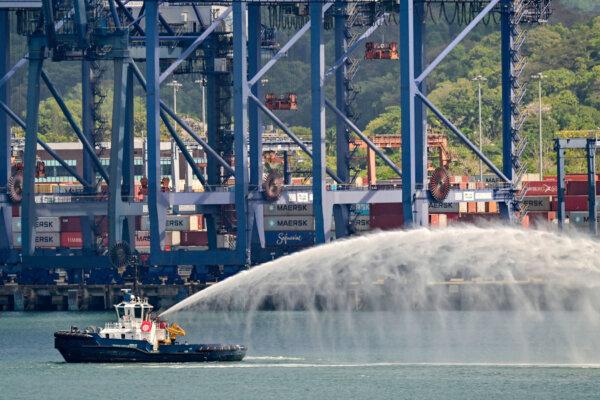
A tug boat sprays water at the port of Balboa in Panama City on Feb. 12, 2026. Hong Kong-based conglomerate CK Hutchison warned on Feb. 12 of possible legal action against Danish firm Maersk and others over the annulment of its contract to operate two ports on the Panama Canal. Martin Bernetti/AFP via Getty Images
.
The Feb. 23, 2026, move by the Supreme Court—followed by orders from the current President José Raúl Mulino for the ports at the Pacific and Atlantic terminal points of the Panama Canal, at Balboa (Pacific) and Cristóbal (Atlantic), to be immediately seized and placed under temporary control of the Panama Maritime Authority (AMP)—essentially slapped Beijing in the face. Panama–PRC diplomatic relations were now in their worst situation since before Varela’s termination of diplomatic relations with Taiwan.
Varela, a former businessman, was pursued after his presidential term over corruption allegations.
The new moves by the Panamanian government and Supreme Court, at their essence, ended the deal initially organized by BlackRock, but put together the elements of it without having to pay Hutchison for the acquisition of the ports. The Panamanian government confirmed that the temporary seizure of the ports would not entail the loss to Hutchison of its equipment at the ports; this would either be returned to the Hong Kong company or Hutchison would be reimbursed for it.
Shortly after seizing back the ports, the Panamanian Port Authority selected Maersk’s APM Terminals to operate the Balboa port for the next 18 months, and Terminal Investment, part of the Swiss-Italian Mediterranean Shipping Co. (MSC), to operate the Cristóbal port. The Panamanian government said that it would never again allow the canal and Panamanian sovereignty to be compromised by a foreign government.
All of that is detail, but it highlights the trend away from PRC influence in the Americas, largely as a result of Trump’s initiatives, including the U.S. containment of Venezuela and the police action to seize Venezuelan leader Nicolás Maduro and extradite him forcibly to face narco-trafficking charges in a New York courtroom. It can be construed that the more the PRC’s star fades in the Americas—and, for that matter, Africa—the greater the opportunities are for Taiwan to rise in access and influence.
The fact that the PRC has used coercive and barely disguised schemes to threaten foreign leaders who have allowed the Shen Yun dance group—widely seen to be anti-communist in its message of traditional Chinese culture—to perform in their countries highlights the fact that Beijing is on the defensive strategically.
Within the Americas, apart from the smaller states that have recognized the Republic of China, there is a strong opportunity for Taipei to improve its ties with Argentina, where President Javier Milei has strenuously rejected Beijing’s influence.
It is not that Taiwan, with a population under 30 million, can expect to “replace” the PRC, with a population vastly larger than that of Taiwan, as much as it is the case that the PRC is being widely perceived as in terminal decline and of little strategic benefit to many of the states that traded with Beijing in recent decades.
Significantly and conversely, the PRC never controlled Taiwan.
The scope of the challenge to the presidency and the Ministry of Foreign Affairs of Taiwan—the Republic of China—to capitalize on the rapidly contracting influence of Beijing worldwide is possibly beyond Taipei’s immediate resources. But it can also be said that a better opportunity has never been presented to Taiwan since it was removed as a member of the United Nations—and its Security Council permanent membership—on Oct. 25, 1971.
What's Your Reaction?
 Like
0
Like
0
 Dislike
0
Dislike
0
 Love
0
Love
0
 Funny
0
Funny
0
 Wow
0
Wow
0
 Sad
0
Sad
0
 Angry
0
Angry
0















Comments (0)