

Religious Freedom Is US National Security, Former US Ambassador Says

.
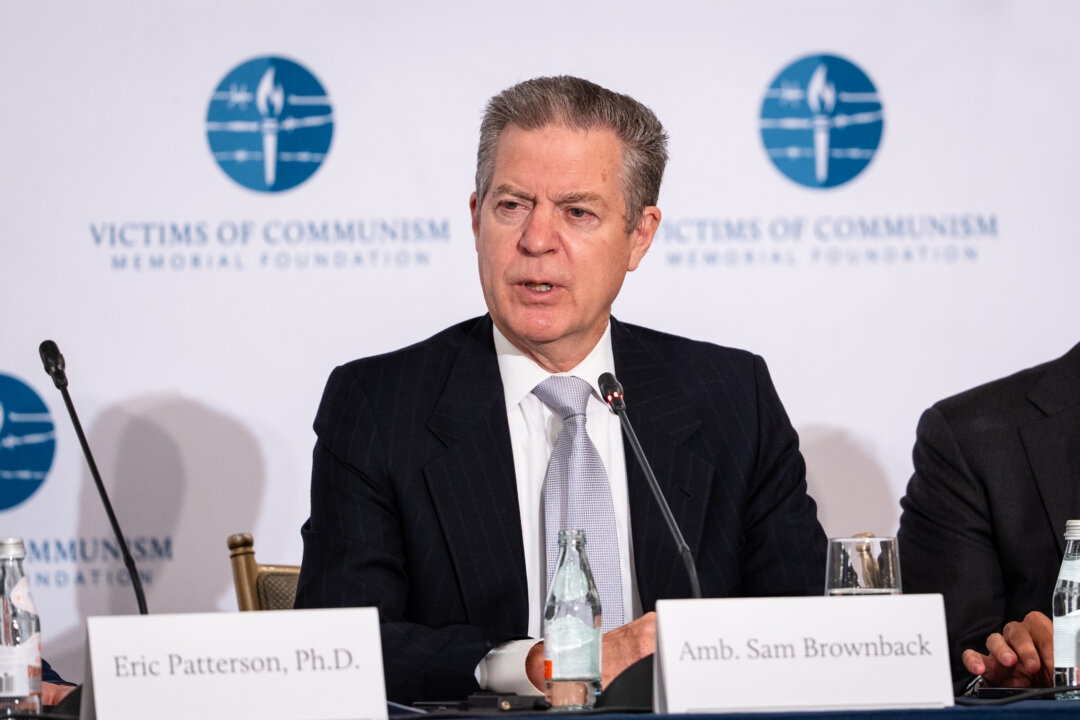
Washington’s most effective weapon against Beijing’s deepest vulnerabilities is elevating religious freedom to a national security priority, according to Sam Brownback, former U.S. Ambassador-at-Large for International Religious Freedom.
Calling the Chinese regime’s persecution of Muslim Uyghurs, Falun Gong practitioners, and Tibetan Buddhists three genocides, Brownback said Washington should offer clear support for people of faith in China.
“For China, religious freedom is an existential threat,” Brownback said. “This should move from being just a human rights issue to a national security issue for us: religious freedom. It is the most potent, powerful tool that we have.”
To accomplish that, Brownback recommended that the U.S. president, vice president, and secretary of state meet with victims of the regime’s religious persecution at the White House and allow them to share their stories. These senior officials could also hold meetings with leaders of these groups, he added.
“We should meet with the founder of Falun Gong in the White House. Li Hongzhi, invite him. Say, ‘Look, we just want to recognize this [persecution],’” Brownback said.
The Chinese Communist Party (CCP) viewed the practice’s popularity as a direct challenge to its authority and responded with a brutal campaign aimed at eradicating it.
Leverage
Brownback elaborated on his point of national security in an interview with Epoch TV’s “American Thought Leaders” on Oct. 28, saying that human rights issues are considered the “weakest” and “the most vulnerable” areas for the Chinese regime.“If the president were to meet with Falun Gong leaders in the White House, that creates huge pressure internally inside China,” he said.
Doing so would also create leverage for the United States, Brownback added.
“If the President were to meet in the Oval Office with a series of people that have been persecuted by [the] Chinese Communist Party, and just [have] them tell their story, that creates leverage back because it shows what system we are up against. That’s what we really need to do, in my estimation, more than anything right now,” he said.
In China, Brownback said the religious communities are the only ones that the United States can work with that would “stand up to” the Chinese regime, which is why Beijing spends billions in oppressing and controlling “every single religion within the country.”
Competition
Speaking out about China’s human rights violations in the United States would hit China “where it hurts,” Brownback told EpochTV, amid the ongoing competition in which Beijing views itself as being in a “Cold War” with the United States.At its core, the U.S.-China rivalry is also a “competition of ideals,” Brownback added, saying that the United States has created the better systems while “communism hasn’t worked anywhere.”
.

Similarly, Craig Singleton, senior director of the China program at the Washington-based Foundation for Defense of Democracies, framed the U.S.-China competition as beyond military and economic rivalry, while speaking at the China Forum on Oct. 30.
“The Chinese say that we are a declining power and that they’re a rising power. So our task is to refute that,” Singleton said. “We have to show that our model is more resilient—that repression leads to economic downturn, that we are dynamic, that we can be resilient.
“I don’t think that human rights, free markets, and civil liberties are just ornaments of power—I actually think they’re multipliers of it,” he said.
In the face of China’s challenges, former House lawmaker Ileana Ros-Lehtinen emphasized the importance of bipartisan unity during a keynote speech at the China Forum.

Ros-Lehtinen stressed that America’s strength lies in bipartisan consensus.
“Because here’s what Beijing understands: they cannot intimidate a united America. But if they can divide us, if they can make us question our own values, if they can get us fighting each other instead of standing together, then they win,” she said. “We cannot let that happen.”
What's Your Reaction?
 Like
0
Like
0
 Dislike
0
Dislike
0
 Love
0
Love
0
 Funny
0
Funny
0
 Wow
0
Wow
0
 Sad
0
Sad
0
 Angry
0
Angry
0












Comments (0)