

Insiders: Passive Resistance Spreading Beyond Military in China

.
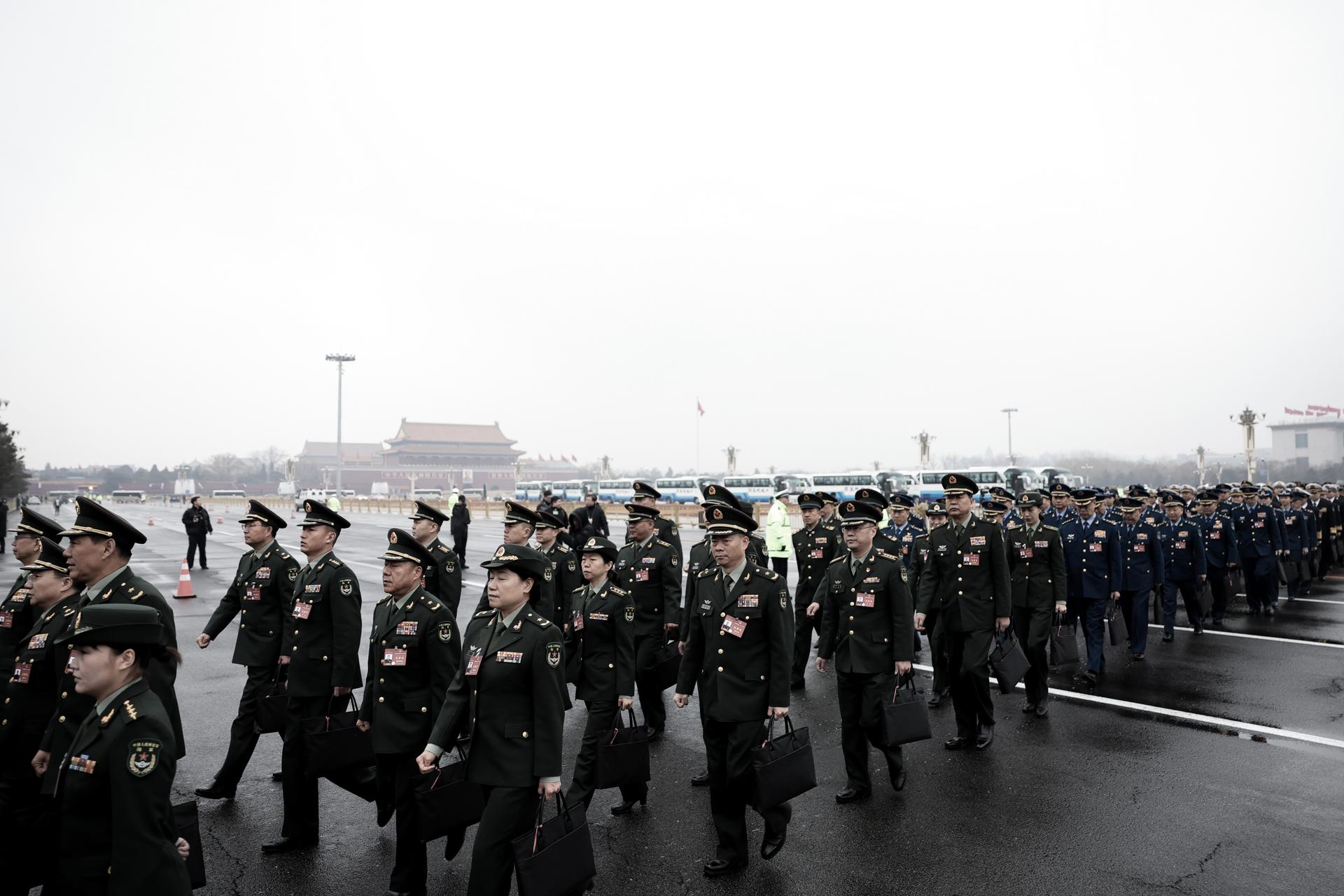
Insiders with knowledge of the Chinese communist regime’s internal discussions say passive noncompliance has begun to spread from the People’s Liberation Army (PLA) into the civilian administrative system, complicating Beijing’s ability to enforce key directives issued by Chinese leader Xi Jinping.
Multiple insiders who spoke to The Epoch Times said this breakdown in command is part of a longstanding pattern of tension between the senior Party leadership and the military. They pointed to previous episodes when top Chinese Communist Party (CCP) officials encountered resistance from the military while attempting to manage politically sensitive crises, particularly under former CCP leader Jiang Zemin.
Cost of the CCP’s Purges
In China’s military hierarchy, the Central Military Commission (CMC) sits at the top of the chain of command, with Xi as its chairman.For decades, the CCP has prioritized political loyalty over professional competence, often purging experienced officers. According to Feng, the institutional costs of that strategy are now converging.
.
While the precise status of Zhang Youxia and Liu remains unclear, China-based insiders told The Epoch Times that both have refused to cooperate with investigators. Their noncooperation is likely known to the PLA’s lowest-level officers and soldiers, who now are showing reluctance to act on orders from the top.
Under the regime’s strategy of “military-civil fusion,” many civilian resources serve the military sector. That civilian administrative system includes military university administrators and defense researchers.
After CMC Vice Chairman Zhang Shengmin—who had been promoted in October 2025—instructed the PLA’s five theater commands and service branches to publicly pledge “resolute support for the unified command of the CMC,” the response was muted at best and defiant at worst.
.


“When ‘unified command’ is mentioned now, the reaction is intense—but not in a positive way,” Feng said, recounting internal discussions.
“It’s not just the uniformed officers who aren’t cooperating. Civilian administrators are also staying silent.
“When neither side signals support, the situation becomes extremely difficult.”
According to Feng, the CMC has dispatched personnel to major theater commands to press for formal statements of loyalty to Xi, but lower-level units have largely failed to respond.
Shift in Propaganda Tone
Regardless of Xi’s intentions in carrying out the recent purge, the practical outcome has been a decline in the PLA’s effectiveness as a force capable of responding quickly and effectively to centralized command, according to the analysts.Lao, a constitutional scholar based in Beijing, told The Epoch Times that decades of tightening political control over the military have produced predictable consequences. With the continued removal of leaders such as Zhang Youxia and Liu—officers with battlefield credibility who are respected within the military—the CCP’s long-standing principle that “the Party commands the gun” is failing.
Instead, the chain of command is increasingly sustained by slogans, propaganda, and ritualized displays of loyalty rather than by enforceable command mechanisms, Lao said.
Changes in wording in the PLA’s official newspaper offered additional insight. A PLA Daily editorial on Jan. 31 calls on officers and soldiers to “resolutely support” the Party leadership and “maintain a high degree of consistency” with Xi.
That shift in propaganda tone, Lao said, was itself a signal of resistance. In CCP political discourse, loyalty is typically declared as a fact, not as something that must be repeatedly demanded.
.

Some insiders interpreted the PLA’s continued silence as evidence that CMC authority is being deliberately sidestepped. A propaganda officer from a PLA theater command told The Epoch Times that the wording change indicates that the Party’s military leadership is effectively paralyzed.
Noncompliance in Chain of Command
Some analysts pointed to parallels between Xi’s move against Zhang Youxia and past clashes between leaders of the CCP and the CMC.The last time such a clash occurred was during Jiang’s era. A former aide who was close to the now-deceased paramount leader told The Epoch Times about a closely guarded episode from April 1999, following a peaceful sit-in protest by adherents of the Falun Gong spiritual practice near Zhongnanhai in Beijing.
The former aide said that Jiang, then both Party leader and CMC chairman, admitted during an internal meeting that he had made a failed attempt to deploy troops to Beijing to suppress the sit-in. Jiang criticized then-CMC Vice Chairman Zhang Wannian for failing to carry out the order. Although that fact has never been made public, the former aide said it has long been known among the CCP’s senior military figures.
.

A Beijing-based analyst told The Epoch Times that the CMC has not yet lost control of the PLA. Orders are still formally obeyed, but the Party’s control is rapidly hollowing out.
What's Your Reaction?
 Like
0
Like
0
 Dislike
0
Dislike
0
 Love
0
Love
0
 Funny
0
Funny
0
 Wow
0
Wow
0
 Sad
0
Sad
0
 Angry
0
Angry
0














Comments (0)