

House Panel Proposes Plan to Loosen CCP Grip on Global Critical Mineral Markets


.
The House Select Committee on the Chinese Communist Party is calling on the Trump administration to establish a federal “critical minerals czar” post, a strategic resources reserve, a critical minerals tax credit, and a “National Center for Rare Earths” to accelerate a mining and refining revival and build a domestic supply chain resilient to Chinese Communist Party (CCP) market manipulation.
Expediting permitting, creating “price-floor benchmarks,” subsidizing priority projects, boosting recycling programs, supporting innovation, and orchestrating production with trading partners were also among the recommendations executives with three key domestic mining and manufacturing ventures praised during a two-hour Nov. 19 committee hearing.
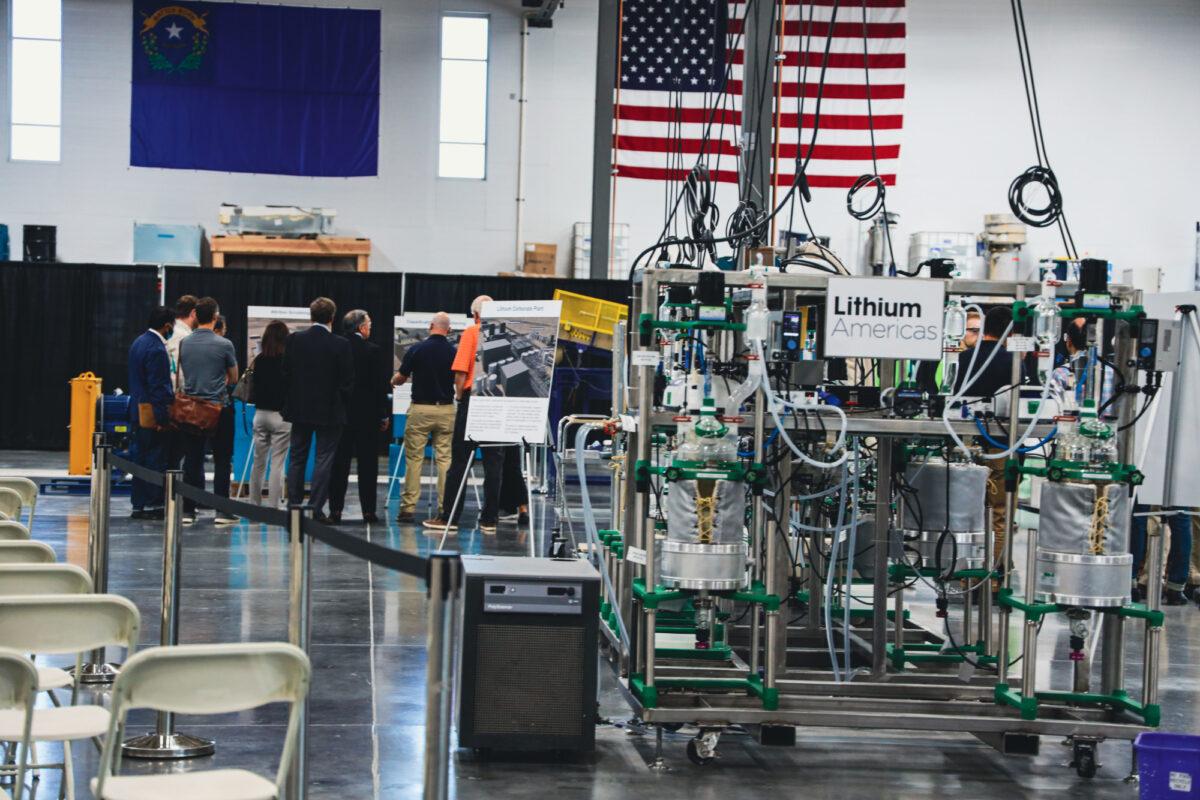
“The CCP views dominance over critical minerals as a matter of geopolitical strategy. Through a coordinated, decades-long effort, China systematically secured control over key mineral supply chains to shape global markets in their favor,” Lithium Americas President and CEO Jonathan Evans said. “This is not merely an economic vulnerability. It poses a direct threat to national security.”
“President Trump brought the United States and our allies a crucial one-year opportunity,” Chair Rep. John Moolenaar (R-Mich.) said. “The task now before Congress, the executive branch, private industry, and our many allies and partners around the world, is to use this year and move quickly to disarm China’s loaded gun before it can be fired again at the global economy.”
But Congress and industry must also respond, Rep. Raja Krishnamoorthi (D-Ill.) said.
Federal Investment Needed
Lithium Americas’ Evans, MP Materials Executive Vice President Matthew Sloustcher, and Niron Magnetics CEO Jonathan Rowntree offered recommendations of their own on how to build a domestic supply chain impervious to CCP market manipulation.All endorsed Trump administration initiatives to allocate at least $1 billion in federal money to acquire stakes in mining and milling companies to provide financial security in advancing projects.
“The government definitely needs to give a signal,” Evans said. “We need to be able to build things in this country again. [Development] must be somewhat predictable and reasonable for financial investors to support projects like this and actually get a return.”
Federal subsidies for critical mineral development “is no different than the space race” in the 1960s, he said. “If you look at the problems the Johnson administration had convincing the American public to keep funding the space race, it was difficult. But it spurred huge economic growth and leadership globally. We’re in the same situation here.”
.
Such public-private partnerships ensure “taxpayers share in the upside,” Sloustcher said, noting DOD’s MP Materials’ investment “has already generated approximately $700 million in unrealized gains for taxpayers.”
These investments “demonstrate how public-private partnerships can deliver national security benefits while creating opportunities for taxpayers ... to share in the upside rather than simply absorbing risk and losses,” he said.
Rep. Dusty Johnson (R-S.D.) said as “a free-market Republican,” public investment in private industry is “not normally the first place my mind goes to what our government should do,” but noted “maybe unusual times call for unusual tactics.”
‘At the Speed of National Security’
Rowntree, whose Minneapolis-based Niron Magnetics is “pioneering the world’s first high-performance, rare earth-free permanent magnets” with iron and nitrogen, said the government should invest in, or provide low-interest loans for, innovators.He offered “five concrete actions” the administration and Congress must take, including “federal procurement preferences for domestically manufactured magnets” and qualifying “alternative magnet technologies” for Defense Production Act relaxed regulation.
“Three,” Rowntree said, “create tax incentives that level the playing field for domestic producers without picking winners among competing technologies. Four, direct federal agencies to prioritize supply chain security over short-term cost savings. And five, provide import tariff exemptions for manufacturing equipment from allied trading partners.”
Rep. Carlos Gimenez (R-Fla.) said tariffs could be tools in blunting China’s supply chain stranglehold.
“Maybe what we should do is establish a kind of rolling tariffs on these materials,” he said. “So if somehow the Chinese … suppress the price of a certain product, certain material, we would then raise the tariff on that material so it would always be kind of like equal” with costs for domestic producers.
Slashing permitting and regulatory requirements, capping litigation timelines, and aligning domestic production with allied trading partners were also among the initiatives the executives touted.
“Permitting does need to move more quickly and, ideally, at the speed of national security, “ Sloustcher said.
U.S. permitting timelines “are very, very long,” Evans said. “If you’re a private investor, you’re going to look at market conditions and market growth potential, but you’re also going to look at, ‘When am I going to get my money back?’ Uncertainty around permitting timelines makes people go away.”
The United States doesn’t have to take on China by itself, he said, noting many nations, especially Canada and Australia, share similar raw resource abundances and milling, smelting, and refining scarcities.
“We’re all suffering the same issue, and I think it’s all coming to roost,” Evans said. “All these countries somewhat sold our soul, allowed China to take the narrative here. It’s hollowing out downstream industries. This is going to retard their growth because the Chinese can shut off [exports] whenever they want to.”
.
What's Your Reaction?
 Like
0
Like
0
 Dislike
0
Dislike
0
 Love
0
Love
0
 Funny
0
Funny
0
 Wow
0
Wow
0
 Sad
0
Sad
0
 Angry
0
Angry
0
















Comments (0)