.
News Analysis
As then-Environment Minister Steven Guilbeault faced questions about his
travel to China in 2023 amid reports of widespread interference by Beijing in Canada’s internal affairs, he said engagement with China was needed to tackle climate change.
Last month, Prime Minister Mark Carney also had
words of praise for China on net-zero initiatives,
saying on Sept. 22, “In my experience with China, they are, amongst other things, very sincere and engaged on climate.”
But for long-time China observers, these sentiments are déjà vu of the West’s efforts to include China in rules-based initiatives such as the World Trade Organization, driven by the belief that engagement with the isolated communist regime would, in time, lead to its democratization—only for many to now acknowledge that China instead used these opportunities to grow richer and more powerful, turning that power against the West while intensifying its crackdown on dissidents at home.
“Some people thought that China would become normal if we just dealt with them economically—they become more like us, open democracies. That clearly is not going to happen,” Phil Gurski, a retired senior analyst with the Canadian Security Intelligence Service and the Communications Security Establishment, said in an interview.
Sheng Xue, a Chinese-Canadian democracy activist and writer, says the goal of the Chinese Communist Party (CCP) is to consolidate its own power, and it would be naive to think that it would act as a fair global player.
“Western democracies once believed that integrating China into the global economy would lead it toward openness and reform. Instead, that policy built the economic and technological foundation for a dictatorship that now seeks to infiltrate, divide, and ultimately undermine the very free societies that enabled its rise,” Sheng said in an interview.
“Every green initiative under Beijing’s control serves its geopolitical ambitions—never the environment, never the people.”
West’s Hand-Up to the CCP
When Beijing joined the World Trade Organization (WTO) in 2001, many Western leaders portrayed the move as a step toward economic and eventual political reform in China.
.
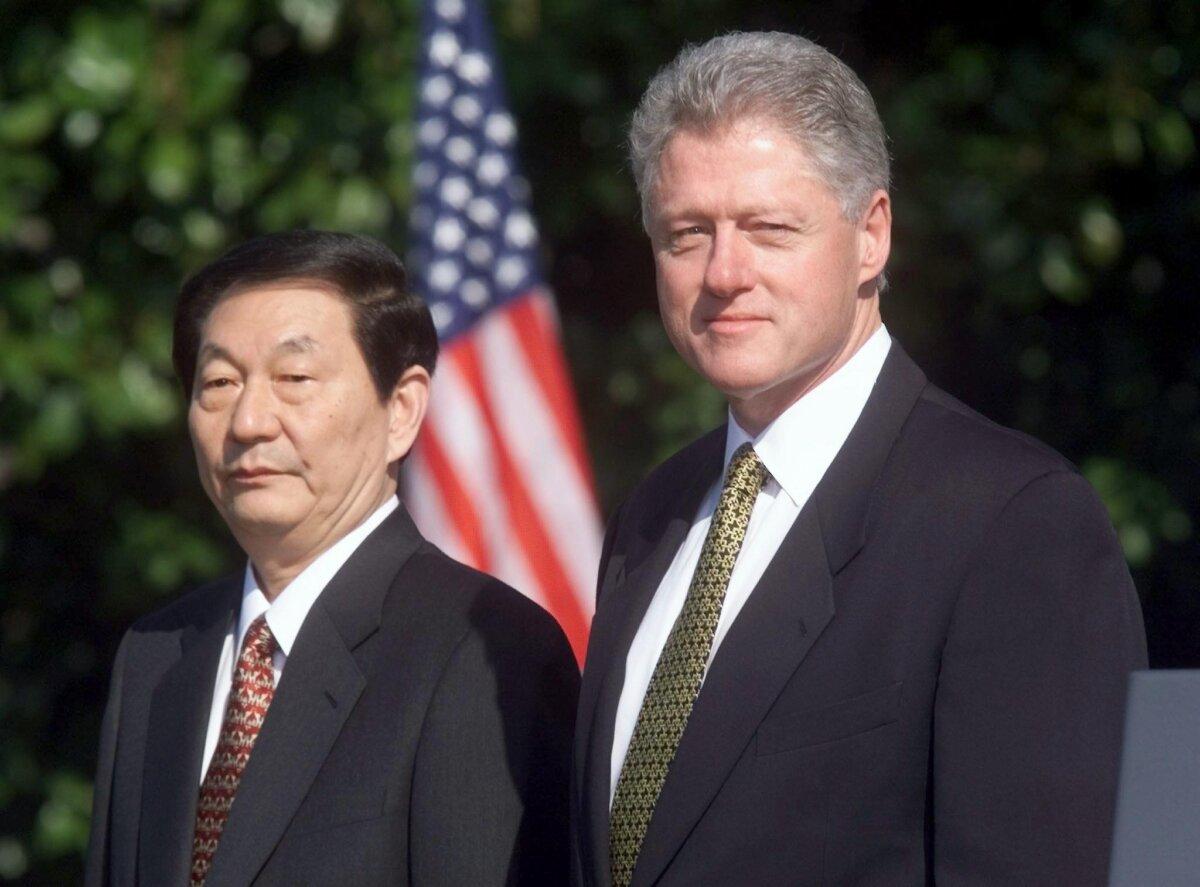
U.S. President Bill Clinton and Chinese Premier Zhu Rongji meet ini Washington on April 8, 1999, to discuss China's entry into the WTO.Tim Sloan/AFP via Getty Images
.
“By joining the WTO, China is not simply agreeing to import more of our products, it is agreeing to import one of democracy’s most cherished values: economic freedom,” then-U.S. President Bill Clinton, who was instrumental in China’s inclusion in the multilateral trade organization, said in a
speech on March 9, 2000.
Then-Canadian Prime Minister Jean Chrétien—whose government led delegations to China helping to bring Beijing out of international isolation due to its 1989 Tiananmen Square massacre—made similar comments at the time.
“WTO accession is part of China’s broad agenda of developing the rule of law, to ensure fair and equal treatment before the courts for both people and companies,” Chrétien said in Shanghai in 2001.
Years later, the trade deficit with China for countries like the United States and Canada has ballooned, with China selling significantly more than it imports. A
study by MIT Economics said the trade normalization with China and its inclusion in the WTO led to the loss of 1 million manufacturing jobs in the United States by 2011.
China used WTO rules to its advantage, “cheating the system in various ways” and using mechanisms that “suit its interests while skirting less convenient restrictions,”
says a Feb. 6 report by New York-based think tank the Council on Foreign Relations.
What’s more, the notion that China’s inclusion in the international rules-based trade system would lead to its liberalization proved illusory, the report noted.
“China did not conform to democracy in the way the United States had hoped. In fact, its vast economic gains have only legitimized the Chinese Communist Party (CCP), which President Xi Jinping believes is central to maintaining economic stability and enabling China to dominate technology-driven industries,” the report
says.Charles Burton, a former diplomat at the Canadian Embassy in Beijing, said in
2019 that China’s actions amid the Meng Wanzhou affair permanently changed what he calls Canada’s “naive” view of China.
Burton noted the attempts of the Trudeau government to seek closer trade ties with China, even at one point pursuing an extradition treaty with the communist regime. But he notes that after China detained Canadian citizens Michael Kovrig and Michael Spavor in retaliation for the arrest of Huawei executive Meng Wanzhou in Vancouver in 2018 on a U.S. extradition request, and following the verbal threats made by Chinese officials against Canada, China’s flaunting of international norms became ever more clear.
“Any naive assumptions Canadians may have had about China coming into compliance with international norms have been thoroughly dashed,” Burton
wrote in the Toronto Sun.
.
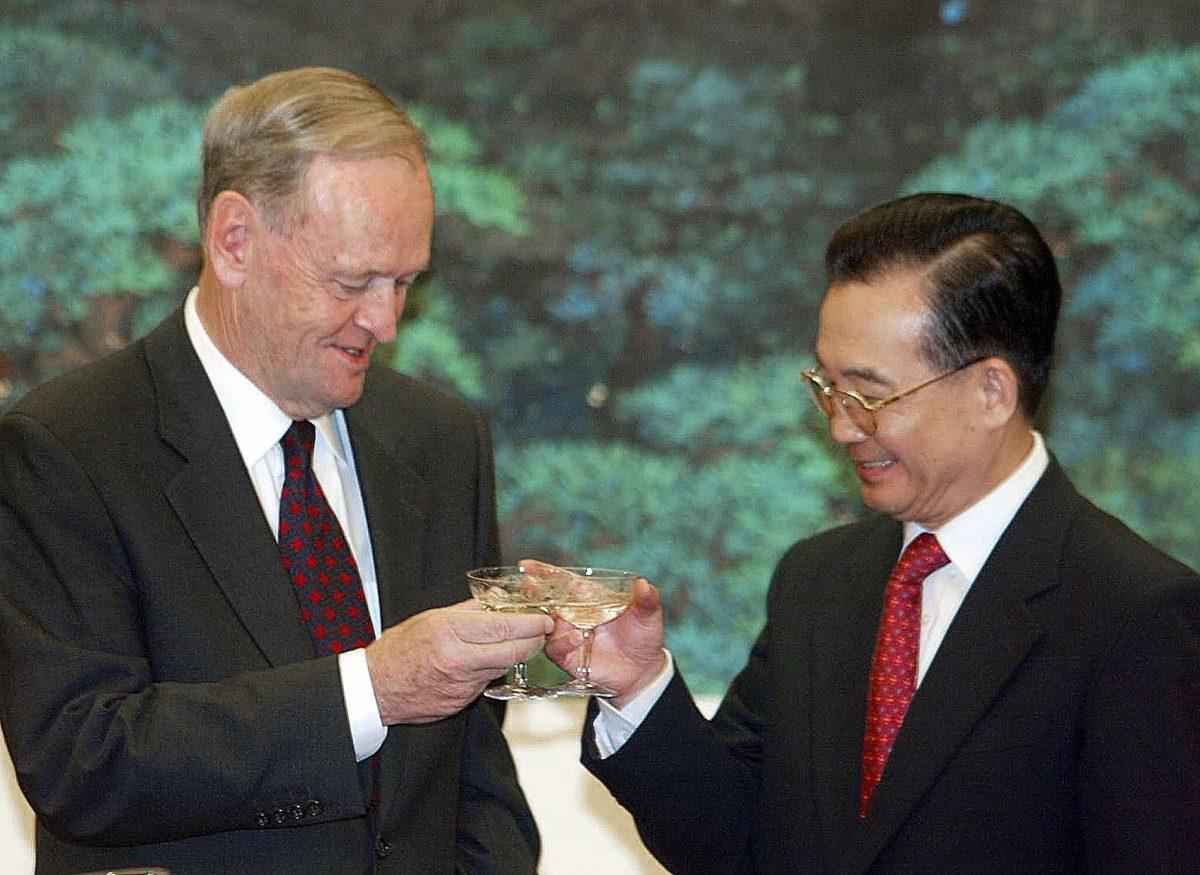
Canadian Prime Minister Jean Chretien and Chinese Premier Wen Jiabao toast to each other following a signing ceremony on Oct. 22, 2003. Frederic J. Brown/AFP/Getty Images
.
Margaret McCuaig-Johnston, a former senior federal government official and now a senior fellow at the Graduate School of Public and International Affairs at the University of Ottawa, was one of those who once
considered herself a “friend of China,” even serving as the vice president of the Canada-China friendship association. But she changed her views following the CCP’s conduct in the aftermath of the Meng Wanzhou affair, saying it served as the last straw showing that the regime isn’t changing its tactics.
“Our governments must now deal with China as it really is, not as they wish it were,” she
wrote in the Ottawa Citizen in 2021.
Re-Engaging CCP
Guilbeault’s 2023 trip to Beijing marked the first visit by a Canadian minister to China since the Meng Wanzhou affair, and came amid intelligence leaks in the media about the regime’s meddling in Canadian elections and other democratic institutions.
Guilbeault defended his government’s push for domestic net-zero emission policies while Canada only accounts for
1.4 percent of global greenhouse gas emissions, saying it was needed to convince the major emitters like China to commit to similar plans.
“It’s easier for me to go to China and India and say, you know what, Canada’s the fourth-largest producer of oil and gas, we’ve emitted a lot, we’re taking responsibility and working really hard to try shift things. Why don’t we work together?” Guilbeault told
iPolitics.
As for his trip occurring at a time of revelations of China’s rampant interference in Canada as pointed out by the Conservatives, Guilbeault said it’s important to “cooperate on issues like climate change and nature,” according to
CBC News.
After Foreign Affairs Minister Anita Anand travelled to China last week, the
readout from her meeting with Chinese Foreign Affairs Minister Wang Yi
said the two discussed key areas of cooperation, which included “environment, energy and health.”
In his recent
remarks on this issue, Carney said net-zero emission issues are an “opportunity” to engage with China.
.
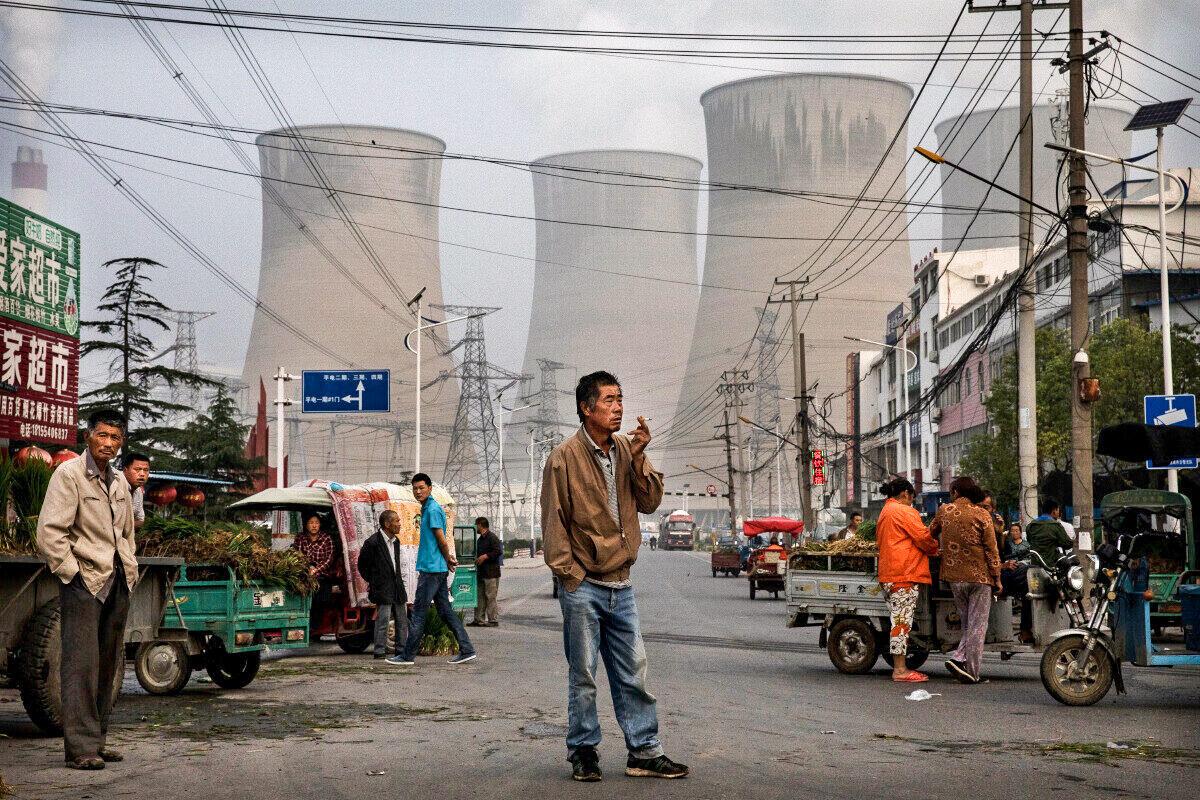
Street vendors and customers gather at a local market outside a state owned coal-fired power plant in Anhui Province, China, on June 14, 2017. Kevin Frayer/Getty Images
.
“This is a country run by engineers—it’s a country that understands a lot of the engineering solutions to issues around emissions,” Carney said. “We care about this issue as well, it’s still part of our policy, so there’s an opportunity to engage.”
The European Union has similarly spoken positively of its engagement with China on issues around emissions.
“The EU underlined the importance it continues to attach to this relationship and reiterated its commitment to deepen engagement with China, and enhance cooperation to address joint global challenges such as climate change,” reads a July 24 EU
press release.
U.S. President Donald Trump suggested in his Sept. 23
address to the United Nations General Assembly that China is taking advantage of the West on green energy. He said Beijing is positioning itself as a key supplier of clean technologies to increase other countries’ dependence, while continuing practices that fall short of the net-zero goals others are pursuing, citing China’s increased use of coal and gas.
Beijing’s Use of Leverage
Gurski says a major issue with Canada’s approach with China on the net-zero emissions file is that it appears Ottawa is still taking China as a fair player when it comes to sectoral cooperation.
“The sectoral approach might make sense between two democracies where both countries see advantages. China’s not a democracy,” he says.
He cites as an example how China is using Canada’s dependence on its market for agricultural exports as leverage, imposing tariffs on canola exports, which in turn prodded some Western premiers to push Ottawa to remove tariffs on Chinese electric vehicles.
“We have to see China for what it is, which is a threat,” he says.
“Let’s take the blinders off. Let’s not be so naive, and let’s focus our efforts on nations that are more like us, rather than nations that are not like us.”
Kovrig, who is a think tank scholar, also pointed out the perils of taking a sectoral approach to dealing with China, saying that Beijing uses “leverage in one area to extract concessions in another.”
.
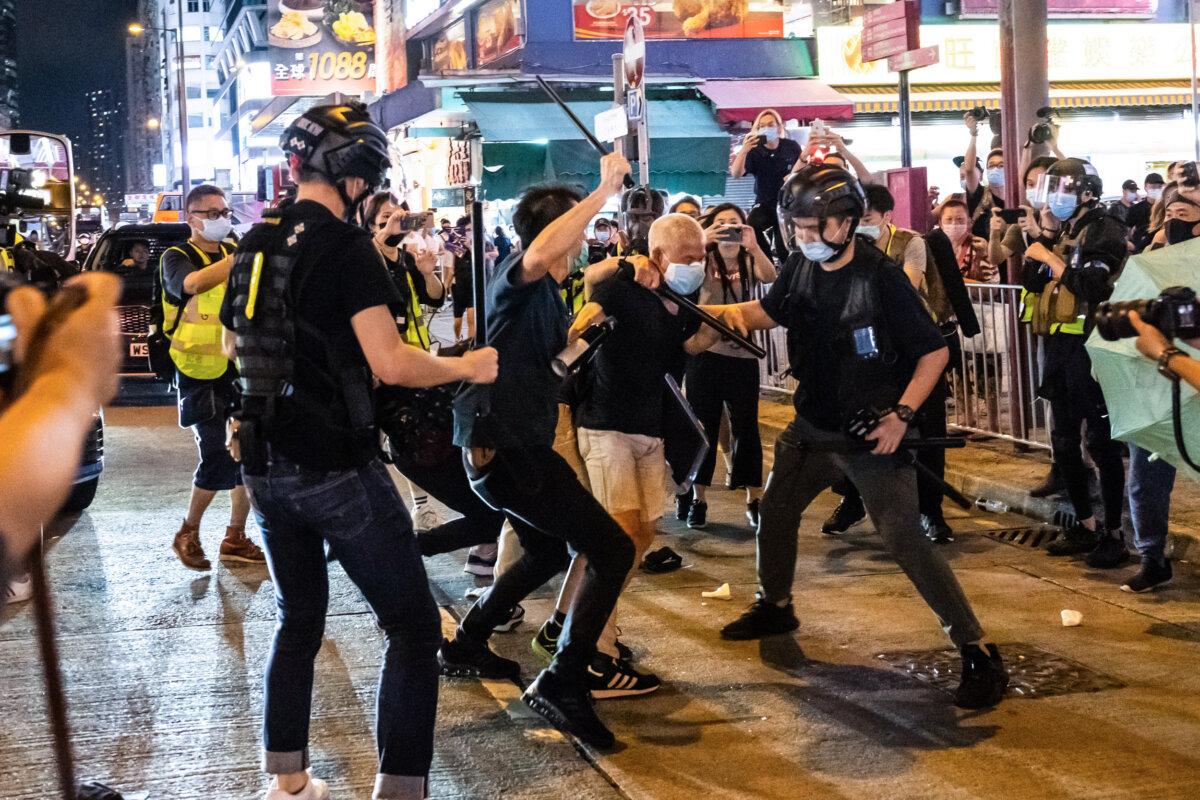
Undercover police arrest attendees during a memorial vigil in Hong Kong, on June 4, 2020.Billy H.C. Kwok/Getty Images
.
“We have to work with countries that are not easy to work with to try to address [global issues], but that doesn’t mean that we can count on the Chinese not to use, for example, green technology or climate change as a point of leverage for something else they get,” Kovrig
said during a Sept. 24 interview with CTV News’ Vassy Kapelos.
Democracy activist Sheng says the Canadian government needs to understand that the CCP’s goal is to “preserve its own power” and uphold the interests of its “ruling elite.”
“Canada is being deeply naive in seeking to collaborate with China on green technology,” she says.
“Canada should not repeat this historic mistake. Cooperation with a regime that destroys the planet, persecutes its own people, and threatens democratic nations is not environmental leadership—it is moral blindness.”
.




 Like
0
Like
0
 Dislike
0
Dislike
0
 Love
0
Love
0
 Funny
0
Funny
0
 Wow
0
Wow
0
 Sad
0
Sad
0
 Angry
0
Angry
0














Comments (0)