

G7 in Évian: High Stakes, Frayed Alliances — and China Calling the Shots from Outside
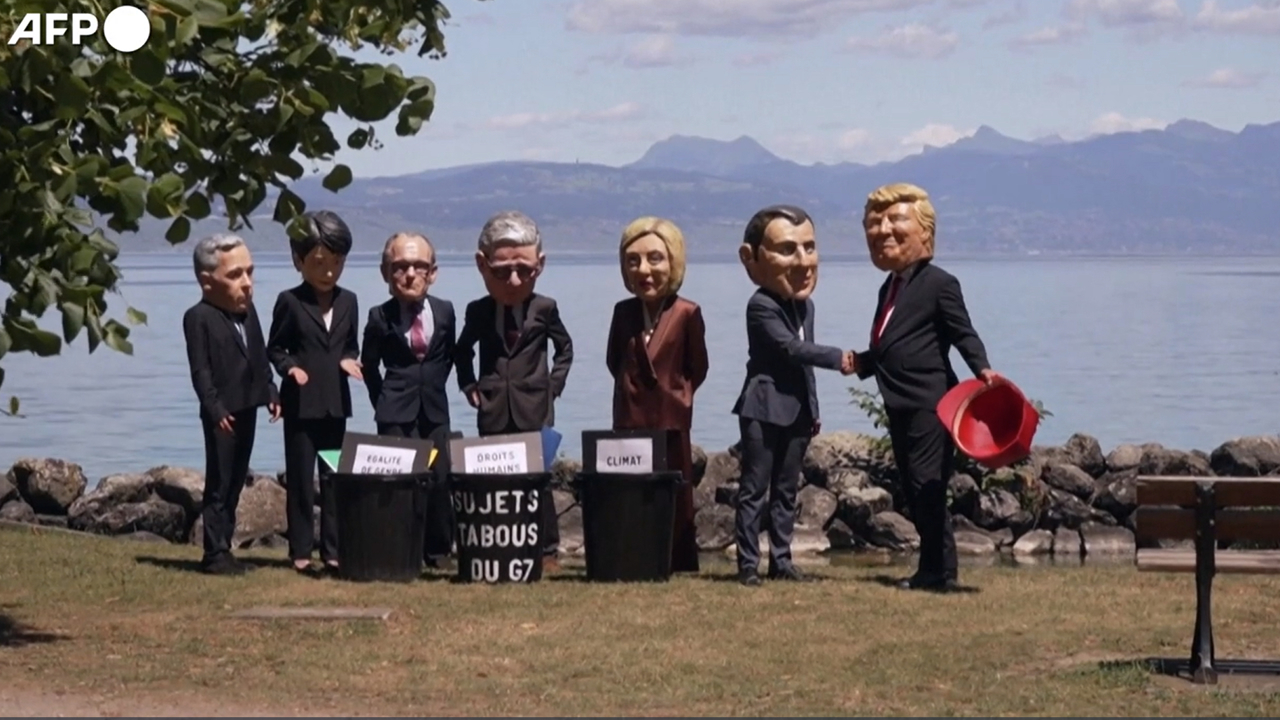
The G7 summit in the French Alpine resort of Évian-les-Bains opened this week under extraordinary pressure. From a landmark Iran deal to a looming trade war with China and an uncertain future for Ukraine, world leaders arrived with more crises on the table than answers. And overshadowing everything: a nation that was never invited.

.
A Birthday Party, Then Diplomacy
U.S. President Donald Trump arrived in France fresh off his 80th birthday celebrations — including a mixed martial arts event on the White House South Lawn — and immediately stepped into one of the most complex G7 summits in decades.
The summit was even delayed by one day due to Trump's postponed travel. By the time he landed, Trump had already changed the dynamic: he declared shortly before departure that the United States and Iran had largely finalized a peace agreement under which Iran would reopen the Strait of Hormuz, the waterway that carries roughly 20 million barrels of oil per day.
The news landed like a thunderclap. Just days earlier, the summit had appeared headed for a very rough opening — with resumed strikes and no ceasefire in sight.
The Iran Deal: Relief, but Questions
The prospect of a U.S.-Iran deal brought visible relief to European leaders, who had been alarmed by the war Trump launched with Israel in February without consulting them. For France and Britain in particular, a stable ceasefire would open the door to a mission they had been quietly preparing for weeks.
According to the AP, both Paris and London are expected to push for a role in clearing the Strait of Hormuz of mines and escorting tankers through the narrow waterway — plans developed in coordination with other nations but put on hold pending a durable ceasefire. Additional discussions are expected on developing alternative energy supply routes out of the Gulf, including through Egypt.
Trump held bilateral meetings with the leaders of Qatar, the UAE, and Egypt on the sidelines, adding a Middle Eastern dimension to what was already the densest G7 agenda in years.
Zelenskyy in Évian — Without a Trump Meeting
Ukraine's President Volodymyr Zelenskyy traveled to Évian carrying a difficult brief. He was set to attend a G7 working session on Tuesday titled "Building peace and security for Ukraine and Europe" — but was not scheduled to receive a bilateral meeting with Trump, a signal of Kyiv's diminished standing in Washington.
Zelenskyy said he hoped to clarify how close the United States is to introducing new sanctions against Russia, stressing that the final decision rests with Trump.
Analysts note that Zelenskyy nonetheless arrives in a stronger position than a year ago, when he famously endured a bruising exchange in the Oval Office with Trump and Vice President JD Vance. Ukrainian forces have made battlefield progress, and that progress may factor into how Trump assesses the war.
Still, the path to a Trump-Zelenskyy meeting remained uncertain at the time of writing.
The Real Elephant: China
Wednesday's economic session will be devoted to a country that is not at the table — and hasn't been for fifty years of G7 history.
China was never invited when the club was founded in 1975 as a forum for major democracies. It remains excluded today, formally on democratic grounds. But its absence from the room increasingly does not equal absence from the agenda.
In an unusual development ahead of the summit, China participated in a preparatory call — something analysts say they had never seen before. The message from Beijing was clear: if you are not at the table, you are on the menu.
The core economic grievance among G7 members is China's massive export surge. A consensus is building that what makes Chinese industrial overcapacity particularly damaging is that the surge in exports is accompanied by a drop in China's imports — a pattern visible across almost all G7 economies. Europe and Japan have seen imports from China increase substantially and quickly.
The rare earth dimension adds a sharper edge. Europe sources all of its heavy rare earth elements, 85 percent of its light rare earths, and 98 percent of its rare-earth magnets from China. When Beijing tightened export licenses, magnet exports fell sharply, carmakers reduced production, and Europe and the United States each faced an estimated $1.5 trillion in direct economic losses.
The Évian summit's formal trade agenda covers four priorities: controlling industrial overcapacity, strengthening supply-chain resilience, modernizing the multilateral trade system, and promoting safer cross-border e-commerce. Every single one points directly at Beijing.
France is reportedly considering establishing a permanent secretariat to manage the critical minerals agenda across future G7 presidencies — a sign of how structural, not merely temporary, the dependency problem has become.
Trump, the G7 — and Chemistry That Isn't There
European leaders arrived with a fresh set of grievances: U.S. tariffs on EU products, Trump's unclear stance on NATO, and the economic fallout from the Hormuz closure.
As the Centre for Strategic and International Studies noted, Europeans in 2025 were still willing to accept a more deferential approach toward Washington — but by 2026, that tolerance has waned.
Canadian Prime Minister Mark Carney set the tone just days before arriving, delivering a pointed address at Trinity College Dublin warning that "Ireland and Canada are navigating a global rupture, not a quiet transition" and that "the post-Cold War world's rules-based order is breaking down."
G7 specialist John Kirton of the University of Toronto has observed that some of the alliance's most consequential decisions have emerged from informal, spontaneous exchanges between leaders. This summit, with its compressed timeline, strained relationships, and multiple live crises, leaves little room for that kind of dialogue.
What the Next 48 Hours Could Decide
The outcomes of Évian are likely to reverberate well beyond the Alpine lakeside. Whether a Hormuz deal holds, whether a critical-minerals coordination body takes shape, or whether a framework succeeds the expiring U.S. tariff authority — all carry consequences for energy markets, manufacturing supply chains, and technology procurement for years to come.
The G7 has held together for more than fifty years without ever missing a summit. What it produces this week — or fails to produce — will say much about whether the club remains the force it was built to be.
.
Sources
- Associated Press, "What to know about the G7 summit Trump is attending in France" — document provided (apnews.com)
- Euronews, "Wars, tariffs and AI: What to expect from the G7 summit in Évian" — https://www.euronews.com/my-europe/2026/06/14/wars-tariffs-and-ai-what-to-expect-from-the-g7-summit-in-evian
- NPR, "Trump will attend the G7 summit in France amid differences with European leaders" — https://www.npr.org/2026/06/14/nx-s1-5855075/trump-will-attend-the-g7-summit-in-france-amid-differences-with-european-leaders
- Atlantic Council, "Seven charts that will define France's G7 summit" — https://www.atlanticcouncil.org/dispatches/seven-charts-that-will-define-frances-g7-summit/
- TechTimes, "G7 Summit 2026: Iran Hormuz Deal, Tariff Deadline, Rare-Earth Crisis Hit Evian" — https://www.techtimes.com/articles/318327/20260613/g7-summit-2026-iran-hormuz-deal-tariff-deadline-rare-earth-crisis-hit-evian.htm
- Radio Free Europe/Radio Liberty, "White House Says Iran, Ukraine, High On Trump's G7 Agenda" — https://www.rferl.org/amp/33779774.html
- Ukrinform / Yahoo News, "Zelenskyy to ask Trump about introducing new sanctions against Russia at G7 summit" — https://www.yahoo.com/news/zelenskyy-ask-trump-introducing-sanctions-143826383.html
.
What's Your Reaction?
 Like
0
Like
0
 Dislike
0
Dislike
0
 Love
0
Love
0
 Funny
0
Funny
0
 Wow
0
Wow
0
 Sad
0
Sad
0
 Angry
0
Angry
0











Comments (0)