

Floods in the Desert: China Warns of Extreme Weather Threat in Xinjiang
China's vast northwestern desert region is facing an alarming new threat this summer — flooding. Officials are warning that abnormally high temperatures, accelerated glacier melt, and unusually heavy rainfall could cause severe "extreme floods" that endanger roads, pipelines, and rail lines across Xinjiang.

.
Water Where None Should Be
It sounds like a paradox: floods in one of the world's driest deserts. Yet that is exactly what Chinese authorities are warning about this summer. On June 12, China's meteorological officials issued alerts for Xinjiang and nearby regions, urging residents and travelers to prepare for "extreme floods" driven by record heat, increased rainfall, and the rapid disintegration of mountain glaciers.
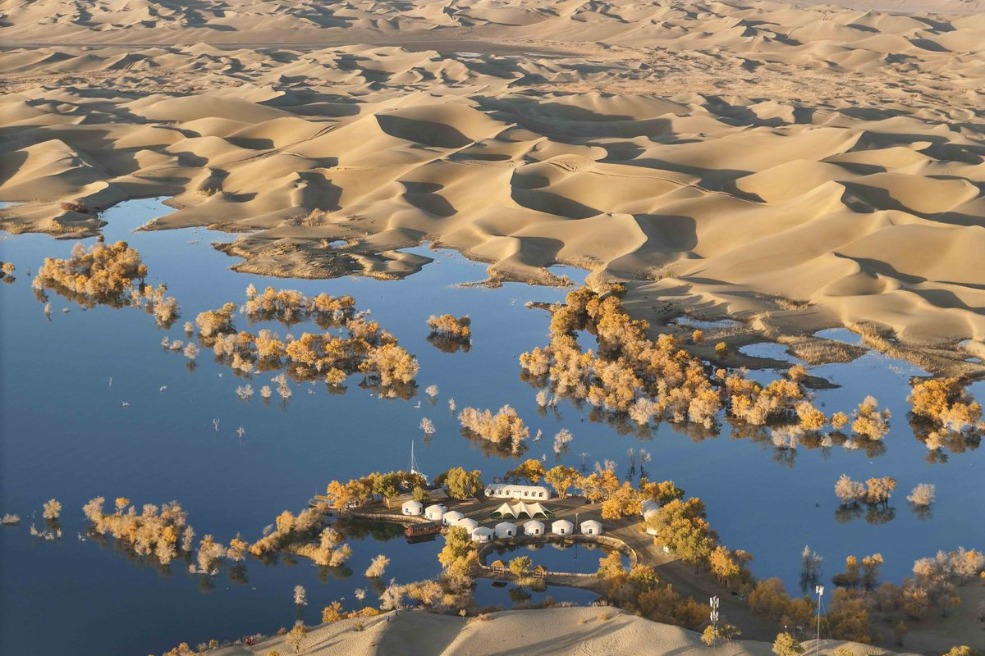
The Taklamakan Desert — China's largest, stretching across an area twice the size of France — recorded its first flood of the year in early June, weeks ahead of what has become a troubling new pattern. State broadcaster CCTV aired footage showing water rushing across typically bone-dry sand dunes. The sight has become less surprising in recent years, but the timing this year has alarmed scientists: such events usually only occur in August, when seasonal temperatures peak.
Record Heat, Record Early
Temperatures in Xinjiang have surged far above normal for this time of year. On June 12 alone, the region was 7.3 degrees Celsius hotter than the historical average, hitting 38°C (100°F), according to the Reuters Climate Monitor.
Western and southern parts of Xinjiang have also experienced a sharp rise in rainfall. In some areas, precipitation in early June has reached double or even triple the typical historical levels, CCTV reported.
The combination is dangerous. When intense heat hits mountain snowfields and glaciers, the melt accelerates dramatically — and when heavy rain falls at the same time, the resulting runoff has nowhere to go but down.
Mountains Feeding the Desert
The Tianshan and Kunlun mountain ranges, which border Xinjiang to the north and south, hold some of China's largest glaciers. As temperatures climb, these glaciers are retreating at an accelerating rate. Between 2001 and 2022, average temperatures in Xinjiang rose by 1°C compared to the 1961–2000 baseline, while average precipitation increased by 16.1%. Over the past 60 years, the glacial area in Xinjiang has shrunk by 11.7%.
The melting ice pours into the Tarim River — China's longest inland waterway — through dozens of tributaries. When the Tarim overflows its banks, water spills into the low-lying desert basin. Scientists warn that accelerated climate warming has caused extensive glacier retreat, expanded glacial lakes, and heightened the risk of glacial lake outburst floods, while simultaneously affecting downstream runoff stability.
Infrastructure Under Threat
While the floodwaters can temporarily create short-lived green patches in the desert, providing some irrigation for local forests and vegetation, experts caution against optimism. The Taklamakan is simply too deep inland and too arid for any permanent transformation. Extreme evaporation will dry out the terrain quickly once the flood recedes.
The more immediate concern is the damage floods can cause before they retreat. Sun Qianqian, an analyst at the China Meteorological Administration, told CCTV: "Extreme floods can destroy roads, railways, and oil and gas facilities, posing a significant disaster risk."
Xinjiang is crisscrossed with energy infrastructure — oil and gas pipelines, power lines, and transport corridors connecting western China to the rest of the country. The region also sits at the heart of China's Belt and Road Initiative, with major rail and highway links running through its desert terrain.
A Pattern Getting Worse
This is not a one-off event. Flooding in the Taklamakan has been documented since at least 2021, with major incidents in 2022 and 2024. What is changing is the frequency, intensity, and — critically — the timing. The fact that 2026's first desert flood arrived in early June, rather than August, signals a clear shift in seasonal patterns.
Chen Yaning, of the Chinese Academy of Sciences' Xinjiang Ecology and Geography Institute, has noted that climate-driven changes to glaciers and the hydrological cycle will increase the uncertainty of water supplies, and that glacial melting will have lasting impacts on future water security in the region.
A study by researchers in Britain and New Zealand found that more than one million people in China — many of them in Xinjiang — live within 50 kilometers of a glacial lake and are at risk from sudden glacial lake outburst floods, a danger that will grow as global temperatures continue to rise.
What Travelers and Residents Should Do
Chinese authorities are urging people in flood-prone areas to monitor official weather warnings, avoid unnecessary travel in vulnerable regions, and adjust plans if alerts are issued. Sun Qianqian stressed: "During the flood season, residents and travellers in these regions should monitor official warnings closely, adjust their travel plans, and prioritise safety."
For a region already facing complex pressures — from extreme heat and water scarcity to political tensions — the added threat of unpredictable flooding represents yet another challenge that neither officials nor residents can afford to ignore.
.
Sources
- Reuters – "China warns of risk of 'extreme floods' in desert regions," June 12, 2026: https://www.reuters.com/business/environment/china-warns-risk-extreme-floods-desert-regions-2026-06-12/
- Dialogue Earth – "China's driest desert hit by floods," August 2024: https://dialogue.earth/en/digest/chinas-driest-desert-hit-by-floods/
- Dialogue Earth – "What chance for China's melting glaciers?," January 2025: https://dialogue.earth/en/climate/what-chance-for-chinas-melting-glaciers/
- iScience / PubMed Central – "Glacier change threatens Central Asia's water towers," January 2026: https://pmc.ncbi.nlm.nih.gov/articles/PMC12887379/
- South China Morning Post – "In China, 1 million people are at risk from glacier-melt flooding," February 2023: https://www.scmp.com/news/china/science/article/3209379/china-1-million-people-are-risk-glacier-melt-flooding-disaster-threat-set-grow-global-warming
.
What's Your Reaction?
 Like
0
Like
0
 Dislike
0
Dislike
0
 Love
0
Love
0
 Funny
0
Funny
0
 Wow
0
Wow
0
 Sad
0
Sad
0
 Angry
0
Angry
0











Comments (0)