

China's Underground Ghost Particle Lab Delivers First Major Breakthrough
A massive underground detector in southern China has released its first scientific results on one of physics' greatest mysteries: the neutrino. While the so-called "ghost particle" has been known for decades, fundamental questions about it remain unanswered — and a new $300 million facility is now joining the global race for answers.

.
What Just Happened?
Scientists at the Jiangmen Underground Neutrino Observatory — known as JUNO — have published their first major findings in the prestigious journal Nature. The results are based on roughly 59 days of data collection, running from late August through early November of last year.
The headline achievement: JUNO has produced the most precise measurements to date of two key properties of neutrinos, improving on previous accuracy by a factor of about 1.6. It is an early but significant milestone for a facility that cost more than $300 million to build.
What Is a Neutrino — And Why Should You Care?
Neutrinos are among the smallest known particles in the universe. They have almost no mass, carry no electrical charge, and barely interact with anything around them. Right now, trillions of them are passing through your body — and you feel absolutely nothing.
They are produced in some of the most energetic places in the cosmos: inside stars, in exploding supernovas, and in nuclear reactors. Because they travel so freely, they carry information about those distant, extreme environments directly to us — if we can catch them.
Understanding neutrinos could eventually explain one of the deepest puzzles in physics: why our universe is made of matter at all, rather than equal amounts of matter and antimatter.
How JUNO Works
The JUNO detector sits beneath roughly 650 meters (about 2,130 feet) of rock under a hill near the city of Kaiping in China's Guangdong province. That depth is essential — it shields the sensitive equipment from the constant background radiation at the surface.
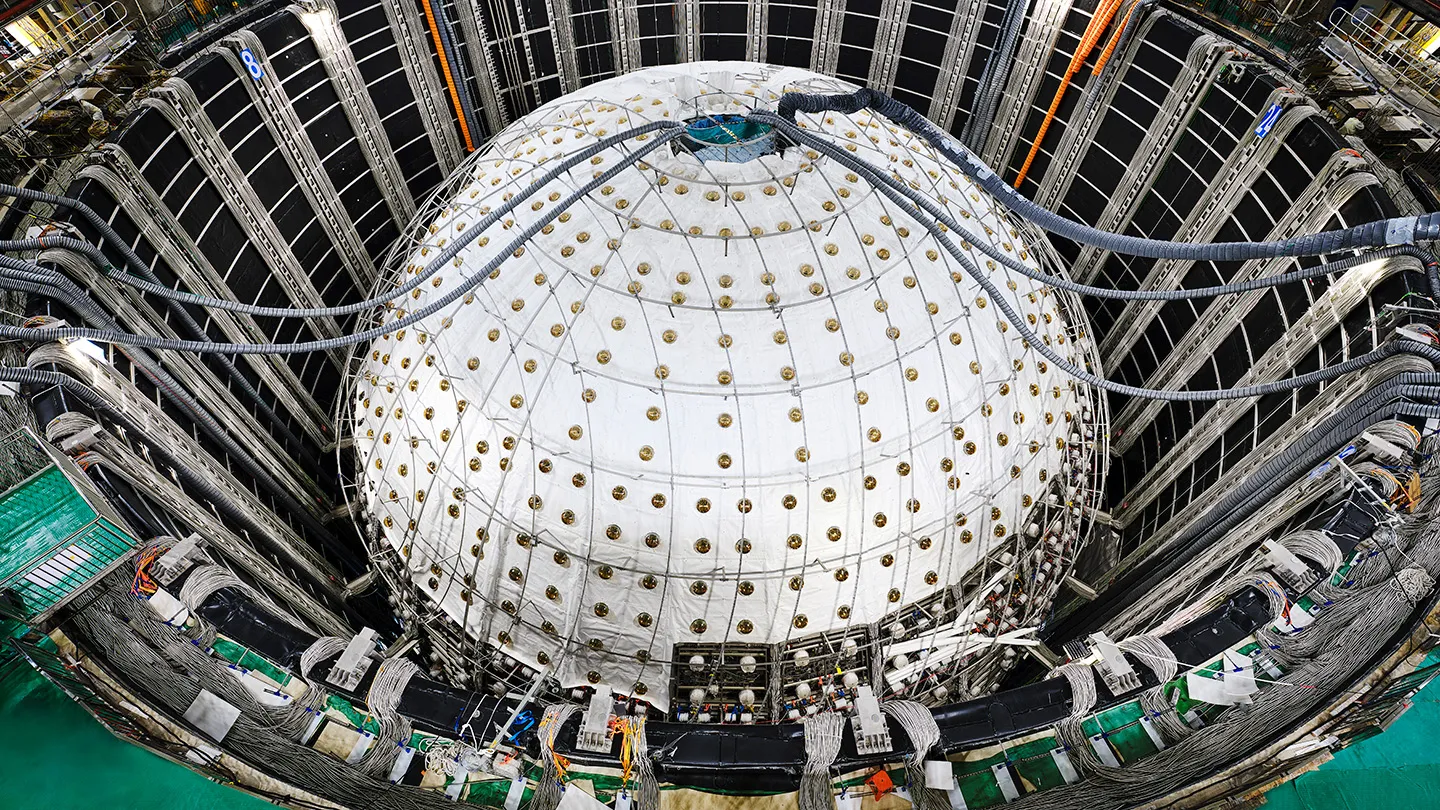
At its heart is a spherical tank filled with 20,000 tons of a specially prepared liquid that flashes faintly when a particle — in this case, an antineutrino — passes through it and reacts. Those flashes are captured by thousands of sensitive light sensors surrounding the tank.
JUNO's primary source of particles is practical and nearby: the Yangjiang and Taishan nuclear power plants, located about 52 kilometers away. Both plants continuously emit streams of antineutrinos — the mirror-image counterpart to neutrinos — which JUNO intercepts and analyzes.
The Big Question JUNO Is Chasing
Neutrinos come in three distinct types, called "flavors." As they travel, they constantly switch between these flavors in a process called oscillation. Scientists have known about this for years.
What remains unknown is the mass ordering: which of the three flavors is heaviest and which is lightest. Two flavors appear to be close in weight; the third seems to be an outlier. But physicists still don't know which way round that ordering goes.
Cracking this puzzle would be a major step toward understanding the fundamental structure of matter. JUNO's first results haven't resolved the question yet — but they demonstrate that the detector is capable of doing so.
"This first result is not yet a determination of the mass ordering," said Yifang Wang, a physicist at the Chinese Academy of Sciences and spokesperson for the JUNO Collaboration. "Its value is that it validates the detector and the analysis with real data."
Part of a Global Scientific Race
JUNO does not stand alone. Two comparable experiments are in development elsewhere in the world.
The Hyper-Kamiokande detector in Japan and the Deep Underground Neutrino Experiment (DUNE) in the United States are both expected to begin collecting data within the next decade. Each uses different technology and different neutrino sources — meaning they will approach the same questions from different angles, cross-checking and complementing each other's results.
"Together, they will provide a broader and more robust understanding of neutrino properties," Wang said.
Duke University physicist Kate Scholberg, who was not involved in the JUNO study, called the early findings promising. "It really makes me look forward to more exciting results in the future," she said.
What Comes Next
JUNO's team plans to expand its research well beyond nuclear reactor antineutrinos. Future observations are expected to include neutrinos from the sun, from Earth's interior, from the atmosphere — and potentially from a future supernova explosion somewhere in our galactic neighborhood.
The sheer scale of the challenge explains why the facility needed to be so large and so deep. "Enormous numbers of neutrinos pass through the Earth every second, but only a tiny fraction interact," Wang noted. "That is why experiments like JUNO need very large detectors, deep underground sites, careful shielding and long-term stable operation."
The ghost particle hunt has officially begun in earnest.
.
Sources:
- Reuters – "Underground detector in China gains insights on ghostly neutrinos" (June 10, 2026): https://www.reuters.com/science/underground-detector-china-gains-insights-ghostly-neutrinos-2026-06-10/
- AP News – "An underground detector in China unveils its first major findings about mysterious ghost particles" (June 10, 2026): https://apnews.com/article/juno-neutrino-detector-ghost-particle-china-dbe6651b664d4af09004f9ad80937325
- Nature – Original JUNO study (June 10, 2026): https://www.nature.com/
- JUNO Collaboration – Official project information: http://juno.ihep.cas.cn/
.
What's Your Reaction?
 Like
0
Like
0
 Dislike
0
Dislike
0
 Love
0
Love
0
 Funny
0
Funny
0
 Wow
0
Wow
0
 Sad
0
Sad
0
 Angry
0
Angry
0













Comments (0)