

China's Military Shadow Grows Over Australia: New Report Warns of Expanding Strike Reach
A new report by Australia's leading foreign policy think tank concludes that China already possesses the ability to strike northern Australia with ballistic missiles — and that this threat will grow substantially over the next decade. The immediate dangers, however, lie elsewhere: in cyberspace, undersea cables, and the strategically vital Pacific island chain.

.
Missiles, Bombers, and a Widening Threat Window
Australia faces a measurably growing military threat from China, according to a comprehensive new assessment published this week by the Lowy Institute, a respected Sydney-based foreign policy research organization.
The institute's report concludes that China is already capable of launching direct missile strikes against Australia, and that this threat will expand considerably over the coming decade as Beijing fields longer-range and hypersonic weapons and continues to reinforce its artificial island outposts in the South China Sea.
The primary near-term threat comes from Chinese missiles launched from warships, submarines, and a new intermediate-range ballistic missile system that can reach Australian territory from Chinese-controlled positions. The weapon in question — the DF-27 — has a confirmed range of between 5,000 and 8,000 kilometres, according to U.S. military assessments published in December.
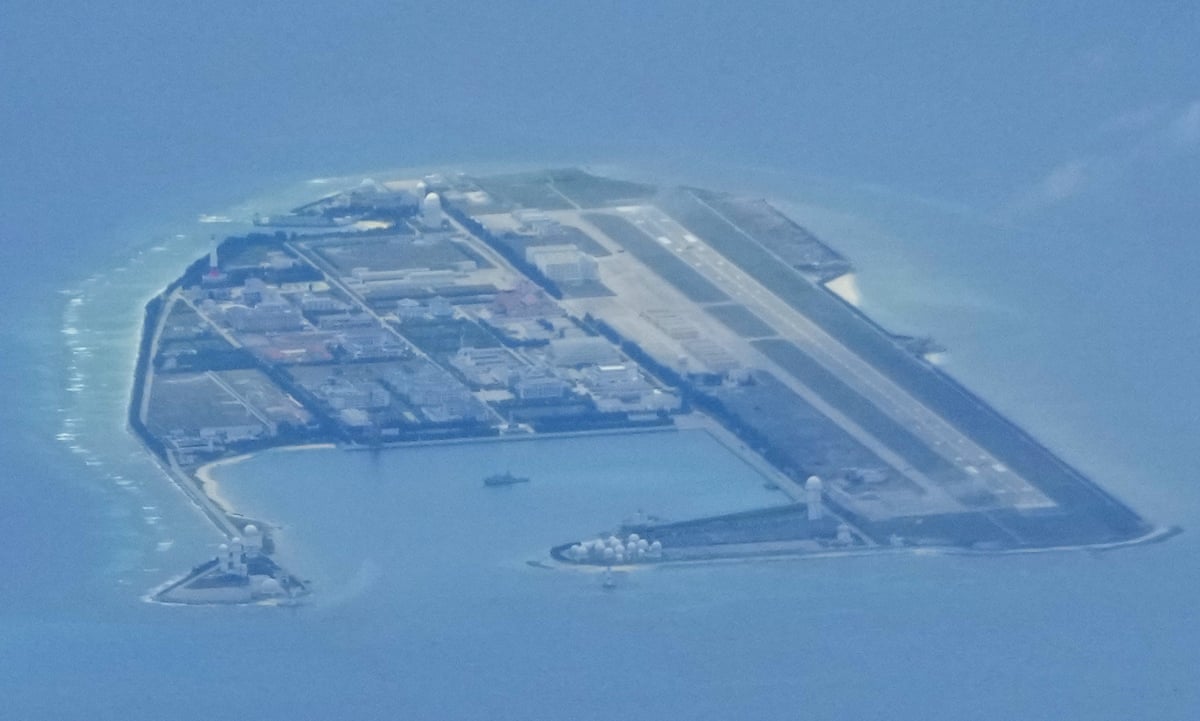
China's People's Liberation Army (PLA) has built and militarized a series of artificial islands across the disputed South China Sea. The DF-26 intermediate-range ballistic missile can already reach northern Australia if deployed to these outposts.
The Silent Threats: Cables, Cyber, and Trade Routes
The report is careful to note that a dramatic missile exchange is not the likeliest near-term scenario. The Lowy Institute identifies less visible — but potentially equally disruptive — threats as the most immediate concern.
China's ability to intercept Australia's maritime trade, sever undersea communications infrastructure, conduct sophisticated cyber operations, and project naval power into Australian waters is already robust and is expected to grow substantially over the coming decade.
Undersea cables carry the vast majority of the world's internet traffic and financial transactions. Cutting them — an act deniable and difficult to attribute — could cause economic paralysis far exceeding the impact of a conventional strike.
China also possesses strong capabilities to disrupt Australia's seaborne trade through key chokepoints in the Indonesian archipelago, a critical vulnerability for a continent-nation that relies heavily on maritime supply chains.
The Game-Changer: Bases in the Pacific
What could transform the threat picture most dramatically is not a technological leap, but a geographic one.
Two factors could quickly and dramatically alter China's strike capacity against the Australian landmass: the deployment of a new long-range bomber — either crewed or drone-operated — or the repositioning of existing bombers and missiles to bases closer to Australia.
China is known to be developing the H-20 stealth bomber. The Pentagon assessed in December 2024 that the H-20 would not make its debut until "sometime in the next decade," meaning meaningful deployment is unlikely before the mid-2030s at the earliest. Separately, in September 2025, evidence emerged of a stealthy drone aircraft with sufficient size and range to strike targets anywhere in Australia — though it is not known if or when this aircraft will enter service.
The more immediate concern is basing rights. Beijing has actively pursued security arrangements with Pacific Island nations for years. The Lowy Institute report states plainly: any Chinese military base in the Pacific would bring central Australia within bomber range and allow attacks to be mounted with far greater frequency than is currently possible.
The Solomon Islands Flashpoint
No Pacific nation better illustrates the strategic stakes than the Solomon Islands, which sits roughly 1,700 kilometres northeast of Australia.
In April 2022, China signed a wide-ranging security pact with the Solomon Islands. A draft version of the agreement, which leaked before signing, included provisions that could allow Chinese armed police and naval vessels to be deployed to the archipelago — alarming both Washington and Canberra.
The pact prompted an intense Australian diplomatic response. The Solomon Islands' new Prime Minister, Matthew Wale, visited Canberra earlier this month and announced that his government would negotiate a comprehensive strategic treaty with Australia and review the existing security agreement with China.
The announcement was the latest in a series of deals Australia has pursued with Pacific neighbours in an effort to counter Beijing's expanding regional influence.
Shifting the Balance of Power — With or Without a Strike
The Lowy Institute is deliberate about the scope of its analysis: it evaluates capability, not intent. Sam Roggeveen, the institute's International Security Program director, described the report as "neither hawkish nor dovish, neither alarmist nor complacent," adding that the PLA's buildup represents the most consequential shift in Australian security since the end of the Cold War.
The broader strategic point stands regardless of whether Beijing ever fires a shot. China's potential to field a long-range sealift and power projection capacity could eventually dwarf anything Imperial Japan threatened Australia with during the Second World War. Defence policy, the report notes, operates in the realm of low-probability, high-consequence events.
Australia has responded by deepening its security alliances, signing the AUKUS submarine deal with the United States and the United Kingdom, and accelerating investment in long-range strike capabilities. The competition for influence across the South Pacific — once considered firmly within the Western sphere — has become one of the defining contests of the current decade.
.
Sources
- Lowy Institute – Understanding the Chinese Military Threat to Australia (2026): https://www.lowyinstitute.org/publications/understanding-the-chinese-military-threat-to-australia
- Reuters – Solomon Islands to negotiate treaty with Australia, review China security pact (June 3, 2026): https://www.reuters.com/world/china/australia-solomon-islands-agree-negotiate-comprehensive-treaty-2026-06-03/
- AFP/Yahoo News – China direct strike threat to Australia 'growing': report (June 15, 2026): https://www.yahoo.com/news/world/articles/china-direct-strike-threat-australia-123035730.html
- South China Morning Post – China's direct strike threat to Australia is 'growing' (June 15, 2026): https://www.scmp.com/news/asia/australasia/article/3357080/chinas-direct-strike-threat-australia-growing-think-tank-report-finds
- VOA News – China Signs Security Agreement with Solomon Islands (April 2022): https://www.globalsecurity.org/wmd/library/news/china/2022/04/china-220419-voa01.htm
- SBS News – Solomon Islands and Australia push forward on treaty (June 3, 2026): https://www.sbs.com.au/news/podcast-episode/solomon-islands-and-australia-push-forward-on-treaty-as-china-ties-reconsidered/mb2gsrtrc
.
What's Your Reaction?
 Like
0
Like
0
 Dislike
0
Dislike
0
 Love
0
Love
0
 Funny
0
Funny
0
 Wow
0
Wow
0
 Sad
0
Sad
0
 Angry
0
Angry
0










Comments (0)