

Death Sentences for Two Uyghurs Bring 11-Year Bangkok Bombing Case to a Verdict
A Thai court has handed down death sentences to two Uyghur men for a 2015 bomb attack on Bangkok's Erawan Shrine that killed 20 people. The ruling closes a trial that took more than a decade — but the case remains deeply contested, with serious questions about due process, motive, and what the verdict means for Uyghur refugees in Southeast Asia.

.
A Long-Awaited Verdict in Bangkok
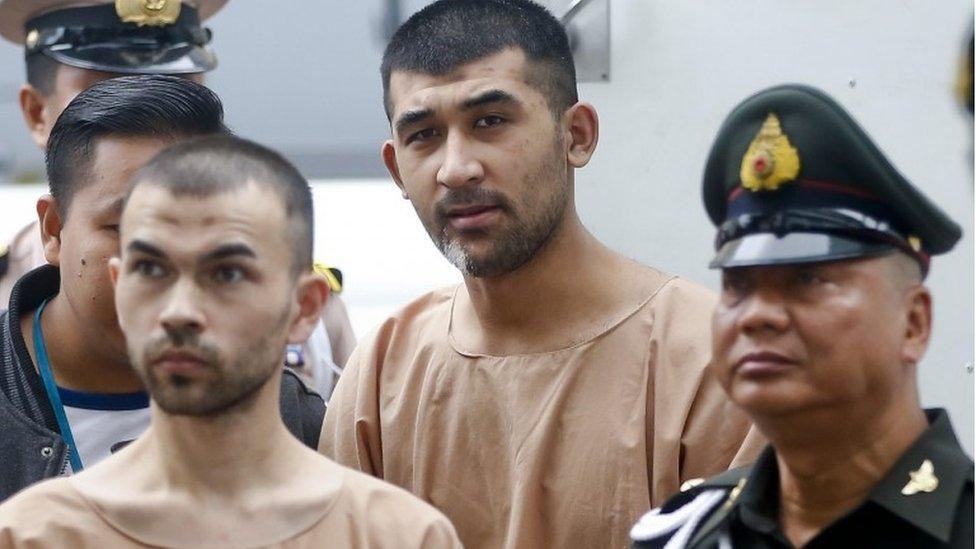
More than eleven years after a bomb tore through one of Bangkok's most visited landmarks, a Thai court has finally delivered its judgment. On June 11, 2026, four judges at the Bangkok South Criminal Court sentenced Yusufu Mieraili and Bilal Mohammad — also known as Adem Karadag — to death for their role in the August 17, 2015, bombing of the Erawan Shrine.
The court found the evidence against both men overwhelming. Prosecutors had built a case from video footage, fingerprints, and physical evidence collected over years. Neither man was able to present sufficient counter-evidence to challenge the charges of premeditated murder, attempted murder, and illegal possession of explosive materials.
"The actions of both defendants constitute multiple separate offenses," the court stated, noting that the premeditated murder charges alone carried the death penalty under Thai law.
The Attack: 20 Dead at a Sacred Tourist Site
The Erawan Shrine sits at the heart of Bangkok's Ratchaprasong intersection — one of the city's busiest commercial and tourist areas. The four-faced statue of the Hindu god Brahma is considered sacred by Thai Buddhists and draws large crowds, particularly visitors from China.
At around 6:55 p.m. on August 17, 2015, an explosion ripped through the site. Twenty people were killed and more than 120 injured. Among the dead were five people from mainland China and two from Hong Kong — a detail that would later fuel theories about the political nature of the attack.
No group ever claimed responsibility for the bombing.
A Trial That Took Over a Decade
The sheer scale of the case contributed heavily to its length. The proceedings involved more than 400 prosecution witnesses, over 45 defense witnesses, and tens of thousands of pages of documentation.
Finding qualified interpreters capable of translating proceedings into Uyghur proved a persistent obstacle. At one point during Thursday's hearing, Mieraili — who taught himself Thai while in detention — was asked to translate portions of the proceedings into Uyghur for his co-defendant because only an English interpreter was available.
The trial also moved between legal systems: it began in a military court in 2016, before being transferred to the civilian Bangkok South Criminal Court in 2019.
Defendants Maintain Their Innocence
Both men initially confessed during police questioning shortly after their arrests in August and September 2015. They pleaded not guilty when formal proceedings began and have maintained that position ever since.
Both claim they were subjected to mistreatment and torture while in detention — allegations the court rejected on Thursday, stating there was no evidence of coercion. Mieraili, visibly distressed after the verdict was read, called out in broken Thai: "I did not receive justice. I ask Thai people to help me."
Their defense lawyers have announced they will appeal. Under Thai law, appeals must be filed within one month of the verdict. "Don't be frightened — there are three other courts," one of the attorneys told reporters outside the courthouse.
In 2023, the International Federation for Human Rights (FIDH) submitted a formal petition to the United Nations, alleging numerous violations of fair trial standards, including a lack of legal basis for the initial arrests and discriminatory treatment of the defendants.
What Was the Motive?
The true motive behind the bombing has never been definitively established, and two competing explanations have circulated since 2015.
Thai authorities publicly attributed the attack to a people-smuggling network that had been disrupted by a police crackdown earlier that year. That crackdown came after abandoned jungle camps — used by Rohingya refugees fleeing Myanmar and migrants from Bangladesh — were discovered near the Thai-Malaysian border.
A second, widely discussed theory points in a different direction: one month before the bombing, Thailand forcibly repatriated more than 100 Uyghur men, women, and children to China — despite international protests. Many Uyghurs flee the Xinjiang region of northwestern China, where the Chinese Communist Party (CCP) has imposed sweeping restrictions on religious practice, language, and cultural life. UN human rights bodies, independent researchers, and governments across the West have documented what they describe as mass surveillance, forced labor, and arbitrary detention in Xinjiang.
The fact that the Erawan Shrine was especially popular among Chinese tourists led several analysts to conclude that the bombing carried a political dimension — a strike at a symbol of Chinese presence on Thai soil.
Beijing Welcomes the Ruling
China's foreign ministry was quick to endorse Thursday's verdict. Spokesperson Lin Jian called the attack an act of "utter inhumanity" and said Beijing "supports Thailand in conducting the trial in accordance with the law and severely punishing the perpetrators."
The statement is notable given the CCP's consistent framing of any Uyghur resistance — armed or otherwise — as terrorism. Beijing has long pressured neighboring countries to return Uyghur nationals who have fled across borders.
Thailand's Uyghur Policy Under Scrutiny
The verdict comes against the backdrop of ongoing controversy over Thailand's treatment of Uyghur asylum seekers. In early 2025, Thai authorities deported 40 Uyghur men back to China — a move carried out despite explicit warnings from United Nations human rights experts, who stated the deportees faced a real risk of torture, serious mistreatment, and what they described as "irreparable harm" upon return.
Rights organizations condemned the deportation. Critics pointed out that Thailand is not a signatory to the 1951 Refugee Convention and has repeatedly acted in ways that prioritize its relationship with Beijing over its obligations under international humanitarian norms.
Separately, charges against a Thai woman — Wanna Suansan, who had been accused of renting property and providing materials to the bombers — were dropped in November 2024 due to insufficient evidence. Of the 17 suspects Thai authorities originally identified in connection with the attack, only three were ever apprehended.
What Comes Next
The defense has made clear it will pursue every available avenue of appeal. Whether the death sentences will ultimately be carried out remains an open question — Thai courts have a lengthy appellate process, and international pressure surrounding any execution of Uyghur nationals would be significant.
For the Uyghur community more broadly, the case serves as a grim illustration of the pressures facing members of the ethnic group who attempt to escape China's Xinjiang region. Caught between persecution at home, hostile reception in transit countries, and deportation under pressure from Beijing, many face a path with few safe exits.
.
Sources
- Reuters – "Thai court sentences two Uyghur men to death for 2015 Bangkok bombing" (June 11, 2026): https://www.reuters.com/world/asia-pacific/thai-court-sentences-two-uyghur-men-death-2015-bangkok-bombing-2026-06-11/
- AP News – "Thai court sentences 2 Uyghur men to death over 2015 Bangkok bombing that killed 20" (June 11, 2026): https://apnews.com/article/thailand-erawan-shrine-bombing-2015-convicted-sentenced-6e1f0ab2f99b2b630df34aa79e1c29d2
- The Nation Thailand – "Erawan Shrine bombing case reaches verdict after decade-long trial" (June 10, 2026): https://www.nationthailand.com/news/general/40067259
- BBC News – "Bangkok Erawan shrine bomb: Uighur suspects plead not guilty" (2016, background): https://feeds.bbci.co.uk/news/world-asia-35585192
- AP News (background) – Thailand deports 40 Uyghurs to China (2025): https://apnews.com/article/uyghur-china-deportation-thailand-xinjiang-human-rights-7a05b58e7f552a3651b90d76a0899e92
.
What's Your Reaction?
 Like
0
Like
0
 Dislike
0
Dislike
0
 Love
0
Love
0
 Funny
0
Funny
0
 Wow
0
Wow
0
 Sad
0
Sad
0
 Angry
0
Angry
0









Comments (0)