

China’s ‘Two Sessions’ Open Amid Increased Defense Spending, Military Purge, and Iran Uncertainty


.
The ‘Two Sessions’ and Defense Spending
The Two Sessions involve the National People’s Congress (NPC), the CCP’s rubber-stamp congress, and the Chinese People’s Political Consultative Conference (CPPCC), the CCP’s top political advisory body. The CPPCC session started on March 4, and the NPC session started on March 5. Both will last eight days.The Two Sessions center on the government work report and a draft outline for China’s upcoming 15th Five-Year Plan. However, for some analysts, the immediate focus is on Beijing’s newly announced growth target for 2026, which is the lowest in decades, at a range of 4.5 percent to 5 percent.
The sessions traditionally focus on government policy plans and long-term development strategies, but analysts have said that one closely watched issue this year is China’s defense spending.
Chinese state media outlet the Global Times reported on March 5 that the CCP’s rubber-stamp congress just unveiled a 7 percent increase to the regime’s defense budget, at roughly $275 billion. This is a slight decline from the 7.2 percent increase in each of the past three years.
Sun Kuo-hsiang, a professor of international affairs and business at Nanhua University in Taiwan, told The Epoch Times that for China’s leadership, defense spending is not merely a response to external threats but a core political priority. Even during economic slowdowns, military outlays have consistently grown faster than the overall economy.
He described defense spending as a rigid expenditure tied to regime security, deterrence in the Taiwan Strait, military–civil fusion in technology, and competition with major powers.
A Deepening Military Purge
The political backdrop is equally unsettled.Personnel cuts have extended beyond the top ranks.
Iran War and Energy Risks
Events in the Middle East have added another layer of uncertainty.U.S.-based China current affairs commentator Wang He told The Epoch Times that prolonged instability in Iran could disrupt China’s oil shipments. Because China’s oil import dependence exceeds 70 percent, any sustained supply shortage from Iran could pose serious economic challenges.
Insiders have said that Khamenei’s death carries symbolic weight as well. Beijing has long opposed what it calls “foreign interference” in sovereign states, and the assassination of the Iranian leader could be viewed by the CCP as a troubling precedent.
According to a Beijing-based insider who spoke to The Epoch Times on the condition of anonymity because of fear of reprisal, the CCP’s senior leaders have held multiple meetings to assess the Middle East situation and its potential domestic impact, including the possibility that unrest abroad could influence public opinion at home.
Together, rising defense spending, ongoing military purges, and geopolitical uncertainty in the Middle East have created a complex backdrop for this year’s Two Sessions, highlighting the range of internal and external challenges confronting Beijing as the leadership sets priorities for the coming year.
.
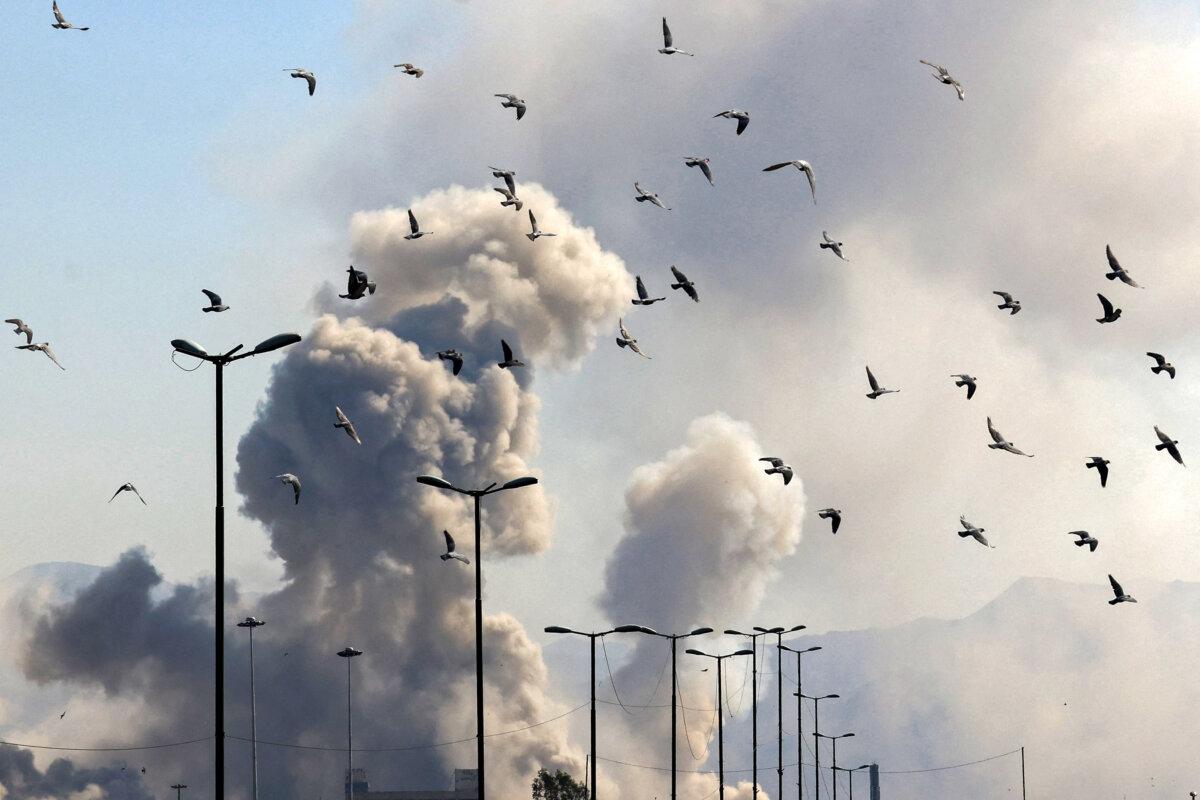
Smoke rises after a strike on the Iranian capital of Tehran on March 5, 2026. Atta Kenare/AFP via Getty Images
.
Ning Haizhong and Luo Ya contributed to this report.
.
What's Your Reaction?
 Like
0
Like
0
 Dislike
0
Dislike
0
 Love
0
Love
0
 Funny
0
Funny
0
 Wow
0
Wow
0
 Sad
0
Sad
0
 Angry
0
Angry
0













Comments (0)