

China’s Influence in Panama Weakens as Court Cancels Hong Kong Company’s Canal Contracts


.
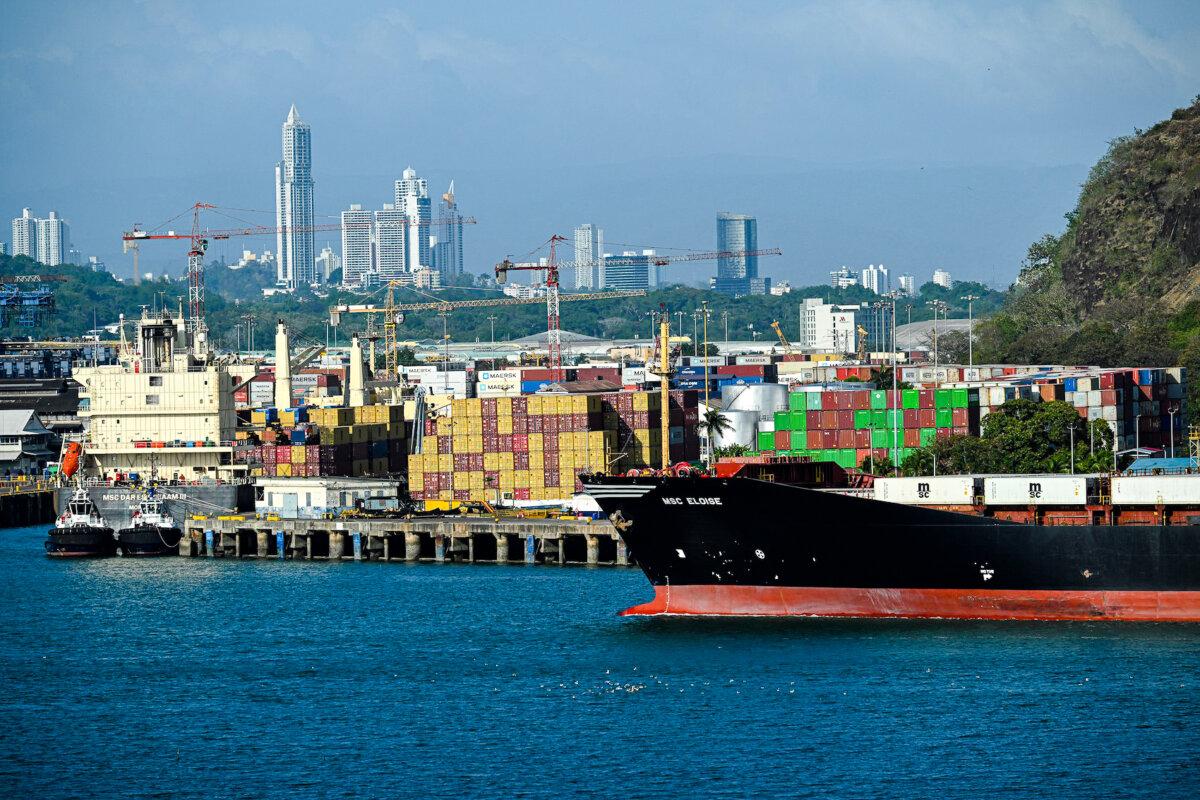
The Panama Supreme Court’s decision to invalidate Hong Kong-based CK Hutchison’s contract to operate the ports at both ends of the Panama Canal has weakened Beijing’s control over the key waterway, but the process may drag out as the Chinese regime fights to maintain its influence in the region, according to analysts.
Panama’s supreme court ruled on Jan. 29 that the concession held by Panama Ports Co., a subsidiary of CK Hutchison Holdings, is unconstitutional.
Panamanian President José Raúl Mulino said at a news conference on Jan. 30 that APM Terminals, a port operator under the Maersk Group, will temporarily take over operations at the two ports. Mulino also said the ports will continue to operate without interruption or layoffs.
This ruling is based on the findings of an audit by the Panamanian comptroller general’s office, which found several irregularities in the 25-year contract extension granted to Panama Ports Co. in 2021. These included unpaid fees, accounting errors, and suspected “ghost” concessions, which have cost Panama an estimated $300 million since 2021 and $1.2 billion since 1997.
The Panama Supreme Court’s ruling is final, but Hong Kong CK Hutchison said on Feb. 4 that its Panama Ports Co. unit has initiated international arbitration proceedings against the ruling.
The Panama Canal, through which 5 percent of global maritime trade passes, was completed in 1914. The United States constructed the canal between 1904 and 1914 and assumed control after a failed French attempt in the 1880s.
The United States played a key role in the early management of the critical waterway and maintained control of the canal after its completion until 1977, when President Jimmy Carter signed a treaty handing over operating rights to Panama.
Currently, the United States and China are the top users of the canal. The United States accounts for 40 percent of the total cargo volume passing through the Panama Canal each year, and China accounts for 21.4 percent.
The Chinese communist regime’s influence in Panama and the canal has grown in recent years. Two of the five ports on the Pacific and Atlantic sides of the Panama Canal were operated by subsidiaries of Hong Kong-based CK Hutchison Holdings.
U.S. officials welcomed the Panama court’s decision.
Secretary of State Marco Rubio posted on X on Jan. 30, “The United States is encouraged by the recent Panamanian Supreme Court’s decision to rule port concessions to China unconstitutional.”
Rep. John Moolenaar (R-Mich.), chair of the U.S. House Select Committee on China, called it a “win for America.”
Danish Company Temporarily Taking Over
Panama’s decision to allow Danish company Maersk to temporarily take over port operations is mainly due to the Panamanian government’s desire to avoid provoking the Chinese Communist Party (CCP) too much, Frank Xie, a professor of business at the University of South Carolina–Aiken, told The Epoch Times.“We know that with the ruling by the Panamanian Supreme Court, the CCP has essentially been forced out of the ports,” Xie said. “The Panamanian government may have some tactful considerations to avoid provoking it.”
He said that for the United States, as long as it gets rid of the influence of the CCP, and European or international companies operate the canal, “there should be no problem.”
“Moreover, the U.S. military is currently stationed directly on both sides of the canal,” he said.
Maersk also operates several ports in the United States and has a large amount of business there, Xie said, which “should be beneficial to keeping the Panama Canal under U.S. control.”
.

U.S.-based economist Davy J. Wong told The Epoch Times that CK Hutchison’s move toward arbitration reflects Beijing’s tactic of delaying and driving up costs rather than deploying stronger trade, financial, or project countermeasures.
Washington’s national security interest in the canal has significantly increased under the Trump administration, Wong said.
CK Hutchison
Xie said the CCP’s response to the voided CK Hutchison contract is to claim that it will protect Chinese companies’ rights, which suggests that the CCP has disregarded its “one country, two systems” framework.The Hong Kong-listed company founded by Li Ka-shing is considered a foreign company under China’s regulations, he noted.
“Now, the CCP claiming it’s a Chinese company reveals the regime’s ambition,” he said.
Taiwanese and Hong Kong-based companies are treated as foreign entities and investors in mainland China.
Legally, CK Hutchison is not a “Chinese company,” Wong said.
“However, in the political context of Beijing, it has been absorbed into the ‘national narrative’ of extending Chinese interests, and is therefore referred to as ‘Chinese capital/Chinese corporate interests,'” he said.
Wong pointed out that this reveals Beijing’s perspective on Hong Kong capital. On crucial geopolitical issues, Hong Kong capital is not treated as a “pure market entity,” but rather as something that can be readily incorporated into the extension of the “national narrative and national interests,” Wong said.
Beijing’s Influence Lingers
Chinese influence in Panama remains “massive,” despite that CK Hutchison has lost its claim to two ports, warned Evan Ellis, a research professor of Latin American studies at the U.S. Army War College Strategic Studies Institute.“The larger problem with putting the Panama Canal at risk is a combination of Chinese physical access relationships and technical knowledge,” Ellis recently told The Epoch Times.
He said that Hutchison is building a fourth bridge over the canal, “with all kinds of regular construction operations on the inside of the Canal Zone and technical knowledge.”
“You have maybe 200 different Chinese companies operating out of Panama, Pacifico, and Colón, doing warehousing operations, doing distribution operations, doing other types of business,” he said.
“From the port’s decision, this is going to drag out for a while with respect to who’s going to own it, who’s going to operate all that.”
.
Wong said that Panama has long served as a nexus for international capital and political elites.
“Changing port operators doesn’t immediately sever supply chains, capital networks, and existing political influence, but it does open a crucial window of opportunity [for getting rid of Beijing’s control],” he said.
This is an ongoing process of strategic maneuvering, Wong said.
“At this stage, Beijing’s influence in Panama has been significantly weakened, but not yet completely dismantled; the true restructuring will depend on how far subsequent judicial and capital restructuring, and U.S.-led security governance, can go,” he said.
Wong suggested that the United States can further reshape Panama’s political and economic environment through compliance measures, sanctions, investment screening, and supply chain security frameworks.
“Under this pressure, the existing external influences and local vested interest groups are either forced to renegotiate, compromise, and reorganize, or choose to relocate and leave,” he said.
Taiwanese political and economic commentator Henry Wu told The Epoch Times that if the court ruling in Panama is ultimately upheld, it would indicate a shift in political winds.
“It will have a demonstrative effect, making some smaller countries that previously leaned toward the CCP—such as Honduras, the Dominican Republic, and even South Korea—realize that aligning with the CCP is no longer beneficial, neither in terms of interests nor security,” he said.
Wu said that “the CCP’s global influence has hit a wall and is beginning to decline.”
“What we are seeing is China’s rise as a great power turning into its demise,” he said.
What's Your Reaction?
 Like
0
Like
0
 Dislike
0
Dislike
0
 Love
0
Love
0
 Funny
0
Funny
0
 Wow
0
Wow
0
 Sad
0
Sad
0
 Angry
0
Angry
0















Comments (0)