

Beijing’s Panic Over Starlink: 2 Major Fears and 3 Desperate Countermeasures


.
Starlink’s Military Applications
The Russia–Ukraine war is the clearest example of Starlink’s military impact. Ukraine has relied heavily on Starlink to gain battlefield advantages over Russia. Some observers regard the war as the first commercial space war.The Ukrainian military has achieved numerous battlefield miracles with Starlink’s help. For instance, despite lacking a significant navy and air superiority, Ukraine used precision-guided missiles, anti-ship missiles, and sea drones to cripple the Russian Black Sea Fleet.
On the other hand, the Russian military obtained Starlink equipment illegally and installed it on drones. By using Starlink to transmit video signals and provide real-time navigation, Russian drones also caused great losses to Ukraine.
In early February, after the Ukrainian defense minister’s talks with Elon Musk, SpaceX deactivated Starlink satellite communications used by the Russian military, quickly turning the tide. The Ukrainian military’s drone forces reportedly said that after the Starlink network was disrupted, Russian drone attacks decreased, and that a key Russian communications system was also disrupted.
Russia is also a space power and has its own Yamal and Express satellite networks. However, these Russian systems are said to be easier to detect and target because of their fixed orientation and lack of mobility.
Starlink Breaks Through Internet Firewalls
In the internet age, the CCP has built a massive censorship system known as the Great Firewall, blocking access to the global internet for more than a billion people, especially websites from Western democracies. The CCP has also exported firewall technology to countries such as Iran, forming what some observers call a digital authoritarian nexus.Starlink, however, is inherently the nemesis of firewalls. As of March 3, Starlink has launched 11,434 satellites into low Earth orbit, according to astrophysicist Jonathan McDowell. With its global network, Starlink allows terrestrial users with Starlink access devices to break free from the limitations of traditional infrastructure and achieve free, high-speed internet access.
A recent event has terrified the CCP even more. According to a Feb. 12 report by The Wall Street Journal, after Iranian authorities brutally suppressed protesters and drastically cut off internet connections in January, the United States, for the first time, directly “smuggled” approximately 6,000 Starlink satellite network terminals into Iran to “help antiregime activists circumvent internet shut-offs in Iran.”
The Wall Street Journal reported that the U.S. State Department’s Middle East bureau once considered virtual private networks (or VPNs) as an alternative to free internet access, but they are “useless when the internet is shut down.” Now, Starlink makes this problem a thing of the past.
.

A protester holds a U.S. flag and a sign with a portrait of the Iranian leader Ayatollah Ali Khamenei, who was killed during U.S.–Israel military operations against the Islamic Republic, in Atlanta, Georgina, on Feb. 28, 2026. Elijah Nouvelage/AFP via Getty Images
.
CCP’s 3 Bizarre Gimmicks
The CCP anticipated this move, so it devised three ridiculous countermeasures against U.S. efforts to provide free access to people behind firewalls.Firstly, Beijing has exerted pressure on Musk and the United States on different occasions.
The Financial Times reported in 2022 that Musk was “under increasing pressure” from Beijing, which “threaten[ed] his access to the world’s biggest consumer market” after he delivered Starlink satellite kits to help Ukraine.
In December 2025, at the United Nations Security Council’s Arria-formula meeting on low-Earth-orbit satellites, the Chinese representative accused Starlink of “seriously hogging orbital slots and radio frequencies, ramping up the risk of satellite collisions and creating way more space debris.”
“Starlink is being heavily used by terrorists, separatist forces, and online scam rings, creating massive headaches for regulation and law enforcement,” the representative also said.
The Chinese representative also avoided naming the United States, yet his criticism is unmistakable—accusing the U.S. of “extensively utilizing commercial space entities to deliver military reconnaissance, battlefield communications, and related services, and even directly intervening in foreign armed conflicts.”
He further claimed that “certain low-orbit satellite constellations flagrantly ignore the laws and regulations of relevant countries, unauthorizedly activating signal services over foreign sovereign airspace and across foreign borders, thereby serving as instruments of interference in other nations’ domestic affairs.”
These statements reveal Beijing’s deep apprehension toward Starlink.
Secondly, Beijing has set up a so-called satellite internet firewall.
.
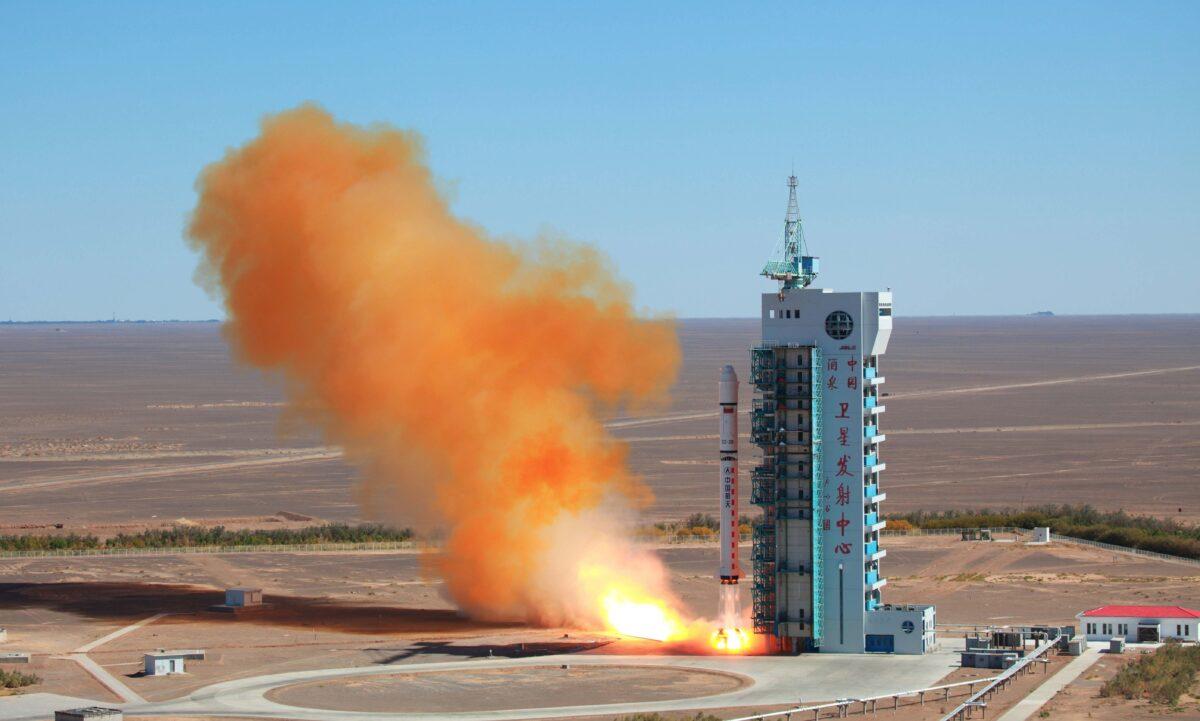
A Chinese rocket takes off with the Venezuelan Earth observation satellite from Gansu Province, China, on Sept. 29, 2012. China's space programs are run by its military. AFP/Getty Images
.
Beijing University of Posts and Telecommunications (BUPT) announced that three satellites developed by BUPT had been successfully launched into space on Sept. 5, 2025, from the Jiuquan Satellite Launch Center in Inner Mongolia using the CERES-1 (also known as Y15) carrier rocket. BUPT touted them as the “first prototype Satellite Internet Firewall,” while rights advocates blasted Beijing for extending the CCP’s Great Firewall into orbit.
Thirdly, Beijing has been competing for resources in low Earth orbit.
Low Earth orbit (LEO) is simply the closest orbits around Earth—generally 1,200 miles or lower in altitude. The Institute for AI and Security Governance, a Beijing-backed think tank, considers the 300–320 miles altitude as the “golden layer” for space-based communications due to its low latency and high bandwidth. The theoretical global capacity for LEO satellites is roughly 60,000, according to a Chinese associate professor at Nanjing University of Aeronautics and Astronautics.
Starlink is currently the dominant player in LEO, aiming for a total of 42,000 satellites.
However, China has been increasing its efforts in the ongoing competition with the United States over satellite frequencies and orbital resources.
For instance, Beijing initiated the Thousand Sails/Qianfan constellation satellite launches in 2024, planning to construct a constellation of 14,000 satellites.
In December 2025 and January 2026, China filed applications with the International Telecommunication Union (ITU) for more than 200,000 satellites, a move viewed by some observers as an attempt to secure orbital space rather than an actual effort to create the largest mega-constellation ever.
Among these satellites, 193,428 were filed on Dec. 29, 2025, by the Institute of Radio Spectrum Utilization and Technological Innovation alone, in two applications—CTC-1 and CTC-2—to the ITU, setting a new record for the number of filings in a single application. It is noteworthy that the institute was registered on Dec. 30, 2025, in Xiong’an City of central Hebei Province, while the applications were filed under its name on Dec. 29, 2025, one day before its registration.
This initiative serves a dual purpose: It positions China to compete head-on with Starlink while securing a strategic high ground for the development of a 6G integrated space-air-ground network, and it also strengthens the overall capabilities of China’s aerospace industrial system.
However, China has yet to master reusable rocket technology, continues to face persistent payload capacity bottlenecks, and still struggles with long satellite development cycles and high manufacturing costs.
That said, Musk has unveiled an even bolder plan. He is seeking approval to launch 1 million satellites to create a global orbital data-center network encircling Earth. These satellites would harness solar energy and deliver unprecedented computing power, designed as a “cost and energy-efficient way to meet the growing demand for AI computing power,” BBC reported last month.
On Feb. 4, the U.S. Federal Communications Commission formally accepted SpaceX’s application for this non-geostationary satellite system and opened it for public comment on March 6.
Conclusion
The bizarre actions reveal the sinister core of the Chinese communist regime: a fear of Starlink and a desire for space supremacy. These motives are not for the good of the people or the country but to maintain its authoritarian control and advance its global ambitions. The CCP is deluded into believing it can dominate the world and views the United States as its principal adversary.Under the Trump administration’s leadership, the United States can achieve true national security only by assisting the Chinese people in dismantling the CCP.
What's Your Reaction?
 Like
0
Like
0
 Dislike
0
Dislike
0
 Love
0
Love
0
 Funny
0
Funny
0
 Wow
0
Wow
0
 Sad
0
Sad
0
 Angry
0
Angry
0















Comments (0)