

The Invisible War Beneath the Waves: How China Is Conquering the World's Most Important Military Frontier
The Invisible War Beneath the Waves: How China Is Conquering the World's Most Important Military Frontier - While the world watches wars in Ukraine and the Middle East, China is quietly winning a conflict nobody is talking about — one being fought in total darkness, thousands of meters below the ocean's surface. And if Beijing succeeds, it could permanently alter the global balance of power.

.
An Analysis by Udumbara.net
.
While the world watches wars in Ukraine and the Middle East, China is quietly winning a conflict nobody is talking about — one being fought in total darkness, thousands of meters below the ocean's surface. And if Beijing succeeds, it could permanently alter the global balance of power.
.
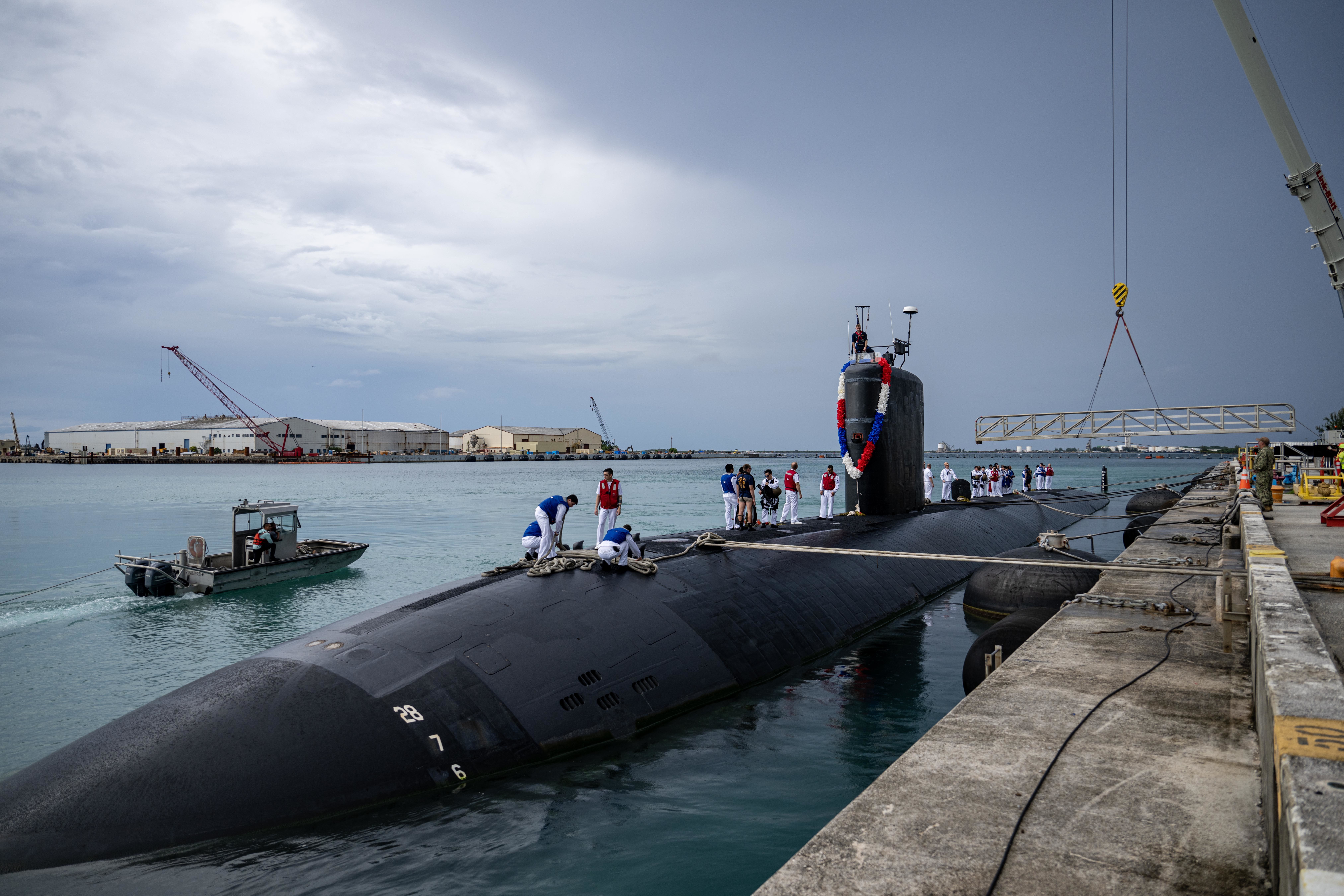
Somewhere in the depths of the Pacific Ocean, an American nuclear submarine glides silently through the dark. For decades, that submarine — and those like it — have represented the ultimate trump card of U.S. military power: invisible, untrackable, and capable of striking anywhere on Earth within minutes. No adversary has ever reliably known where they are.
That is about to change.
China is engaged in the most ambitious undersea intelligence-gathering campaign in history — and according to U.S. naval officials, what Beijing is building beneath the world's oceans is not just a scientific curiosity. It is the infrastructure for a new kind of warfare. One that could, within a decade, render America's most powerful weapon system visible — and therefore vulnerable — for the first time.
The Research Ships That Are Not Just Doing Research
.
A Reuters investigation based on five years of ship-tracking data from 42 Chinese research vessels analyzed by New Zealand firm Starboard Maritime Intelligence reveals for the first time the full geographical scope of what Beijing calls its "transparent ocean" program. The scale, said Ryan Martinson of the U.S. Naval War College, is "frankly astonishing."
The vessel at the heart of the story is the Dong Fang Hong 3 — a research ship operated by Ocean University of China, whose president has publicly celebrated the institution's close ties to China's navy. The ship spent 2024 and 2025 surveying waters near Taiwan and Guam, as well as regions of the Indian Ocean. In March 2025, it conducted an extensive survey between Sri Lanka and Indonesia, covering maritime approaches to the Malacca Strait, one of the world's most important shipping chokepoints. While the university describes the ship's activities as climate research and sediment surveys, naval analysts say the deep-sea data it collects has clear military value.
The Dong Fang Hong 3 is not alone. Over the past five years, 42 Chinese research vessels have been active across three major oceans, forming a systematic operation involving dozens of ships and hundreds of sensors. China's mapping activities are concentrated in militarily sensitive regions, including waters around the Philippines and the First Island Chain, and areas near U.S. bases in Guam and Hawaii.
The pattern of movement is the tell. To collect detailed information on underwater terrain, research vessels map the seabed by traveling back and forth in closely spaced lines — a pattern clearly visible in the tracking data reviewed by Reuters across extensive areas of the Pacific, Indian, and Arctic oceans. This is not how ships doing climate research move. This is how armies survey a battlefield before the fighting begins.
Why the Ocean Floor Is a Military Asset
.
To understand why this matters, you need to understand the physics of underwater warfare.
Submarines are invisible because they are silent — and because the oceans are, for most practical purposes, opaque. Sound waves bounce and bend unpredictably as they travel through water, depending on temperature, salinity, ocean currents, and the shape of the seafloor. A submarine that knows exactly how sound propagates in a given patch of ocean can use that knowledge to hide itself or to find the enemy.
As Jennifer Parker, a former Australian anti-submarine warfare officer and defense scholar, told Reuters: "The scale of what they're doing is about more than just resources. If you look at the sheer extent of it, it's very clear that they intend to have an expeditionary blue-water naval capability that also is built around submarine operations."
Peter Scott, a former chief of Australia's submarine force, described the survey data as "potentially invaluable in preparation of the battlespace" — explaining that commanders need detailed knowledge of underwater terrain to avoid collisions, hide their vessels, and track adversaries operating within a few hundred meters of the surface.
This is precisely what the U.S. Office of Naval Intelligence has been warning about. Rear Admiral Mike Brookes, in testimony to a congressional commission, said China had dramatically expanded its surveying efforts, providing data that "enables submarine navigation, concealment, and positioning of seabed sensors or weapons" — and that "potential military intelligence collection" by Chinese research vessels "represents a strategic concern."
The "Transparent Ocean": Beijing's Master Plan
.
Behind the individual research ships lies a far more ambitious strategic concept — one that China's military planners have been developing for over a decade.
The Transparent Ocean Project was proposed around 2014 by Ocean University scientist Wu Lixin, who received at least $85 million in funding from China's Shandong provincial government. The idea was deceptively simple: deploy enough sensors across enough ocean that the underwater environment becomes, in real time, fully visible to Chinese authorities — just as radar made the skies visible in the 20th century.
The People's Liberation Army is building what experts describe as an "invisible net" across the western Pacific — a five-layer, seabed-to-space sensor architecture that challenges the ability of U.S. and allied submarines to maneuver and hide.
Those five layers, as described by defense analysts Tye Graham and P.W. Singer in Defense One, work together as an integrated system:
The outermost layer — Ocean Star Cluster — is a satellite constellation using radar and laser-based ocean profiling for wide-area detection. Below that, the Air-Sea Interface layer deploys smart buoys, wave gliders, and unmanned surface vessels. Deeper still, Starry Deep Sea sends autonomous underwater vehicles patrolling below the ocean's mixed layer for weeks at a time. The foundation is Undersea Perspective — a seabed network of observatories and cabled hubs that serve as docking and recharging stations for unmanned submarines, dramatically extending their endurance. And tying it all together is Deep Blue Brain: an AI-powered data fusion center that merges input from all layers and identifies targets.
The capability of this system was demonstrated during the Joint Sea-2025 exercises near Vladivostok, where Chinese and Russian forces linked their communications and shared hydro-meteorological and air-sea tracks in real time, with the stated goal of leaving deep-diving submarines with nowhere to hide.
A Chinese Ocean University researcher who oversees the Indian and Pacific sensor arrays pledged in a 2025 press release to "transform the most advanced scientific and technological achievements into new types of combat capabilities."
The Last American Advantage — Now Under Threat
.
For the United States, underwater dominance has never been merely a military preference — it has been a strategic cornerstone. In a simulated Chinese invasion of Taiwan, four U.S. nuclear attack submarines and one guided-missile submarine sank 53 enemy ships in just two weeks, including two aircraft carriers and two amphibious assault ships. U.S. submarines could wreak havoc on a Chinese invasion force — their operational reach bypasses the need for overseas bases, unlike carrier groups, and their stealth gives them access to the most contested waters.
That stealth is the variable China is working to eliminate.
For now, U.S. submarines "still have a significant advantage in quieting and sensor performance," according to naval warfare expert Chris Carlson. But a new RUSI report warns that China's submarine fleet is rapidly closing the qualitative gap — and that Beijing's upcoming Type 095 nuclear attack submarine will be significantly larger and quieter than its predecessors, while the new Type 096 ballistic missile submarine will be armed with 24 missiles capable of striking the continental United States from protected Chinese waters.
Analysts predict that the oceans could become "transparent" in the mid-2030s — much like how radar made the skies transparent in the early 20th century — through the combination of AI-driven sensor fusion and China's expanding underwater network.
What the U.S. and Its Allies Must Do
.
The challenge is real — but so are the countermeasures being developed.
Defense analysts recommend that the U.S. and its allies adopt a "mesh-vs-mesh" approach: rather than simply trying to hide, they must build counter-sensing and counter-drone capabilities, develop deception and jamming tactics, and create joint systems that can hunt and disrupt China's underwater drones before they establish a permanent presence. Australia's Ghost Shark unmanned submarine and Japan's investments in long-range underwater communications are steps in that direction — but they need to be woven into a cohesive, rehearsed allied playbook.
The urgency is heightened by timing. The transparent ocean programme sits within a broader pattern of China positioning itself as the dominant power in the Indian Ocean region, while the United States is consumed by its Middle East campaign. Every month of distraction is a month Beijing uses to lay more cable, deploy more sensors, and map more seafloor.
The oceans have always been a domain of invisible power. For seventy years, that invisibility belonged overwhelmingly to the United States and its allies. China has decided it wants that advantage for itself — and it is pursuing that goal with a patience, scale, and strategic coherence that Washington is only beginning to fully grasp.
The war beneath the waves has already begun. Most people just cannot see it yet.
.
Sources:
- Reuters – China Is Mapping the Ocean Floor as It Prepares for Submarine Warfare with the U.S. (March 24, 2026): https://www.japantimes.co.jp/news/2026/03/24/asia-pacific/politics/china-ocean-submarine-warfare-us/
- Defense One – China's Burgeoning Undersea Sensor Net Aims to Turn the Ocean Transparent (October 2025): https://www.defenseone.com/threats/2025/10/chinas-burgeoning-undersea-sensor-net-aims-turn-ocean-transparent/408815/
- Asia Times – China's AI Sea Grid Aims to Render US Subs Transparent (October 2025): https://asiatimes.com/2025/10/chinas-ai-sea-grid-aims-to-render-us-subs-transparent/
- Asia Times – China's Undersea Great Wall Targets US Sub Supremacy (March 2026): https://asiatimes.com/2026/03/chinas-undersea-great-wall-targets-us-sub-supremacy/
- Interesting Engineering – China Conducting Oceanographic Surveys for Undersea Surveillance (March 2026): https://interestingengineering.com/military/china-mapping-ocean-bed-for-submarine-war
- International Business Times SG – China Is Mapping India's Surrounding Seas (March 2026): https://www.ibtimes.sg/china-mapping-indias-surrounding-seas-submarine-warfare-indian-ocean-scale-astonishing-84707
- National Security Journal – Advanced Chinese Submarines Could Threaten U.S. Underwater Dominance (November 2025): https://nationalsecurityjournal.org/advanced-chinese-submarines-could-threaten-u-s-underwater-dominance-study-warns/
- National Security Journal – The U.S. Navy's Achilles Heel: China's Underwater Drones (September 2025): https://nationalsecurityjournal.org/the-u-s-navys-achilles-heel-chinas-underwater-drones/
- Military Times – China Maps Ocean Floor as It Prepares for Submarine Warfare with U.S. (March 2026): https://www.militarytimes.com/news/your-military/2026/03/24/china-maps-ocean-floor-as-it-prepares-for-submarine-warfare-with-us/
- U.S. Naval War College / Ryan Martinson – Quoted in Reuters Investigation: https://usnwc.edu
.
What's Your Reaction?
 Like
3
Like
3
 Dislike
0
Dislike
0
 Love
3
Love
3
 Funny
0
Funny
0
 Wow
3
Wow
3
 Sad
0
Sad
0
 Angry
0
Angry
0















Comments (0)