

Spain's Sanchez Courts Beijing — But Who's Really Winning?
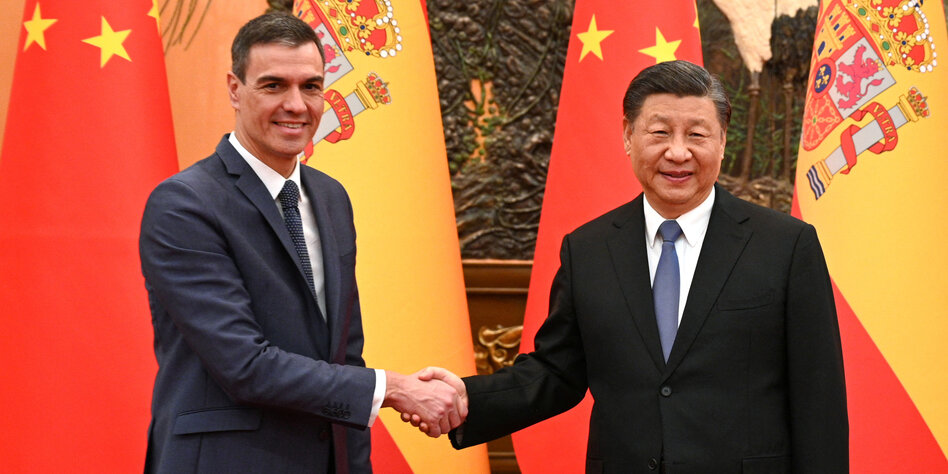
Spanish Prime Minister Pedro Sanchez arrived in Beijing on Monday for what has become an almost annual ritual: pitching China as Europe's indispensable partner while the trade deficit between the two countries quietly balloons. Speaking at Tsinghua University, Sanchez called on China to take a more prominent global role — on climate change, artificial intelligence, nuclear weapons, and international security. His tone was warm. The numbers behind the visit, however, tell a more sobering story.

.
Spanish Prime Minister Pedro Sanchez is making his fourth trip to China in four years, championing closer ties with Beijing. Critics warn it comes at a steep cost — and raises uncomfortable questions about Europe's strategic coherence.
.
A Familiar Trip With Familiar Problems
Spanish Prime Minister Pedro Sanchez arrived in Beijing on Monday for what has become an almost annual ritual: pitching China as Europe's indispensable partner while the trade deficit between the two countries quietly balloons.
Speaking at Tsinghua University, Sanchez called on China to take a more prominent global role — on climate change, artificial intelligence, nuclear weapons, and international security. His tone was warm. The numbers behind the visit, however, tell a more sobering story.
Spain's trade deficit with China reached €42.3 billion (roughly $49 billion) in 2025 — a country of 50 million people facing a structural imbalance with a nation of 1.4 billion. That deficit, Sanchez himself acknowledged, now accounts for 74% of Spain's total trade shortfall with the entire world.
The Bridge Builder Narrative
Sanchez has long positioned Spain as a "bridge" between Brussels and Beijing. Spain has been one of Europe's loudest proponents of treating China as a strategic ally rather than the economic and geopolitical rival that Washington views it as.
That stance has taken on new urgency in 2026. Trump's tariffs and unpredictable foreign policy have caused concern among European allies. Leaders from Britain, Canada and Germany have recently visited Beijing, each seeking to diversify trade partnerships away from Washington.
Sanchez fits neatly into that pattern — but with an added dimension. Trump threatened last month to cut trade with Spain after Madrid denied the use of its military bases for U.S. strikes against Iran. Sanchez's response was to deepen ties with Beijing instead.
Concrete Goals, Thin Delegation
Despite the diplomatic pageantry, the practical ambitions of the visit appear modest. No major business deals are expected, and Sanchez did not bring a trade delegation with him — raising questions about whether the trip will yield concrete economic results or remain primarily a geopolitical statement.
Madrid's stated hope is to boost agricultural and manufacturing exports. Spanish government sources said a primary goal is to secure greater market access for agricultural and industrial goods and to explore joint ventures in the technology sector. Officials are also working on a poultry export deal complicated by bird flu restrictions.
Chinese investment in Spain surged from €149 million in 2024 to €643 million in 2025 — a figure Madrid welcomes, though analysts note that Chinese investment typically flows toward sectors of strategic interest to Beijing, not necessarily to the benefit of Spanish workers or supply chains.
The CCP's Willing Stage
Beijing has been more than happy to host the parade of European leaders. For China's Communist Party leadership, each visiting prime minister serves a clear purpose: it signals that the West is divided, that Washington's pressure campaign to isolate Beijing is failing, and that business with the Party-state remains open.
China's Foreign Ministry described Spain as "an important cooperation partner in the EU" and said the two countries had achieved "robust development" — language designed to project normalcy and signal stability to other potential visitors.
What Beijing does not advertise is the structural asymmetry at the heart of these relationships. Germany's trade deficit with China reached €90 billion last year — a figure that has grown fourfold since 2020. Britain's trade deficit with China ballooned by over 18% year-on-year to £42 billion in the 12 months ending June 2025. Spain's trajectory mirrors both.
European leaders arrive in Beijing citing the need for "balance." They leave with warm words, photo opportunities, and — in most cases — deficits that continue to grow.
A Warning From Washington
The United States has not stayed silent. Treasury Secretary Scott Bessent warned that any country seeking closer ties with China would be "cutting their own throat" — arguing that Chinese manufacturers will seek to dump into European markets goods they can no longer sell in the U.S. following American tariffs.
It is a warning worth taking seriously. As Trump's tariffs redirect Chinese export volumes, Europe — and Spain in particular — risks becoming the pressure valve for Beijing's overcapacity problem. More cheap Chinese goods, not fewer, may flow westward as a result of this diplomatic warmth.
Sanchez's Gamble
Sanchez insists his approach is pragmatic. He told reporters after meeting Xi that "trade wars are not good — nobody wins," and that "the world needs both China and the United States to talk."
That is a reasonable sentiment. But diplomacy requires leverage, and it is worth asking how much leverage Spain actually holds. Sanchez arrived without a business delegation. He carries a $49 billion deficit. And he is negotiating with a regime that has mastered the art of projecting cooperation while maintaining structural advantage.
Sanchez's visit also comes after Trump threatened to cut trade with Spain — and the Spanish leader, rather than seeking to repair that relationship, flew east instead. Whether that is a principled foreign policy or a strategic miscalculation will likely become clear in the months ahead.
One thing is certain: Beijing will continue to welcome European leaders with open arms. It knows exactly what it is getting from these visits. The question Europe needs to answer more honestly is — what is it getting in return?
.
Sources
- Free Malaysia Today — Spain's Sanchez calls China's trade imbalance with EU 'unsustainable' (April 13, 2026): https://www.freemalaysiatoday.com/category/business/2026/04/13/spains-sanchez-calls-chinas-trade-imbalance-with-eu-unsustainable
- Free Malaysia Today — Spain's Sanchez seeks closer China ties amid strains with US (April 13, 2026): https://www.freemalaysiatoday.com/category/world/2026/04/13/spains-sanchez-seeks-closer-china-ties-amid-strains-with-us
- IBTimes UK — Trump Threatened to Cut Off Spain — Its PM Flew Straight to Beijing (April 13, 2026): https://www.ibtimes.co.uk/spain-sanchez-china-trade-agreements-1791321
- EconoTimes — Spain's Sanchez Visits China to Deepen Trade Ties Amid U.S. Tensions (April 13, 2026): http://www.econotimes.com/Spains-Sanchez-Visits-China-to-Deepen-Trade-Ties-Amid-US-Tensions-1738778
- Global Banking & Finance — Spanish PM Sanchez Visits China, Risks Clash with Trump on Trade: https://www.globalbankingandfinance.com/spanish-premier-sanchez-heads-fourth-china-visit-risks/
- Chinese Foreign Ministry — Spokesperson Mao Ning Press Conference, April 8, 2026: https://www.fmprc.gov.cn/eng/xw/fyrbt/202604/t20260408_11888565.html
- CNBC — China and the UK are attempting to reset their relationship (January 29, 2026): https://www.cnbc.com/2026/01/29/china-uk-starmer-xi-relations-visit-businesses-.html
- Al Jazeera — Xi, Merz seek to build on economic ties amid fallout from US tariffs (February 25, 2026): https://www.aljazeera.com/news/2026/2/25/germany-merz-arrives-in-china-for-two-day-visit-with-focus-on-trade
.
What's Your Reaction?
 Like
2
Like
2
 Dislike
0
Dislike
0
 Love
2
Love
2
 Funny
0
Funny
0
 Wow
2
Wow
2
 Sad
0
Sad
0
 Angry
0
Angry
0











Comments (0)