.
The Chinese regime staged one of its most expansive military exercises encircling Taiwan earlier this week, a show of force analysts linked to turbulence within the top brass of the country’s armed forces.
Just three days before New Year’s Day, China’s military launched a live-fire drill in the sea and water near Taiwan. The Eastern Theater Command
announced it deployed destroyers, bombers, unmanned aerial vehicles, amphibious assault ships, and other weapons to test combat readiness to blockade and control ports and critical areas.
Taiwan’s military
noted that the latest round of Chinese drills came closer to its main island than previous ones. Ten Chinese rockets struck within Taiwan’s 24-nautical-mile contiguous zone, while multiple Chinese naval and coast guard vessels also sailed into the zone, according to Taiwan’s Ministry of National Defense.
A spokesperson for the Chinese defense ministry called the exercises a “stern warning” to Taiwan’s independent forces and “outside intervention,” when asked at a regular monthly briefing earlier this week if the maneuvers were a response to recent U.S. arms sales to Taiwan.
The People’s Liberation Army’s (PLA) activities came roughly two weeks after the Trump administration
approved a record $11.1 billion arms sale to Taiwan, the largest U.S. weapons package ever proposed for the self-ruled democratic island.
While the drills may aim to showcase Beijing’s displeasure over increasing international support for Taiwan, political pressures within the Chinese Communist Party (CCP) leadership could also play a role, according to Su Tzu-yun, a research fellow at the Institute for National Defense and Security Research, a Taiwanese government-funded think tank.
He noted that the Chinese military staged the drill one week after its leadership unveiled a new commander overseeing operations in Taiwan.
Yang Zhibin was
elevated to the rank of full general at a ceremony in Beijing, state media Xinhua reported on Dec. 22, 2025. The report referred to Yang as the head of the PLA Eastern Theater Command, a title for Yang that Beijing had never previously disclosed.
The promotion ceremony—the first and only in 2025—came amid an extensive anti-corruption campaign that had taken down dozens of military chiefs, including some longtime
associates of CCP leader Xi Jinping.
Established by Xi as part of a broad military overhaul in 2016, the eastern battle zone covers some of the most politically sensitive areas for the CCP, including the East China Sea and the Taiwan Strait.
As the purge of the PLA deepens, the command has emerged as a main target of political cleansing. In one of the largest single-day dismissals of military leaders in decades, Beijing
expelled nine senior commanders from the Party and the military, accusing them of corruption and abuse of power. Seven of the nine previously served in the Eastern Theater Command, with Lin Xiangyang and He Weidong being its former commander, according to an October 2025
analysis published by the Jamestown Foundation.
.
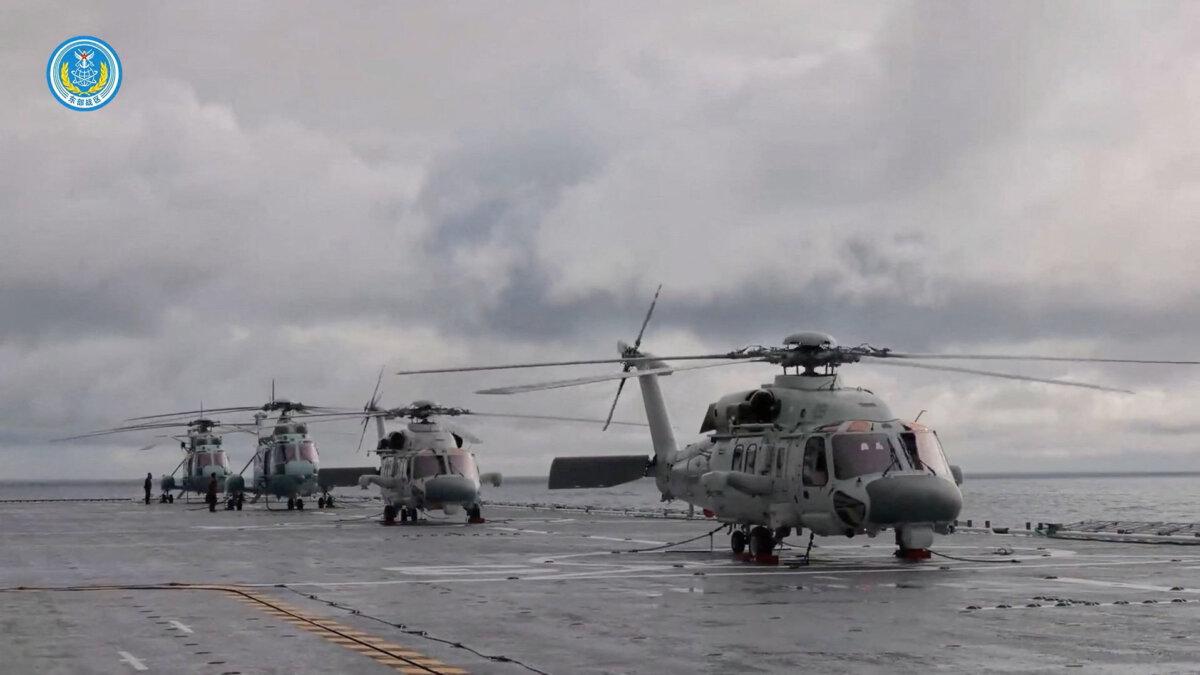
Helicopters on an amphibious assault ship take part in military drills in waters southeast of Taiwan, in this screenshot from a video released by the PLA Eastern Theater Command on Dec. 29, 2025. Eastern Theater Command/Handout via Reuters
.
Additionally, the war games kicked off less than 24 hours after the Shanghai-Taipei
forum, an annual event that Chinese authorities say aims to promote the peaceful development of cross-strait relations. This year’s forum saw Taipei Mayor Chiang Wan-an leading a delegation on Dec. 28, 2025, to Shanghai, where he and Shanghai mayor Gong Zheng signed two memoranda of understanding to boost cooperation in water management and vocational training.
“The CCP’s sudden military actions, especially coming right after the Cross-Strait Twin Cities Forum, are highly unusual,” Su, a Taiwanese expert on the PLA’s capability and culture, told The Epoch Times. Held in Shanghai on Dec. 27–28, 2025, and considered by many as politically sensitive, the forum is an annual event serving as an exchange platform between leaders from Taipei and Shanghai.
Pointing to recent
rumors about the Chinese defense minister, Su suggested Beijing might be using the stepped-up action against Taiwan to divert attention from a power struggle in the upper echelons of the CCP.
“There could be some issues within the CCP that pushed Beijing to hastily organize such a military exercise. That’s to divert political pressure,” he said.
Backlash
The leadership in Beijing appears to be using Taiwan to show that, even though it’s corrupt, the PLA remains capable of taking a region it has long claimed as its own, according to Shen Ming-shih, a research fellow at Taiwanese think tank the Institute for National Defense and Security Research.
“The PLA aims to use this military exercise to demonstrate that its combat capabilities remain intact, despite the corruption plaguing top military officials,” Shen told The Epoch Times. “They want to prove they can still carry out large-scale exercises and, if necessary, to use force against Taiwan.”
By flexing its military muscle, Beijing also seeks to exert pressure on Tokyo and Washington, Shen noted, adding that he doesn’t expect the Japanese government to back down or the United States to stop its arming of Taiwan.
Instead, “Beijing will face a greater backlash,” he said. “The international community will pay more attention to Taiwan’s defense, as well as the impact of the drills on cross-strait relations and the wider Indo-Pacific region. The drills could even rally more international support for Taiwan.”
The CCP has
unleashed a sweeping campaign against Japan since its prime minister, Sanae Takaichi, in
response to a parliamentary question in November 2025, linked a Taiwan contingency to a potential “survival-threatening situation” for Japan, a classification that could allow the government to mobilize its own troops to intervene.
Takaichi has
said her government remains open to dialogue with the Chinese side, but
rejected Beijing’s demand to retract her earlier remarks, which she said align with Tokyo’s longstanding policy.
.
Chinese soldiers fire a rocket into the air as they conduct military drills on Pingtan island, in eastern China's Fujian province, the closest point to Taiwan, on Dec. 30, 2025. Adek Berry/ AFP via Getty Images
.
Japan’s foreign ministry has
raised concerns over Beijing’s latest drills near Taiwan, which lies only 68 miles from its westernmost territory. The U.S. State Department also called on Beijing to exercise restraint and stop its military pressure on Taiwan.
“China’s military activities and rhetoric toward Taiwan and others in the region increase tensions unnecessarily,“ Tommy Pigott, spokesperson for the State Department, said in a
statement on Jan. 1.
“The United States supports peace and stability across the Taiwan Strait and opposes unilateral changes to the status quo, including by force or coercion,” Pigott added.
Luo Ya and Frank Fang contributed to this report.
.





 Like
0
Like
0
 Dislike
0
Dislike
0
 Love
0
Love
0
 Funny
0
Funny
0
 Wow
0
Wow
0
 Sad
0
Sad
0
 Angry
0
Angry
0












Comments (0)