

Why Canada’s China Pivot Makes US Tariff Relief Harder


.
For much of the past year, Canada and the United States have been stuck in a familiar cycle: trade tensions and competing narratives about who’s to blame. What used to look like one of the world’s closest alliances now looks strained, and increasingly unpredictable.
Under these conditions, Ottawa has moved in a direction that would have been hard to imagine not long ago: cutting a trade arrangement with Beijing, even after Prime Minister Mark Carney said only months prior that China is Canada’s “biggest security threat.”
President Donald Trump on Jan. 24 threatened to impose 100 percent tariffs on all Canadian goods if Ottawa proceeded with a trade deal with China, arguing it would let Beijing use Canada as a “drop-off port” to evade U.S. duties and undermine U.S. economic interests.
The bigger picture, though, hasn’t changed. Ottawa and Washington remain locked in a rolling dispute that looks no closer to a durable trade understanding—and some analysts say the reasons go beyond tariffs.
The problem, said Frank Tian Xie, a business professor at the University of South Carolina Aiken, is that Canada is trying to manage its standoff with Washington with a “miscalibrated foreign policy approach” while being the most U.S.-dependent economy in the developed world.
The China deal, as some analysts put it, sharpens that contradiction: It gives Beijing a foothold in a sensitive sector with few hard guardrails, hands Washington an easy pretext for friction with Canada, and arrives just ahead of the July 1 review of the United States, Mexico, and Canada Agreement (USMCA)—when the United States has maximum leverage and Canada has the most to lose.
A Plan to Diversify Trade
Carney has framed his foreign policy pivot as a response to a changing global order.Days later, in his Jan. 20 address at the World Economic Forum in Davos, Switzerland, Carney declared that the international “rules-based order” is facing a “rupture,” increasingly replaced by “great power rivalry” and economic coercion.
He said major powers are increasingly “weaponizing economic integration”—using tariffs, financial systems, and supply-chain dependence as tools of pressure.
His government says it has little choice but to diversify.
“That’s a very challenging world,” Hodgson said, adding that Ottawa’s answer is to “build new trading lanes and new partners.”
In Davos, he pointed to efforts to deepen trade ties with the EU, China, India, ASEAN nations, Mercosur, Qatar, and other partners, describing a “dense web of connections.”
“The logic is straightforward: if Washington is going to squeeze Canada, Ottawa needs options,” said Shen Rongqin, an international business professor at Canada’s York University.
“But the problem is that options take time—and can backfire,” Shen told The Epoch Times.
“Canada has never dealt with a U.S. administration like Trump 2.0,” he said. “Trump isn’t a typical politician. He’s strictly America-first.”
For Canada, he added, that’s a “system shock” after decades of close partnership since World War II, and “Ottawa is still figuring out how to respond to [Trump’s] negotiation style.”
Timing
The timing of the Beijing deal couldn’t be worse for Ottawa, Xie told The Epoch Times.“It hands the U.S. a pretext to squeeze Canada right before the USMCA review on July 1, when U.S. leverage is at its peak and Canada has the most to lose,” he said.
He also warned that Canada’s tilt toward China could become an issue in those negotiations.
U.S. Treasury Secretary Scott Bessent reiterated that message on Feb. 5.
He said that Washington cannot allow its northern border to be used as a way for Chinese electric vehicles (EV) to come into the United States—a sign that the Canada–China deal has become a fresh point of contention.
Under the USMCA, 85 percent of Canadian goods are exempt from tariffs, while products that don’t comply with the trilateral deal currently face tariffs of 35 percent. Mexico’s non-USMCA products are subject to 25 percent tariffs.
Canada’s vulnerability, Xie said, comes down to simple math.
In 2024, the United States took about 76 percent of Canada’s total exports—roughly C$596 billion (about $420 billion). The auto sector is even more exposed: Roughly 94 percent of Canada’s motor vehicles and parts exports go south of the border. China, by contrast, accounts for only about 4 percent of Canadian exports, or about C$30 billion (roughly $21 billion).
“With that baseline, Ottawa doesn’t have much room to play chicken with Washington,” Xie said. “No matter how good a deal Canada gets from Beijing, it can’t come close to offsetting the nearly half-trillion dollars in trade it does with the United States.”
“Canada is picking a fight with the one partner that can cripple its economy on short notice—and it’s doing it when U.S. leverage is maximum,” he added.
Xie contrasted Canada’s approach with Mexico’s, which he said appears more focused on reassuring Washington on trade and China.

The Canada–China Deal
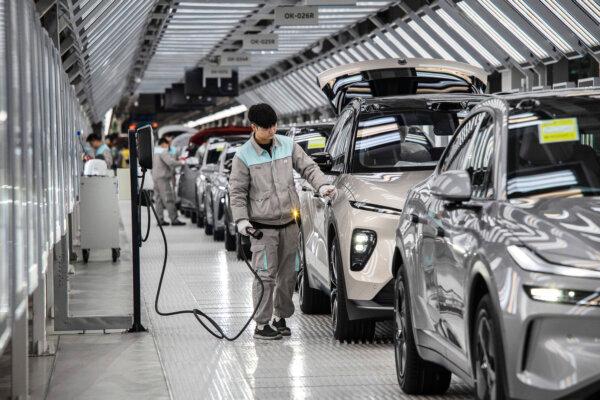
Under the framework announced after Carney’s Beijing trip, Canada agreed to lower its tariff on Chinese EVs to 6.1 percent—down from the 100 percent surtax imposed in 2024—for a quota of 49,000 vehicles per year.And that quota could rise to 70,000 vehicles over five years, Carney said during the news conference in Beijing on Jan. 16.
Ottawa also extended and expanded remissions for certain Chinese steel and aluminum tariff lines.
In return, China is expected to cut tariffs on Canadian canola seed from roughly 85 percent to 15 percent starting March 1. Some of the agriculture relief Ottawa has described—such as for canola meal and several seafood products—will remain in place until at least the end of this year.
To critics, the bigger issue isn’t the numbers. It’s the structure.
Canada’s concessions are immediate and enforceable: Ottawa lowers tariffs and Chinese products can enter. China’s side, by contrast, is framed largely in the language of “expected” outcomes—tariffs that may be reduced, measures that may be suspended—without the kind of hard guardrails that reassure exporters and investors.
Ottawa has also called the package an “agreement-in-principle,” with a three-year review built in to assess whether the “expected” benefits actually materialize.
That detail undercuts the image of a durable trade breakthrough, said U.S.-based economist Davy J. Wong.
“Canada gave up something you can enforce tomorrow for something Beijing can reverse whenever it wants,” Wong told The Epoch Times. “Ottawa is offering real market access now while describing China’s concessions as things it expects will happen.”
The worry is not theoretical, Wong said. Even if China lowers a tariff, that doesn’t guarantee it will buy meaningful volumes.
Beijing has many ways—formal and informal—to choke off imports without reintroducing a headline tariff: paperwork delays, “technical” inspections, or sudden anti-dumping investigations that are hard to challenge quickly and easy to justify politically, Wong said.
China’s recent record with Canadian canola is why Ottawa should not treat Beijing’s promises as something it can rely on, Wong said.
In March 2025, Beijing announced retaliatory tariffs that included 100 percent duties on Canadian rapeseed oil and oilcake and peas, and 25 percent duties on pork and some aquatic products—measures presented as retaliation for Canada’s restrictions on Chinese EVs and metals.
Then in August 2025, Beijing imposed another anti-dumping duty of 75.8 percent on Canadian canola seed. Canadian ministers condemned China’s actions, calling it “self-initiated” and expressing deep disappointment.
“That all happened in the same dispute cycle Ottawa is now trying to unwind,” Wong said. “Canada is accepting a partial rollback of barriers Beijing put up in the first place, while giving Beijing new access to Canada’s market in a politically sensitive sector.”
In that sense, he said, Ottawa didn’t secure new ground.
“Canada didn’t win new access so much as it got China to lower a barrier China put up arbitrarily,” Wong said. “And in exchange, Canada opened a door the U.S. and Europe are trying to keep closed.”
Ontario Premier Doug Ford took a similar line, warning the agreement strengthens China’s position in Canada “at the expense of Canadian workers” and could jeopardize Canadian access to the U.S. market.
.
An ‘Open Door’
Canada’s move also stands out internationally. Both the United States and the European Union have taken a hard-line approach to Chinese EVs by keeping tariffs extremely high or restricting access.“When major peer markets restrict entry, exporters look for the next open door,” Wong said. “Canada has volunteered to be that door, while still relying on American goodwill to keep the North American market stable.”
The controversy isn’t just economic.
U.S. officials have raised security concerns about Chinese EVs and internet-connected vehicles, and Washington has moved to regulate connected-vehicle technology tied to “foreign adversaries,” including China.
Canadian business groups have also flagged cybersecurity risks around expanded access for Chinese vehicles and advanced technologies.
With Chinese EVs able to enter Canada, Wong said, Washington worries that those vehicles—and the data systems embedded in them—could also move freely into the United States through the shared border, posing security risks in a deeply integrated cross-border economy.
Values and Principles
Beyond tariffs and quotas, the Beijing deal collides with Ottawa’s own messaging about China. Carney has described China as Canada’s most significant security threat.“Ottawa is betting strategic economic relief on a state that has detained Canadians as leverage and has executed Canadians,” Shen said, “all while antagonizing the ally that buys roughly three-quarters of its exports.”
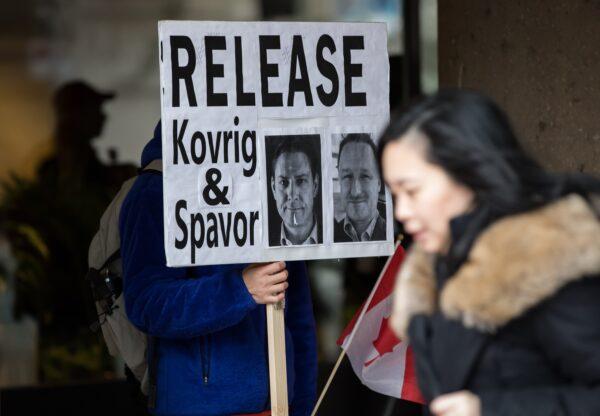
High-profile cases include the 2018 detention of Michael Kovrig and Michael Spavor—widely described as “hostage diplomacy”—following Canada’s arrest of Huawei executive Meng Wanzhou at the request of the United States; both men were released in 2021, after the release of Meng.
.
In 2025, China executed four Chinese Canadians for alleged drug offenses, despite clemency pleas from Canadian officials.
“It ends up sounding like Ottawa is saying, ‘We can’t trust Trump, but we’ll trust Beijing,’” Shen said. “That undermines Canada’s own values and messaging.”
All of this circles back to the question hanging over Canada’s strategy: What does Trump do next?
“Think of USMCA like a fast lane at the border,” Wong said. “If your goods meet the rules—mainly where they’re made and how much North American content they have—you get low or zero tariffs and smoother entry. But the U.S. can make that fast lane harder to use without formally leaving the deal.”
Even short of withdrawal, he said, Washington can squeeze Canada by pulling back tariff exemptions granted under other U.S. policies, applying USMCA benefits more strictly, and tightening checks at the border. In other words, Canada’s “best case” isn’t guaranteed access—it’s smooth, predictable access that depends on the United States keeping that preferential lane wide open.
“Trump doesn’t need Canada to violate USMCA to raise the stakes,” Wong said. “A credible threat of withdrawal—or to weaken the deal in practice through tariffs and tougher enforcement—can be enough to force Ottawa into concessions.”
.
What's Your Reaction?
 Like
0
Like
0
 Dislike
0
Dislike
0
 Love
0
Love
0
 Funny
0
Funny
0
 Wow
0
Wow
0
 Sad
0
Sad
0
 Angry
0
Angry
0












Comments (0)