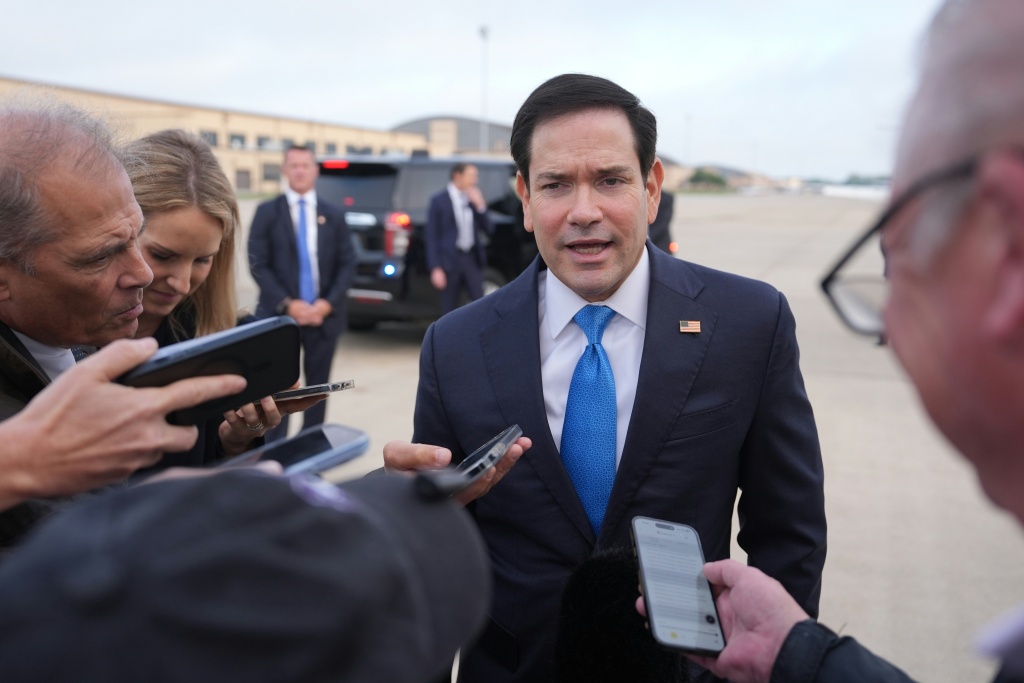
U.S. and Chinese officials continued trade talks on Sept. 14 in a meeting at the Palacio de Santa Cruz in Madrid.
On the U.S. side, Treasury Secretary Scott Bessent and Trade Representative Jamieson Greer are returning for talks. Chinese Vice Premier He Lifeng and Ministry of Commerce official Li Chenggang are representing Beijing’s interests.
Spanish foreign minister José Manuel Albares publicly greeted the two delegations before the start of talks.
Meanwhile, the Spanish prime minister has traveled to China three times in the past three years and ignored calls to tighten European access to Chinese electric vehicles.
Russia Looms Large
Russia’s war efforts will eclipse the discussion, as Beijing has ignored calls from the United States to stop buying Russian oil, selling weapons to Russia, and otherwise assisting Russia in avoiding other international sanctions by purchasing supplies for reshipment to Russia or purchasing Russian goods to resell on the international market.
The Treasury has said it will demands that the Chinese regime stop its illegal technology shipments to Russia.
Bessent and Greer recently held a video conference with G7 nations, calling on them to
impose “meaningful tariffs” on China and India over the purchase of Russian oil.
“Only with a unified effort that cuts off the revenues funding Putin’s war machine at the source will we be able to apply sufficient economic pressure to end the senseless killing,” Bessent and Greer said in a statement on Sept. 12.
On Sept. 13, Trump said on social media he would impose “major sanctions” on Russia if NATO countries could agree to also stop buying Russian oil.
“Anyway, I am ready to ‘go’ when you are,“ he wrote. ”Just say when.”
TikTok
Both sides have said that the question of TikTok’s future is also on the agenda.
After President Joe Biden signed the TikTok divest-or-ban law, its Chinese parent company was given until Jan. 19, the last day of Biden’s term, to divest of the popular social media app. A court granted a delay, given that Trump was assuming office the day after the deadline.
Since then, Trump has extended the divestiture deadline several times.
In June, he
signed another executive order to keep TikTok “up and running.”
The president has expressed confidence in securing an American buyer for the app. However, TikTok’s parent company, ByteDance, previously said the Chinese regime would not allow it to sell.
“We probably have to get China approval. I think we'll get it,” Trump
told reporters on Air Force One, as he traveled back from the G7 Summit in Canada.
.
“I think [Chinese leader] Xi [Jinping] will ultimately approve it.”
TikTok came under scrutiny of federal regulators due to the massive amounts of data it collects on Americans, which, under Chinese national security laws, make be accessible to Chinese authorities without disclosure.
Fourth Round in Europe
This is the fourth time this year the parties have met in attempts to come to a trade agreement.
In July, the parties
met in Stockholm, where Bessent said both parties presented “tough” terms but expressed optimism for a deal. An extension for the upcoming Aug. 12 deadline was not agreed on during the meeting, but Trump later
announced another 90-day extension just before the deadline.
.
In June, the parties
met for two days in London, with the discussion focusing on the critical mineral shipments China had slow-walked.
.
In May, U.S. and Chinese trade officials
spoke by phone but gave few specifics.
On May 12, the parties met, for the first time since the April tariff war, in Geneva. The parties announced a 90-day truce, but Trump later said that China had “totally” reneged on the deal by refusing to export critical minerals, which had resulted in a halt of some auto production lines.
China Export Controls
Beijing has accused the United States of “abuse” of export controls, saying it will raise the issue during the Madrid talks.
China has imposed several of its own export controls since the new administration announced its tariffs.
Days ahead of the talks, Beijing opened an anti-discrimination investigation into U.S. trade policy. This came after the communist regime
revised its Foreign Trade Law, which would codify and supply legal rational for trade actions it has taken like its earlier blockage of critical mineral exports, allowing trade bans on entities it deems a threat to its security.
.
The Chinese regime has also opened a dumping investigation over U.S. chips as it seeks to
reduce dependency on U.S. chips in its supply chain. The United States is also making it
harder for China to obtain technologies to develop its chip industry, tightening export controls across the supply chain.
.
Reuters contributed to this report.
.