

Trump's Beijing Trip on Track: U.S. and China Trade Blows in Pre-Summit Talks
Senior American and Chinese economic officials held a high-stakes video call on April 30, 2026, ahead of a planned summit between President Donald Trump and Chinese President Xi Jinping in mid-May. Both sides aired sharp grievances — but kept the diplomatic door open.


.
High-Level Call Sets the Stage for Beijing Summit
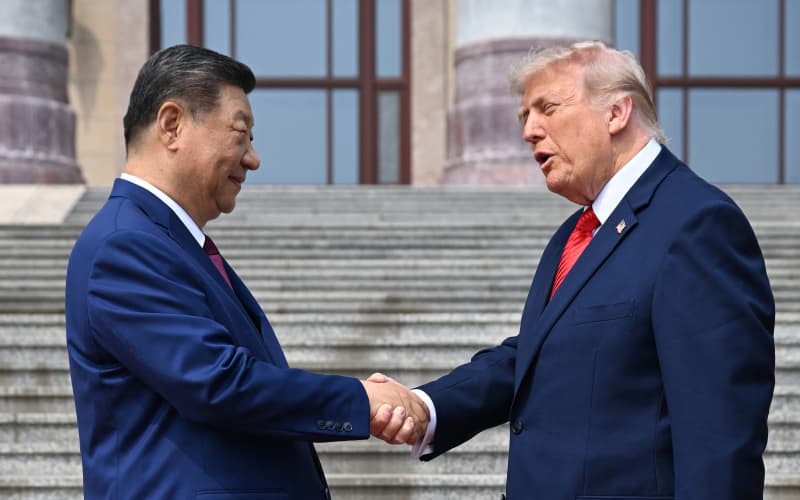
With President Trump's visit to Beijing scheduled for May 14 and 15, the two largest economies in the world are in an intense round of last-minute diplomacy. U.S. Treasury Secretary Scott Bessent and U.S. Trade Representative Jamieson Greer held a video call with Chinese Vice Premier He Lifeng on April 30 — widely seen as a final preparatory round before the leaders meet face to face.
Both sides described the exchange as "candid." That word, often used in diplomatic language to signal genuine tension rather than pleasantries, turned out to be apt: each side used the call to put its grievances squarely on the table.
Bessent posted on X after the call that he had stressed to his counterpart that Beijing's newly enacted supply chain regulations are "provocative" and are already sending a chill through international business networks. At the same time, Chinese state broadcaster CCTV reported that Vice Premier He Lifeng had expressed "serious concern" over what Beijing describes as U.S. restrictions on trade.
Despite the friction, both governments signaled that the summit remains on track.
Beijing's New Rules: A Direct Challenge to U.S. Trade Strategy
At the heart of the dispute are two sweeping regulatory orders issued by China's State Council in late March and early April 2026. Known as Decree No. 834 and Decree No. 835, they took effect immediately — with no grace period for affected businesses.
Decree 834 establishes a formal framework allowing Chinese authorities to investigate and impose consequences on foreign governments, companies, or individuals whose actions are deemed harmful to China's industrial supply chains. Decree 835 goes further, creating a legal mechanism to push back against what Beijing calls unlawful foreign attempts to apply their own laws inside China — the so-called "extraterritorial jurisdiction" that the U.S. uses when imposing sanctions or export controls.
In plain terms: if a Western company stops buying from a Chinese supplier to comply with U.S. sanctions or forced-labor laws, China now has a legal tool to investigate and potentially punish that company. Legal experts at major international law firms have warned of a significant "compliance gap" — where obeying U.S. law could simultaneously put a company in breach of Chinese law.
Decree 835 also introduces a "Malicious Entity List" targeting firms or individuals deemed to promote or assist in implementing foreign sanctions against Chinese entities. Critically, it includes the possibility of criminal liability for individuals — a notable escalation beyond previous administrative-only penalties.
Washington Fires Back — Quietly but Clearly
Bessent's post-call statement marked a notable shift. Until now, the Trump administration had largely stayed silent on China's new regulatory moves, even as U.S. businesses sounded the alarm. By publicly calling the rules "provocative," Bessent broke that silence and signaled that Washington is paying close attention.
At the same time, the Trump administration has not been standing still. In recent weeks, U.S. authorities placed additional restrictions on chip-making equipment shipments to one of China's leading semiconductor manufacturers — a move seen as a direct counter-pressure play ahead of the summit.
Both sides, in other words, have been increasing leverage while also keeping communication lines open. This dual-track approach — pressure plus dialogue — is a familiar feature of U.S.-China relations and suggests that both capitals want results from the May summit, not just optics.
Taiwan and Iran Add to the Complexity
The economic agenda is not the only flashpoint. In a separate call on the same day, Chinese Foreign Minister Wang Yi told U.S. Secretary of State Marco Rubio that Taiwan remains the single greatest point of risk in the bilateral relationship. China views Taiwan as its own territory and has consistently demanded that Washington distance itself from the democratic island.
The summit itself had already faced one delay: Trump's original trip to Beijing was postponed due to the ongoing U.S.-Israeli military campaign against Iran. Peace negotiations between Washington and Tehran have stalled over issues including the Strait of Hormuz and Iran's nuclear program — and analysts note this remains a wildcard that could affect the May schedule.
U.S. Industry Sounds the Alarm on Auto Market Access
As the summit approaches, domestic pressure is growing in Washington. Ten major American steel industry groups sent a joint letter on April 30 to Bessent, Greer, Secretary of State Marco Rubio, and Commerce Secretary Howard Lutnick urging the administration not to grant the Chinese Communist Party access to the U.S. automotive market as part of any deal.
The warning reflects a broader concern among U.S. manufacturers and lawmakers: that Beijing could use trade concessions to gain a foothold in strategic sectors, raising both economic and national security risks — particularly around data collection through connected vehicles.
What to Expect from Beijing
The last face-to-face meeting between Bessent, Greer, and He Lifeng took place in Paris in March 2026, where the two sides explored possible Chinese purchases of U.S. agricultural products and discussed the creation of joint bodies to manage the bilateral economic relationship. The October 2025 trade truce reached in Busan, South Korea, had paused the worst of the tariff escalation triggered by Trump's so-called "Liberation Day" duties and China's retaliatory rare-earth export restrictions.
Since then, the U.S. Supreme Court struck down Trump's broad global tariffs in February 2026, prompting the administration to launch new investigations to rebuild them on firmer legal ground.
The May summit in Beijing will be a high-stakes moment — and based on the April 30 call, neither side is coming to the table without its list of complaints ready.
.
Sources:
- Reuters – "China, US economic chiefs raise complaints in 'candid' call ahead of Trump-Xi summit," April 30, 2026: https://www.reuters.com/world/asia-pacific/china-us-trade-chiefs-had-candid-call-weeks-ahead-of-expected-trump-xi-summit-2026-04-30/
- The Korea Times – "Top US, Chinese officials hold talks ahead of planned Trump-Xi summit," May 1, 2026: https://www.koreatimes.co.kr/world/20260501/top-us-chinese-officials-hold-talks-ahead-of-planned-trump-xi-summit
- Morrison Foerster – "China Issues New Regulations Countering Foreign States' Extraterritorial Restrictive Measures," April 2026: https://www.mofo.com/resources/insights/260420-china-issues-new-regulations-countering-foreign-states
- Morgan Lewis – "China Issues New Regulations on Countering Foreign Extraterritorial Jurisdiction: What MNCs Need to Know," April 2026: https://www.morganlewis.com/pubs/2026/04/china-issues-new-regulations-on-countering-foreign-extraterritorial-jurisdiction-what-mncs-need-to-know
- Baker McKenzie – "China Introduces New State Council Decrees on Supply Chain Security," April 2026: https://sanctionsnews.bakermckenzie.com/china-introduces-new-state-council-decrees-on-supply-chain-security-and-countering-unjustifiable-extraterritorial-measures/
.
What's Your Reaction?
 Like
0
Like
0
 Dislike
0
Dislike
0
 Love
0
Love
0
 Funny
0
Funny
0
 Wow
0
Wow
0
 Sad
0
Sad
0
 Angry
0
Angry
0












Comments (0)