

Trump Pulls the Brakes on AI Executive Order — "I Don't Want to Get in the Way of Our Lead Over China"
President Donald Trump abruptly postponed signing a major executive order on artificial intelligence on Thursday, just hours before a scheduled ceremony with top tech CEOs. Trump cited concerns that parts of the order could slow down American innovation — and hand Beijing an opening in the global AI race.

.
Last-Minute Reversal at the White House
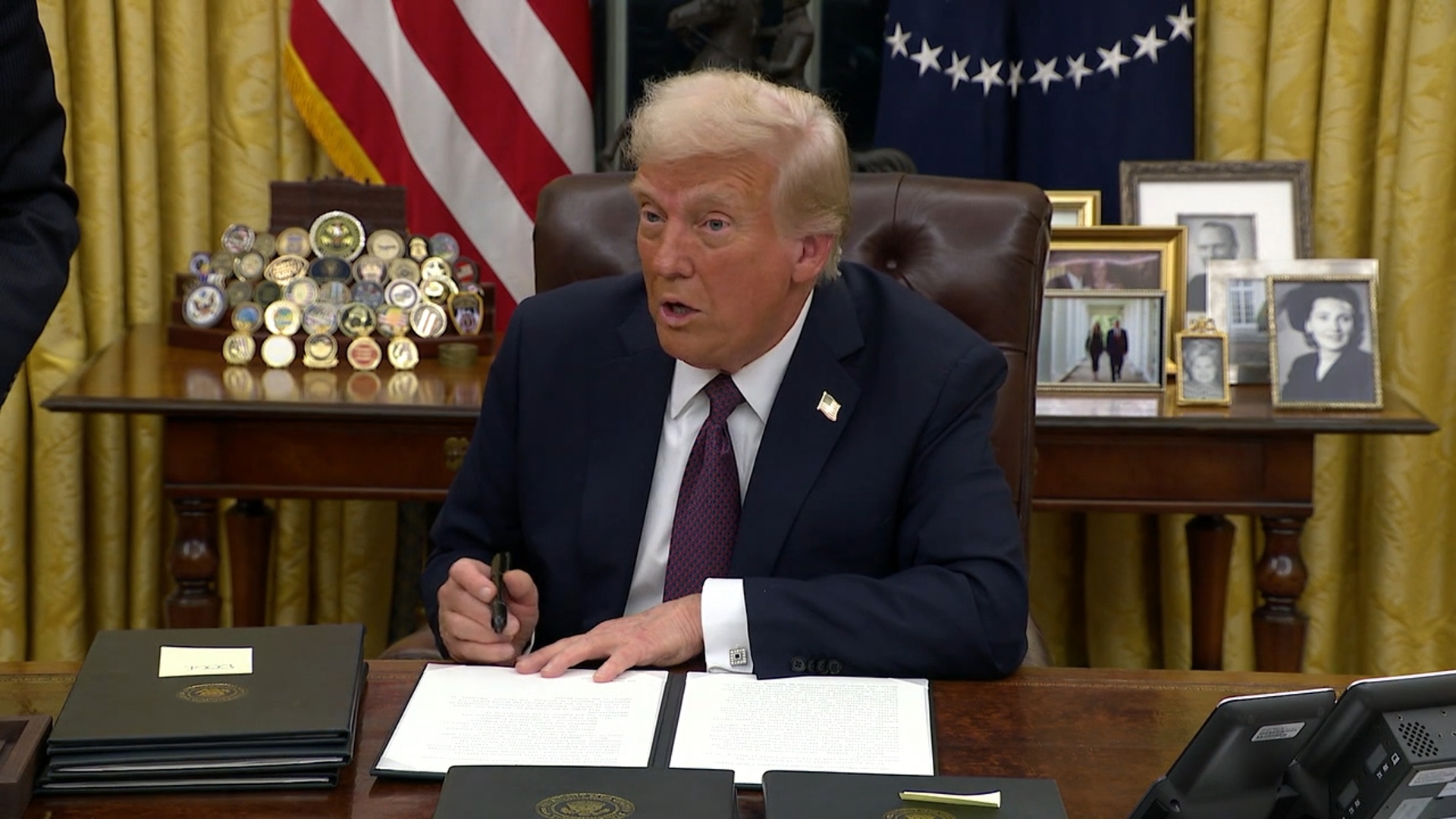
A signing ceremony at the White House that had been on the calendar for Thursday afternoon was cancelled without prior warning. President Trump told reporters in the Oval Office that he had decided to hold off on signing the executive order because he did not like certain aspects of it.
"I didn't like certain aspects of it," Trump said bluntly. The room had been prepared. The guest list included top executives from leading AI companies. Yet the president chose to walk away from the signing rather than put his name to an order he believed could damage U.S. interests.
The China Factor
Trump made clear that the central issue was America's competitive position against China. The United States is currently ahead in the global AI race, and the president was not willing to risk that advantage.
"We're leading China, we're leading everybody, and I don't want to do anything that's going to get in the way of that lead," Trump said. He added that AI is "causing tremendous good" and described the shelved order as something that "could have been a blocker."
The U.S.-China rivalry in artificial intelligence has intensified sharply in recent months. China's stated ambition is to become the world's dominant AI power by 2030, and it has made significant investments in both civil and military AI development to reach that goal.
What the Order Would Have Done
According to multiple sources familiar with the draft, the executive order was built around two main pillars.
The first was a voluntary framework requiring AI developers to share their most advanced models with the federal government at least 90 days before public release. The goal was to allow government agencies — potentially including the NSA — to evaluate new AI systems for cybersecurity risks before they reach the public. Major AI firms such as OpenAI and Anthropic had been involved in negotiations over this framework for weeks.
The second pillar focused on cybersecurity infrastructure. The order would have directed the U.S. government to use advanced AI to strengthen the digital defenses of federal agencies, as well as critical sectors of the economy such as banking and healthcare.
A voluntary information-sharing hub — described as a "clearinghouse" — was also envisioned, bringing together the Treasury Department, other agencies, and private AI companies to identify and address vulnerabilities in unreleased AI models.
The Anthropic "Mythos" Factor
The order's urgency was driven in part by the emergence of a powerful new AI model. Anthropic, the AI safety company, recently unveiled a system called Mythos — an advanced, cybersecurity-focused model that the company itself has warned could be used to supercharge sophisticated cyberattacks.
Mythos has not been released to the general public. Anthropic is currently offering access only through a tightly controlled program called Project Glasswing, which includes federal, state, and local government representatives. The model's capabilities appear to have rattled parts of Washington and prompted calls — even from within Trump's own political base — for greater oversight of frontier AI systems.
Cybersecurity experts, however, have been more measured in their assessments, suggesting that fears of unchecked AI-powered hacking may be overstated.
A Balancing Act Between Big Tech and Security Hawks
The postponement reflects a genuine tension within the Trump administration. On one side are the president's powerful allies in Silicon Valley — figures like Meta's Mark Zuckerberg, Amazon's Jeff Bezos, Google's Sundar Pichai, and OpenAI's Sam Altman, all of whom were present at Trump's inauguration and have been among his most prominent tech-industry supporters. These voices have consistently pushed back against regulatory burdens that could slow AI development or cut into company profits.
On the other side are Trump-aligned figures who have grown alarmed by the national security implications of increasingly powerful AI systems and are calling for safeguards.
The voluntary 90-day review framework was itself an attempt at a middle ground — less intrusive than a mandatory regulatory regime, but more structured than the largely hands-off approach the administration had taken until recently.
This is not the first time this particular executive order has been delayed. According to CNN, the signing had already been postponed on several previous occasions before Thursday's last-minute cancellation.
What Comes Next
Trump has not indicated when a revised version of the order might be ready for his signature, nor has he specified which elements he found objectionable. For now, the U.S. government has no formal framework in place for evaluating advanced AI models before their public release.
The episode underscores the difficulty of crafting AI policy that satisfies competing demands: protecting national security, preserving American technological leadership, and keeping the tech industry onside. With China closing the gap — and with AI systems becoming more powerful by the month — the pressure to find that balance is unlikely to ease.
.
Sources:
- CNBC – Trump postpones AI executive order signing: https://www.cnbc.com/2026/05/21/trump-ai-executive-order-postponed.html
- NBC News – Trump scraps signing of landmark executive order regulating AI: https://www.nbcnews.com/tech/tech-news/trump-scraps-signing-landmark-executive-order-regulating-ai-rcna346288
- Axios – Scoop: Trump AI executive order seeks early government access to frontier models: https://www.axios.com/2026/05/20/ai-trump-executive-order-white-house-infighting
- CNN – Trump could sign AI executive order as soon as Thursday: https://www.cnn.com/2026/05/20/tech/ai-executive-order-trump-white-house
- Nextgov/FCW – Anticipated executive order could give NSA a role in voluntary AI model testing: https://www.nextgov.com/artificial-intelligence/2026/05/anticipated-executive-order-could-give-nsa-role-voluntary-ai-model-testing/413663/
.
What's Your Reaction?
 Like
0
Like
0
 Dislike
0
Dislike
0
 Love
0
Love
0
 Funny
0
Funny
0
 Wow
0
Wow
0
 Sad
0
Sad
0
 Angry
0
Angry
0














Comments (0)