

Elon Musk in Beijing: Visionary, Rival, and Diplomatic Wild Card
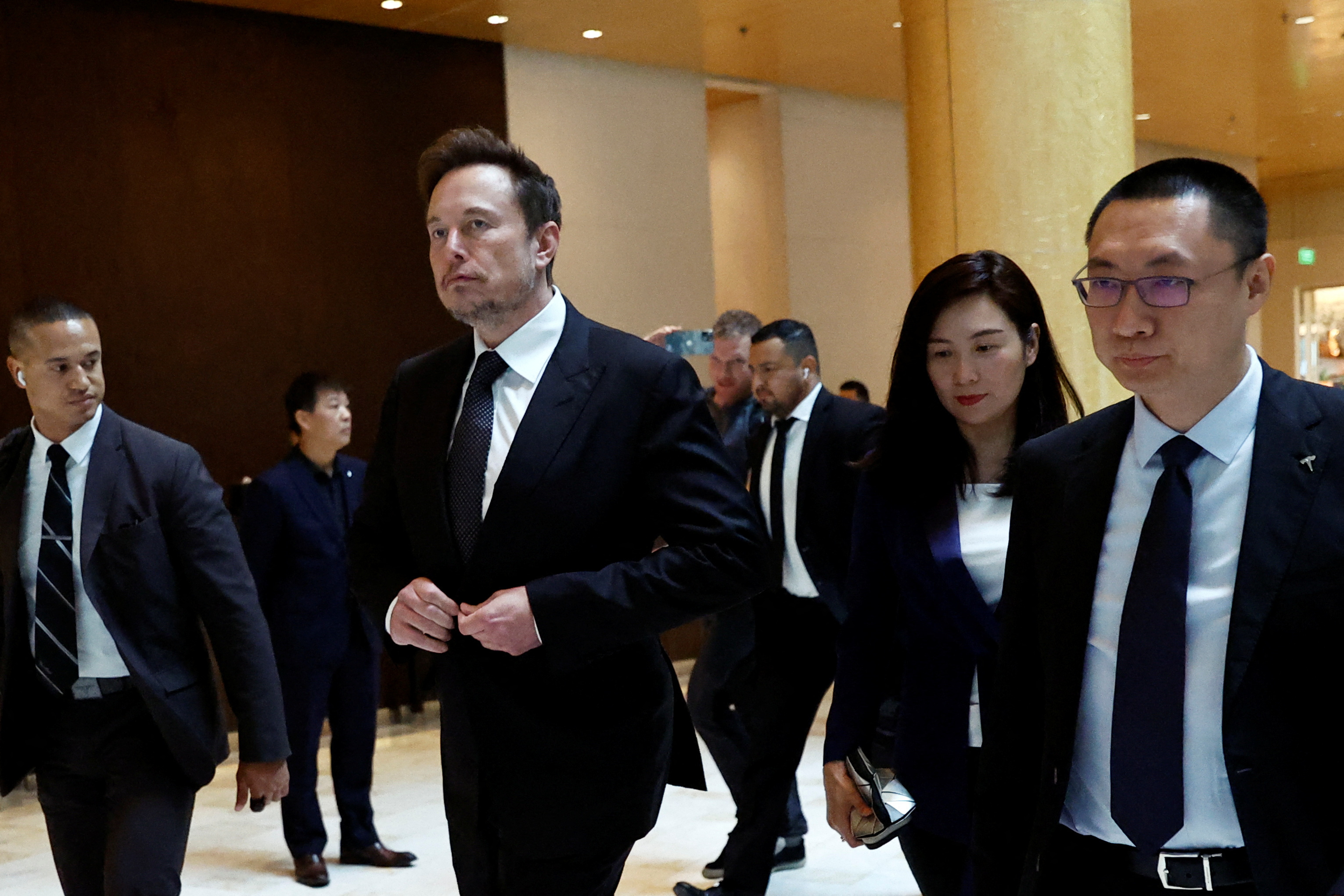
As Donald Trump leads a high-powered business delegation to Beijing, Elon Musk stands out as perhaps the most complex figure in the room. Admired by millions of Chinese consumers, scrutinized by Beijing's military planners, and increasingly challenged by China's own electric vehicle giants — Musk's relationship with the world's second-largest economy is anything but simple.

.
The World's Richest Man Lands in Beijing
When U.S. President Donald Trump arrived in Beijing for his high-stakes summit with Chinese President Xi Jinping, he didn't come alone. More than a dozen of America's most powerful corporate leaders joined him — among them Apple's Tim Cook and Nvidia's Jensen Huang. But few carry as much symbolic weight in China as Elon Musk.
Musk, the chief executive of Tesla and SpaceX, stepped out of the Great Hall of the People on Thursday and told reporters he hopes to accomplish "many good things" in China. It was a characteristically brief statement — but behind it lies years of complicated history between one of the world's most influential entrepreneurs and the Chinese state.
Admired by Millions — and Watched Closely by the Military
In a country where his X social media platform is blocked, Musk nevertheless commands 2.3 million followers on Chinese platform Weibo. He has been celebrated there as a "global idol," a "pioneer," and even affectionately referred to as "Brother Ma." His mother has developed her own celebrity following in China.
Yet the admiration has never been unconditional. Beijing's military establishment views his SpaceX empire — and its Starlink satellite network in particular — with deep suspicion. A 2022 paper co-authored by researchers at a People's Liberation Army engineering university explicitly warned that Starlink's demonstrated effectiveness in the Russia-Ukraine conflict would likely prompt Western powers to deploy it in potential future conflicts in Asia. China has since accelerated its own satellite programs in direct response.
Tesla's Deep Roots — and Growing Competition
Tesla's foothold in China is substantial. The company sold approximately 626,000 vehicles there last year, ranking it fifth among electric and plug-in hybrid vehicle makers by sales, according to the China Passenger Car Association. China accounts for roughly one-fifth of Tesla's global revenue.
In 2018, Tesla became the first foreign automaker permitted to build a fully independent manufacturing facility in China — without a required joint venture with a local partner. That was a significant concession by Beijing, and Tesla used it well. Its Shanghai Gigafactory became one of the company's most productive plants globally.
Tesla's influence on Chinese automakers has been profound. Felipe Munoz, a veteran automotive analyst, notes that Tesla's approach — designing vehicles around battery performance and software — became a central inspiration for Chinese manufacturers. During the pandemic years, Chinese firms reportedly used the opportunity to study Tesla's engineering in detail and develop their own competitive alternatives.
Even Chery, one of China's major automakers now expanding into European markets, has publicly cited Tesla as a key inspiration. Chery's chairman Yin Tongyue told Reuters last month that his company aims to combine Tesla's innovation focus with Toyota's quality standards.
Kyle Chan, a fellow in Chinese technology policy at the Brookings Institution, argues that Musk's business priorities align unusually well with Beijing's own strategic agenda — covering electric vehicles, autonomous driving, artificial intelligence, humanoid robotics, brain-computer interfaces, and satellite technology. "When you look at Beijing's tech priorities, many of them line up almost perfectly with Elon Musk's," Chan told Reuters.
A Relationship That Has Seen Turbulence
The relationship between Musk and Chinese authorities has not always been smooth. In 2021, Tesla faced a serious public relations crisis when a dissatisfied customer climbed onto a Tesla vehicle at the Shanghai Auto Show to protest the company's handling of her brake malfunction complaints. The incident went viral across Chinese social media and drew criticism from state-run media outlets. Tesla was ultimately compelled to issue a public apology.
That same year, Teslas were barred from entering Chinese military and government facilities over concerns about the cameras embedded in the vehicles. The ban remained in place for years — it was only lifted after Musk personally visited China in 2024 and the national auto industry association certified the company's data handling practices as compliant.
New Business, New Complications
Musk's current visit carries additional commercial stakes. Reuters reported in March that he is seeking to purchase approximately $2.9 billion worth of solar panel manufacturing equipment from Chinese suppliers. That plan may face complications: Beijing is currently considering restrictions on exports of advanced technologies to the United States — a countermeasure in the ongoing trade dispute between the two powers.
Tesla is also pursuing regulatory approval to expand the rollout of its Full Self-Driving driver assistance system within China — a market where local competitors are rapidly advancing their own autonomous driving capabilities.
The Rise of Chinese Rivals — and What It Means for Musk
Perhaps the most significant long-term challenge Musk faces in China is not political — it is commercial. Domestic automakers including BYD, Nio, Li Auto, and others have caught up rapidly in technology and are increasingly competitive on price. The gap between Tesla and its Chinese rivals is narrowing.
Chang Yan, founder of Supercharged — a widely-read Weibo blog focused on the electric vehicle sector — puts it plainly: as Chinese companies match or surpass Musk's technological achievements, his prestige in China may gradually decline. "But he will likely remain an icon among China's tech industry for what he's accomplished," Chang told Reuters.
For now, Musk remains a rare figure in the fraught world of U.S.-China relations — simultaneously a business partner, a strategic concern, and a cultural phenomenon. His presence at Trump's side in Beijing underscores just how intertwined American technological ambition and Chinese industrial power have become.
.
Sources:
- Reuters – "China's view on Elon Musk? Visionary, occasional villain" (May 14, 2026): https://www.reuters.com/business/autos-transportation/chinas-view-elon-musk-visionary-occasional-villain-2026-05-14/
- Brookings Institution – Kyle Chan, Fellow in Chinese Technology Policy: https://www.brookings.edu/people/kyle-chan/
- China Passenger Car Association (CPCA) – Industry Data on EV Sales: https://www.cpca.org.cn
- Reuters – "Musk seeks $2.9 billion in Chinese solar equipment" (March 2026): https://www.reuters.com (Archivsuche nach dem entsprechenden Bericht empfohlen – siehe Note)
- Human Rights Watch / AP Background on U.S.-China Tech Restrictions: https://apnews.com
.
What's Your Reaction?
 Like
0
Like
0
 Dislike
0
Dislike
0
 Love
0
Love
0
 Funny
0
Funny
0
 Wow
0
Wow
0
 Sad
0
Sad
0
 Angry
0
Angry
0











Comments (0)