International students pursuing education in the United States are welcome, President Donald Trump said on Aug. 26, including those from China.
“I think it’s very insulting to say students can’t come here, because they‘ll go out and start building schools and they’ll be able to survive it,” Trump
said after a meeting with his Cabinet members at the White House, when asked to clarify his administration’s policy on Chinese students.
“And you know what would happen if they didn’t? Our college system would go to hell very quickly,” he said. “It wouldn’t be the top colleges, it would be colleges that struggle on the bottom.”
China has been the
top sender of international students to the United States, a position it maintained for over a decade. While the number of Chinese students enrolling in U.S. colleges has decreased in recent years—particularly following the COVID-19 pandemic—China still ranks as the second-largest origin of foreign students pursuing an American education. India is the leader.
According to
statistics compiled by nonprofit Institute of International Education, in conjunction with the State Department, about 277,000 Chinese students studied in the United States during the 2023-2024 academic year.
“We check, and we’re careful, and we see who’s there, and [Secretary of State] Marco [Rubio] wants that—we spoke, we’re in the same position,” Trump told reporters, in an apparent reference to the security screening of student visa holders.
There have been longstanding concerns over espionage in academia linked to the Chinese Communist Party (CCP). In recent years, federal prosecutors have brought a number of
criminal cases against Chinese students, including those involved in targeting U.S. military installations and intellectual property theft.
On May 27, Rubio
announced a plan to “aggressively” revoke visas of Chinese students, targeting individuals with connections to the CCP or studying in critical fields. He said that the State Department would revise visa criteria and enhance screening for all future applications from China and Hong Kong.
The administration also tightened vetting procedures for all foreign students applying to study in the United States. On June 18, the State Department
introduced social media vetting to the application process, aiming to identify applicants with the intention of harming Americans and U.S. national interests.
.
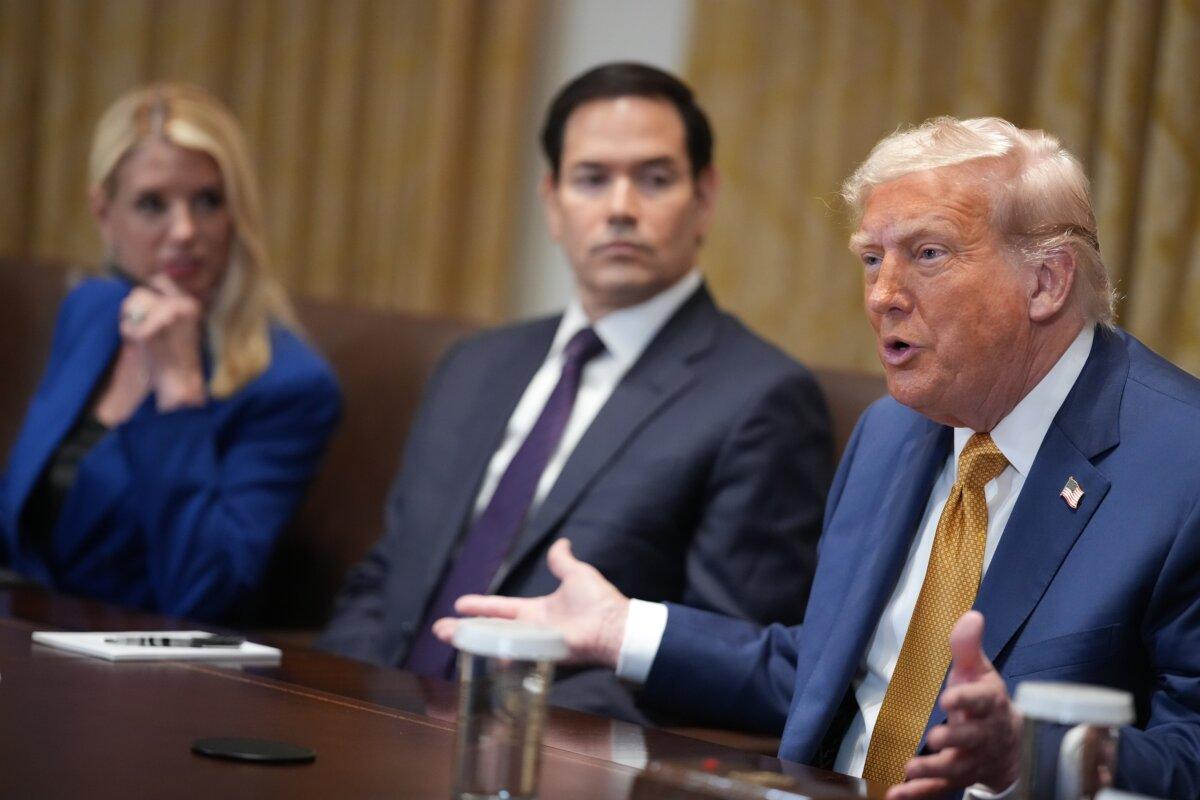
President Donald Trump (R) speaks as Secretary of State Marco Rubio (C) and Attorney General Pam Bondi (L) listen in Washington on July 8, 2025. Andrew Harnik/Getty Images
.
Amid the increased scrutiny, the president has repeatedly assured the public that America welcomes all international students.
“Look, I’ve always been in favor of students coming in from other countries. That includes China,” Trump told
reporters on June 12, when asked if he worried about national security risks posed by Chinese students.
“Does it mean you—that you have to watch people? Yeah, you have to watch students, but you have other people also.”
At his
meeting with South Korean President Lee Jae Myung at the White House on Aug. 25, Trump suggested that the United States may allow 600,000 Chinese students.
“I hear so many stories about we’re not going to allow their students or—we’re going to allow their students to come in,” Trump
told reporters. “We’re going to allow, it’s very important, 600,000 students. It’s very important.”
Some Republicans rejected this idea.
“We should not let in 600,000 CHINESE students to attend American colleges and universities that may be loyal to the CCP,” Rep. Marjorie Taylor Greene (R-Ga.)
said on X.
“If refusing to allow these Chinese students to attend our schools causes 15 percent of them to fail then these schools should fail anyways because they are being propped up by the CCP.”
.
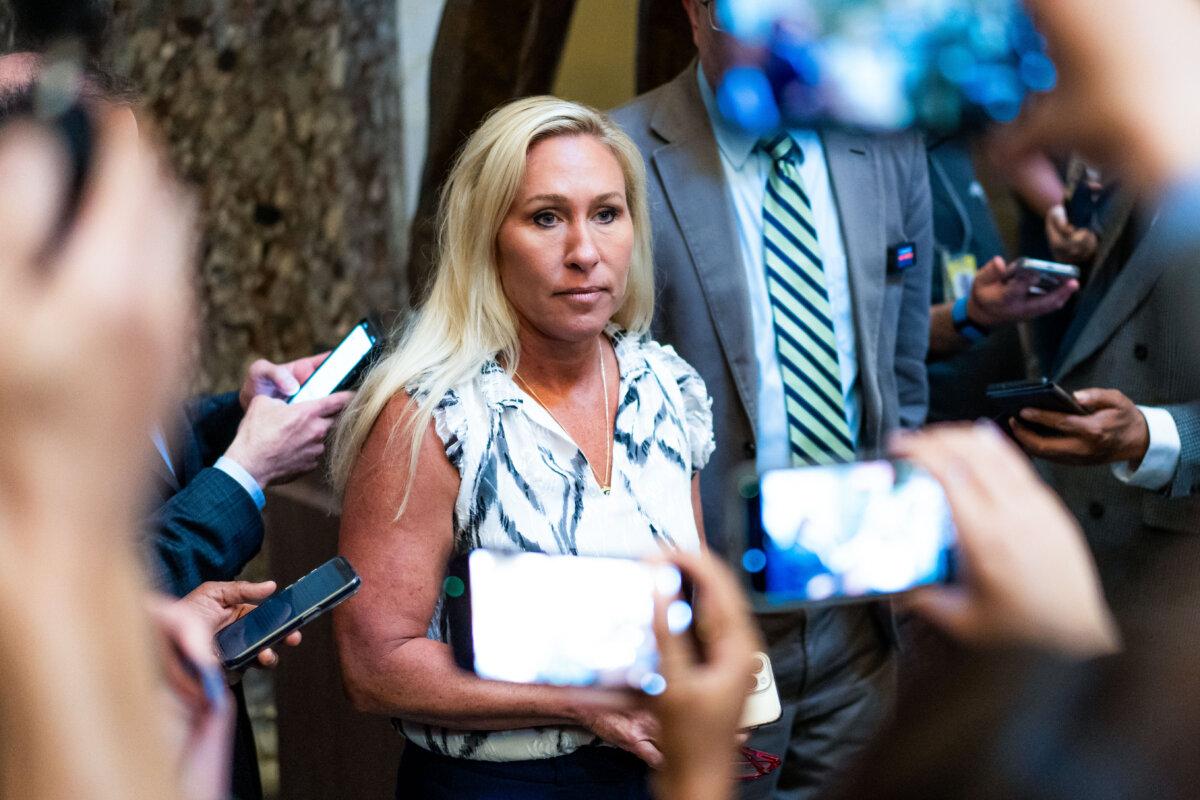
Rep. Marjorie Taylor Greene (R-Ga.) speaks to reporters in Washington on May 6, 2024. Madalina Vasiliu/The Epoch Times
.
‘Greatest Threat’ to Chinese Students
Just hours before Trump’s comments, the Chinese embassy in the United States cautioned students to be careful when flying through George Bush Intercontinental Airport in Houston, claiming that several students recently experienced “unwarranted interrogation and harassment” by border agents there. Some students reported being held for more than 80 hours and ultimately being sent back to China “without a reason,” the embassy said in a notice on its website.
The Epoch Times has reached out to the U.S. Department of Homeland Security for comment.
The Chinese regime’s foreign ministry repeated the accusations on Aug. 28 and said it hopes Chinese students will be welcomed in the United States as Trump stated.
Meanwhile, international human rights advocates have identified the real threats facing Chinese students abroad as stemming from the CCP.
In a 2024
report, the U.S.-based nonprofit Freedom House found that authoritarian regimes, big or small, have extended their reach outside their borders and engaged in similar acts of “transnational repression” to silence their targets at U.S. universities. Among them, the communist regime in China represents “the single greatest threat” to international students in the United States, it said.
.
To monitor Chinese academia and students across the world, as well as suppress discussion of issues sensitive to the CCP, Beijing has created a sophisticated network, known as the Chinese Students and Scholars Association (CSSA). According to the
State Department, the CSSA has more than 150 chapters across U.S. campuses.
.
The FBI has
warned that although the majority of Chinese students came to the United States for legitimate academic reasons, some students—mostly post-graduate students and post-doctorate researchers studying science, technology, engineering, and mathematics—were deployed by the CCP as “nontraditional collectors of intellectual property.”
.
Frank Fang contributed to this report.
.




 Like
0
Like
0
 Dislike
0
Dislike
0
 Love
0
Love
0
 Funny
0
Funny
0
 Wow
0
Wow
0
 Sad
0
Sad
0
 Angry
0
Angry
0












Comments (0)