

China Secretly Trained Russian Soldiers for Ukraine — While Rolling Out the Red Carpet for Putin
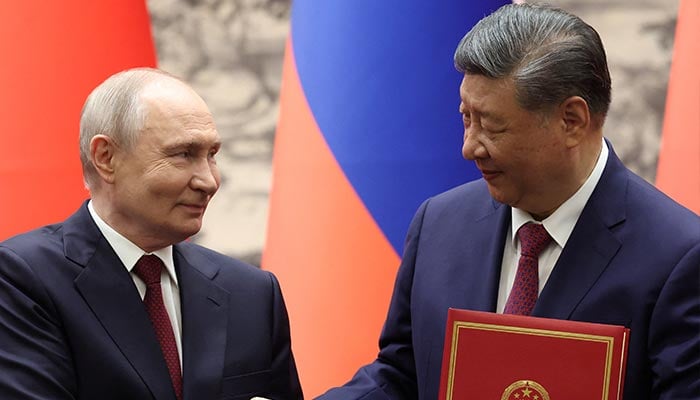
Russia's Vladimir Putin visited Beijing on Wednesday for a high-profile summit with China's Xi Jinping — just days after U.S. President Donald Trump had received the same ceremonial treatment. The meeting produced a lengthy joint statement and dozens of signed documents, but no major breakthroughs. What the cameras didn't show, however, was far more alarming: European intelligence agencies report that China covertly trained around 200 Russian military personnel on Chinese soil — soldiers who have since returned to fight in Ukraine.

.
The Summit Beijing Wanted the World to See
The optics were impeccable. Putin arrived at the Great Hall of the People to a full honor guard and a gun salute. Children waved Chinese and Russian flags. A military band played as soldiers marched in formation. Xi Jinping and Vladimir Putin then walked inside together to begin what the Kremlin had described as a meeting with "very serious expectations."
The summit carried deliberate symbolism. It came just days after U.S. President Donald Trump's own Beijing visit — and Xi extended identical ceremonial honors to both leaders within the same week. That fact alone underscores China's rising clout: no other power today can host the American president and the Russian president in the same breath.
Xi opened by saying China-Russia relations had reached their current level through "deepened political mutual trust and strategic cooperation." Putin called their partnership "an example of international relations in the modern world" and emphasized that Russia remains "a reliable energy supplier." He also extended an invitation for Xi to visit Russia next year.
The Kremlin was careful to note that visitors should look at the substance of the two visits, not just the ceremonial trappings — and that "not everything was visible on the surface." That turned out to be an understatement.
What the Cameras Didn't Show: Secret Military Training
While the public ceremony proceeded smoothly, a far more consequential revelation surfaced simultaneously.
According to three European intelligence agencies and documents reviewed by Reuters, China's armed forces secretly trained approximately 200 Russian military personnel on Chinese soil late last year. Some of those soldiers have since returned to Ukraine to fight.
The covert training focused on drone warfare — one of the most tactically significant areas of the conflict. It was formalized in a dual-language Russian-Chinese agreement signed by senior military officers from both countries in Beijing on July 2, 2025. Training took place at military facilities in multiple locations, including Beijing and the eastern city of Nanjing.
Neither the Russian nor the Chinese defense ministry responded to requests for comment. China's foreign ministry issued a brief denial, telling Reuters that Beijing has "consistently maintained an objective and impartial stance" on Ukraine and has worked toward peace talks.
That response is increasingly difficult to square with the evidence. Beijing has long insisted it does not supply weapons to Russia. But training combat personnel — specifically in drone operations, which have reshaped the battlefield in Ukraine — represents a direct contribution to Russia's war effort, regardless of how it is labeled.
A Mountain of Paper — But No Major Deals
The summit produced an impressive volume of signed documents. A sprawling 9,935-word joint statement addressed topics ranging from nuclear security and Taiwan to Amur tigers, giant pandas, and golden snub-nosed monkeys. A shorter joint declaration was signed alongside it. More than 20 additional agreements were inked, covering areas from sanitary norms and state media cooperation to nuclear energy.
Yet as of the conclusion of the talks, no major deals had been clinched. For a summit framed with such fanfare, the concrete output was more symbolic than substantive.
One notable side development: Sberbank CEO German Gref announced that Russia hopes to power its flagship GigaChat artificial intelligence model with Chinese-made chips — a direct consequence of Western sanctions that continue to block Russia's access to advanced technology from other markets.
"Law of the Jungle" — and a Swipe at the Golden Dome
In their joint declaration, Xi and Putin issued pointed criticism of U.S. foreign policy. The two leaders warned that some countries' attempts to dominate global affairs in the manner of the colonial era had failed — but cautioned that the world risks a return to the "law of the jungle."
They also jointly criticized U.S. President Donald Trump's planned Golden Dome missile defense shield, stating that it threatens global strategic stability. The two sides further accused Washington of irresponsibility for failing to work toward a replacement for a landmark nuclear arms control treaty that has lapsed.
The statement amounts to a coordinated geopolitical challenge to American primacy — framed in diplomatic language, but unmistakable in its intent.
Germany Watches Closely — and Speaks Plainly
German Chancellor Friedrich Merz said on Tuesday that Berlin is "monitoring the visit very closely." He expressed hope that Xi would urge Putin to end the war in Ukraine — a war, Merz said plainly, that Putin "cannot win" and that "is causing heavy loss of life for Russia every single day."
Merz also said Germany does not currently expect "a fundamental shift in the strategic relations between Russia and China" — a sober assessment that the summit, whatever it produced on paper, is unlikely to alter the underlying dynamic.
The Pipeline Question — A Step Forward, No Finish Line
The Power of Siberia 2 natural gas pipeline remains one of the most consequential concrete issues between the two countries. The proposed 2,600-kilometer route would carry up to 50 billion cubic meters of gas annually from Russia's Arctic fields through Mongolia into northern China.
Kremlin aide Yuri Ushakov had confirmed ahead of the summit that the pipeline "will be discussed in great detail." And progress was made — but only partially. The Kremlin said a general understanding on the project had been reached. However, key details and a timetable for the vast undertaking still need to be agreed upon. A formal deal, once again, did not materialize.
Putin has been using the ongoing disruption in Middle Eastern energy markets as a new argument for why Beijing should commit to a long-term overland supply deal. China, however, is not rushing. Beijing has been quietly diversifying its energy imports, including liquefied natural gas from the United States, Qatar, and Australia.
Russian oil exports to China did surge 35% in the first quarter of 2026, according to Kremlin figures, and China remains Moscow's largest oil customer by volume — accounting for around 20% of China's total oil imports. But on gas pricing, the gap remains wide: Russia is seeking around $265 per thousand cubic meters, while China has been pushing for closer to $120.
Xi Calls for Ceasefire in the Middle East
Xi used the summit to address the ongoing conflict in the Middle East, calling it "imperative" to stop the fighting and emphasizing that negotiation is the only viable path forward. He also noted that ending the war would help stabilize global energy supplies and international trade — an observation that connects directly to Russia's energy pitch.
Russia, meanwhile, signaled it is ready to help mediate between the United States and Iran. Deputy Foreign Minister Sergei Ryabkov stated that Moscow stands prepared to offer "all possible assistance" in resolving the conflict — a role Russia has clear interests in playing, both as a diplomatic actor seeking relevance and as an energy supplier that benefits from Middle Eastern instability.
Beijing Plays Both Sides — and Signals Washington Too
Perhaps the most striking detail of Wednesday came not from the Putin summit itself, but from China's commerce ministry. As Xi and Putin sat down for talks, Beijing officially confirmed it will purchase 200 Boeing jets — the first formal acknowledgment of a deal announced by Washington following Trump's visit the previous week.
Trump has since said the order could ultimately reach 750 aircraft, all fitted with GE Aerospace engines. Beijing confirmed that the U.S. will provide supply guarantees for engine parts under the arrangement, and that both sides will seek reciprocal tariff cuts on at least $30 billion worth of goods each.
The timing was not accidental. By confirming the Boeing order on the same day Putin arrived in Beijing, China sent a clear message: its relationship with Moscow does not come at the expense of its economic relationship with Washington. Beijing is hedging — and doing so openly.
The two sides are also seeking an extension of the trade truce reached in Kuala Lumpur, under which U.S. tariff rates on Chinese goods are capped. China confirmed that any U.S. tariffs going forward must not exceed the levels set under that arrangement.
What This Summit Actually Means
The ceremony in Beijing on Wednesday was, by every external measure, a success for both leaders. Dozens of bilateral documents were signed. A sweeping joint statement reaffirmed the partnership. A joint declaration calling for a "multipolar world order" and "a new type of international relations" frames the meeting as a formal challenge to Western-led global governance.
But beneath the pageantry, several uncomfortable realities persist.
China's claimed "neutrality" in Ukraine is now harder than ever to defend. The covert drone training of Russian soldiers is not a footnote — it is a direct contribution to a war that has killed hundreds of thousands of people.
The Power of Siberia 2 pipeline — Russia's hoped-for economic lifeline — moved one step closer to agreement, but remains without a deal, a timetable, or a price.
And Xi's decision to confirm the Boeing order on the very day Putin arrived suggests that even China's closest partnerships have their limits — and that Beijing is not willing to sacrifice its economic relationship with the United States on the altar of "no limits" friendship with Moscow.
China answers to no one. But that also means Beijing's loyalties are always, ultimately, conditional.
.
Sources:
- Reuters – Putin's China visit live (May 20, 2026): https://www.reuters.com/world/putin-china-live-russian-leader-meets-xi-beijing-days-after-trump-2026-05-20/
- Reuters – Xi, Putin praise ties at Beijing talks; energy in focus (May 20, 2026): https://www.reuters.com/world/china/xi-putin-meet-beijing-tea-diplomacy-after-trump-visit-2026-05-19/
- Reuters – Nuclear energy, Taiwan and Trump's Golden Dome: key points from Xi-Putin talks (May 20, 2026): https://www.reuters.com/business/finance/nuclear-energy-taiwan-trumps-golden-dome-key-points-xi-putin-talks-2026-05-20/
- Reuters – Russia, China scold U.S. over Golden Dome plans (May 20, 2026): https://www.reuters.com/business/aerospace-defense/russia-china-scold-united-states-over-golden-dome-plans-2026-05-20/
- Reuters – China says it will buy 200 Boeing jets, seek extension of US tariff truce (May 20, 2026): https://www.reuters.com/business/aerospace-defense/china-says-it-will-buy-200-boeing-jets-seek-extension-us-tariff-truce-2026-05-20/
- Columbia Center on Global Energy Policy – Russia's Pivot to Asia (background): https://www.energypolicy.columbia.edu/russias-pivot-to-asia/
.
What's Your Reaction?
 Like
0
Like
0
 Dislike
0
Dislike
0
 Love
0
Love
0
 Funny
0
Funny
0
 Wow
0
Wow
0
 Sad
0
Sad
0
 Angry
0
Angry
0











Comments (0)