

Nepal's New Government Plays China and India Against Each Other
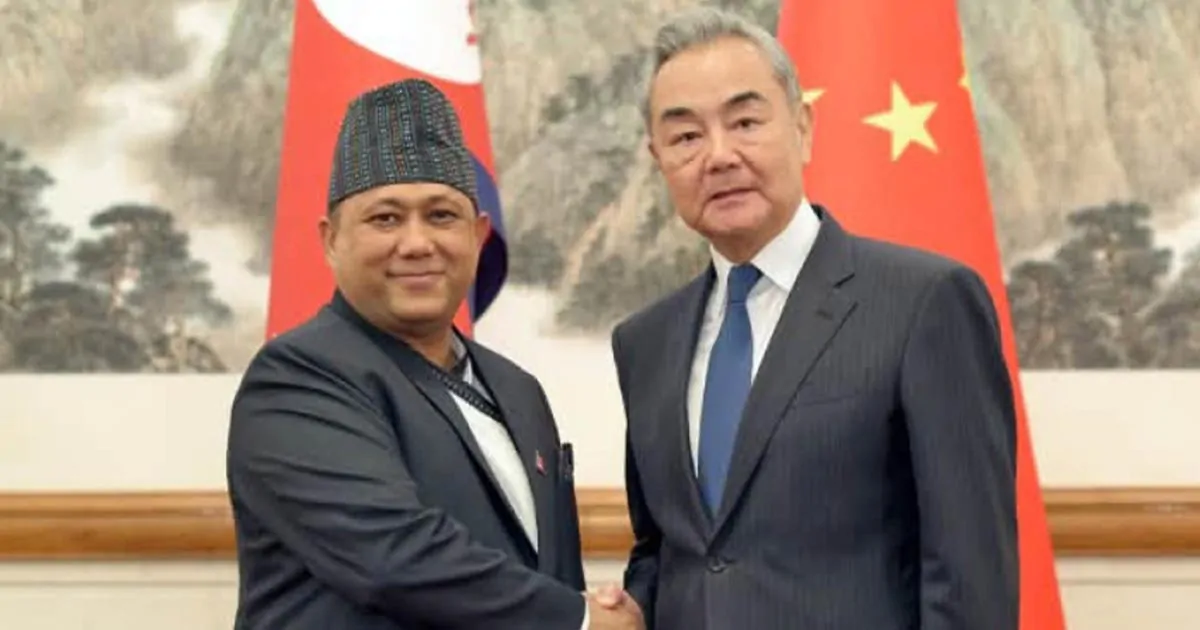
Nepal's Foreign Minister Shisir Khanal visited Beijing this week for talks with China's top diplomat Wang Yi — but only after stopping in India first. The sequence is no coincidence. A new, non-communist government in Kathmandu is quietly reshuffling the cards in one of Asia's most delicate diplomatic balancing acts.

.
A Small Country Between Two Giants
Nepal is landlocked, home to roughly 30 million people, and squeezed between two nuclear-armed neighbors: India to the south, China to the north. For decades, Kathmandu's foreign policy has been a constant tightrope walk — leaning too far toward either side risks damaging the other relationship.
This week, Foreign Minister Shisir Khanal made that balancing act unusually visible. He arrived in Beijing on June 14 for a four-day official visit and held talks with Chinese Foreign Minister Wang Yi on Monday. But before flying to China, Khanal had already been to New Delhi earlier this month — his very first foreign trip since taking office.
The order matters. India first, then China. The signal was unmistakable.
A Political Earthquake in Kathmandu
The backdrop to this diplomatic dance is a dramatic shift inside Nepal itself. In March 2026, voters delivered a stunning verdict at the polls: Nepal's long-dominant communist parties were swept from power in what analysts called a historic democratic rejection of the left.
The Rastriya Swatantra Party (RSP), led by former rapper and Kathmandu mayor Balendra Shah, won in a landslide. Voters swept aside the two main communist parties that had shaped Nepali politics for years, reducing them to minor players in parliament. Overall support for communist parties roughly halved, dropping to around 21 percent from a consistent 40 percent in past elections.
The Balen Shah cabinet has been in office since March 27, 2026. It is the first non-communist-led government in Nepal in years.
Beijing's Uncomfortable Surprise
For China, this was unwelcome news. Beijing had long cultivated Nepal's communist factions as a way to secure influence in a country that borders Tibet and sits along India's northern frontier. For years, China quietly encouraged "leftist unity" among Nepal's communist factions to help cultivate a stable, friendly government and expand its influence along India's northern frontier. The electoral collapse of these parties leaves Beijing's preferred political channels in Nepal marginalized.
Eric Olander, co-founder of the China-Global South Project, a media and research organization, put it bluntly: Beijing doesn't like surprises, and this one clearly caught them off guard. Popular movements that topple governments Beijing favors tend to get China's full and anxious attention.
Kathmandu Signals a Fresh Start
Khanal did not waste the opportunity his India visit offered. He told his hosts in New Delhi that the new Nepali government is "free from the political baggage from the past" and ready to improve ties with India. The two countries share a long and complicated border — roughly 1,750 kilometers — and have feuded over boundary questions for some eight decades.
Nepal is a priority partner of India under its "Neighbourhood First" policy, and the visit reinforced the tradition of regular high-level exchanges between the two close and friendly neighbours. During his Delhi stop, Khanal also met India's National Security Advisor Ajit Doval — a meeting that underlines the security dimensions of the relationship.
In Beijing: Promises, but Old Problems Remain
In his meeting with Wang Yi, the Chinese side was careful to project warmth. Wang told the Nepali delegation that China has always placed Nepal at the center of its neighborhood diplomacy and pledged to support Nepal's sovereignty and territorial integrity. He reiterated Beijing's commitment to infrastructure cooperation — mentioning energy, highways, ports, and aviation.
But behind the diplomatic language lies a long record of undelivered promises. Nepal joined China's Belt and Road Initiative (BRI) in 2017 as part of Xi Jinping's flagship global infrastructure program. Yet nearly a decade later, not a single BRI project in Nepal has been completed.
The biggest stumbling block is the financing question: China insists that projects under the initiative will largely be funded by loans, while Nepal maintains that only grant-funded projects are welcome.
No project formally labelled under the Belt and Road Initiative has been completed in Nepal in eight years. A bribery scandal involving China's state-owned CAMC Engineering at Nepal's Pokhara Airport has further damaged Beijing's reputation as a reliable infrastructure partner.
Nepal Holds a Rare Card
Despite the power asymmetry, Nepal is not without leverage. Its ties to India give it room to maneuver — and Beijing knows it. For once, China finds itself in the unfamiliar position of having to prove its worth to a smaller neighbor rather than dictating terms.
The closely timed visits to India and China underscore Nepal's continuing effort to balance relations with its two powerful neighbors amid intensifying regional competition.
The RSP has unseated the two long-dominant parties — the Nepali Congress and the Communist Party of Nepal (Unified Marxist-Leninist) — who had taken turns ruling the country. The new leadership brings no ideological ties to Beijing and no debt of political loyalty to repay.
Outlook: Fresh Start, Old Fault Lines
Whether Khanal's Beijing visit produces anything concrete remains to be seen. China's BRI machine has stalled in Nepal for reasons that a single diplomatic meeting is unlikely to fix. The fundamental disagreement over loans versus grants has not gone away.
What has changed is the political chemistry. Nepal's new government is signaling that it will not define itself through alignment with either giant. For a small Himalayan nation wedged between Asia's two rising powers, that may be the most pragmatic foreign policy available.
.
Sources:
- Reuters – Nepal's foreign minister visits China after first calling on regional rival India (June 16, 2026): https://www.reuters.com/world/china/nepals-foreign-minister-visits-china-after-first-calling-regional-rival-india-2026-06-16/
- The Diplomat – Why Are BRI Projects in Nepal Stalled? (June 2025): https://thediplomat.com/2025/06/why-are-bri-projects-in-nepal-stalled/
- NPR – A new Nepali party, led by an ex-rapper, is set for a landslide win (March 8, 2026): https://www.npr.org/2026/03/08/nx-s1-5741598/nepali-party-rapper-win-parliamentary-election
- The Hill – Nepal just revolted against communism at the ballot box (March 19, 2026): https://thehill.com/opinion/international/5781267-nepal-just-revolted-against-communism-at-the-ballot-box/
- Rising Nepal Daily – Foreign Minister Khanal visiting China on Sunday (June 12, 2026): https://risingnepaldaily.com/news/81793
- Review Nepal – Nepal's Foreign Policy Balancing Act in Focus (June 2026): https://www.reviewnepal.com/nepals-foreign-policy-balancing-act-in-focus-as-foreign-minister-heads-to-china-after-india-visit/
- Observer Research Foundation – BRI in Nepal: An Appraisal (June 2024): https://www.orfonline.org/research/bri-in-nepal-an-appraisal
- Kathmandu Post – Nepal's communists lose electoral grip (March 12, 2026): https://kathmandupost.com/national/2026/03/12/nepal-s-communists-lose-electoral-grip
.
What's Your Reaction?
 Like
0
Like
0
 Dislike
0
Dislike
0
 Love
0
Love
0
 Funny
0
Funny
0
 Wow
0
Wow
0
 Sad
0
Sad
0
 Angry
0
Angry
0













Comments (0)