

Pro-CCP Influencers Exploit Kirk’s Assassination to Attack US, Divide Americans

.
Pro-Chinese regime social media influencers and accounts are capitalizing on the assassination of conservative commentator Charlie Kirk to attack the United States and sow division, an Epoch Times investigation has uncovered.
Additionally, the Chinese Communist Party (CCP) has allowed information and comments about Kirk to spread widely on the Chinese internet; many comments that use the assassination to argue that the American system of governance is inferior the CCP’s. In China, the internet is tightly controlled by Beijing’s censors and topics are only free to spread and be discussed when allowed by the CCP.
Kirk was assassinated on Sept. 10 during a public speaking event at Utah Valley University.
While his death was widely condemned by people on both sides of the political aisle, pro-CCP accounts amplified the spread of comments that were disrespectful, offensive, outright celebrated his death, or spread conspiracy theories about who was behind the assassination—including suggesting the U.S. government or Israel were involved.
For example, Zhao DaShuai, a self-described propagandist for Chinese Armed Police, jumped between blaming the incident on American society, Israel, and insinuating the U.S. government was involved.
When U.S. War Secretary Pete Hegseth posted the Bible quote, “Well done, good and faithful servant,” in Kirk’s honor, Zhao replied: “What did he mean by this? Won’t be surprised if the shooter was ex-military.”
Her account has more than 200,000 followers and has been pumping out dozens of posts on X about the incident, many of them suggesting Israel was responsible.

In one post, she included a clip of Kirk interviewing conservative political commentator Ben Shapiro, who is Jewish.
“You can’t see Ben Shapiro’s hands, but they are dialing his contact in the Mossad to plan the hit,” she commented.
User @USA_Silly, who lists the Chinese Ministry of Public Security as his location and has more than 120,000 followers, called Kirk “Android redneck” and posthumously scolded him for calling the Chinese regime authoritarian.
Meanwhile, user @leige88888, with nearly 40,000 followers on X, who routinely calls Chinese critics of the CCP “traitors,” suggested Kirk invited his assassination, saying, “those who argue without virtue will surely be put to death.”
Carl Zha, who hosts a pro-China podcast with nearly 200,000 followers on X, blamed the assassination on “a dysfunctional country which will become even more dysfunctional” before replying “Yes” to claims that Kirk was an “ignorant buffoon” who “helped to make [America] dysfunctional.”
Both Zha and DaShuai also claimed that President Donald Trump’s address after the incident was “AI generated.”
Even some non-Chinese pro-CCP accounts followed the pattern.
User @loongkingdom, a self-described Italian who often travels to China and has more than 20,000 followers, claimed that the assassination demonstrates that “the legal system in the US has collapsed.” She also posted a picture of a distasteful figurine showing Kirk’s death.
.

The CCP is known for using an army of online bots and trolls to push its agenda on American social media. It appears, however, that the accounts are getting more sophisticated at exploiting existing divisions in American society.
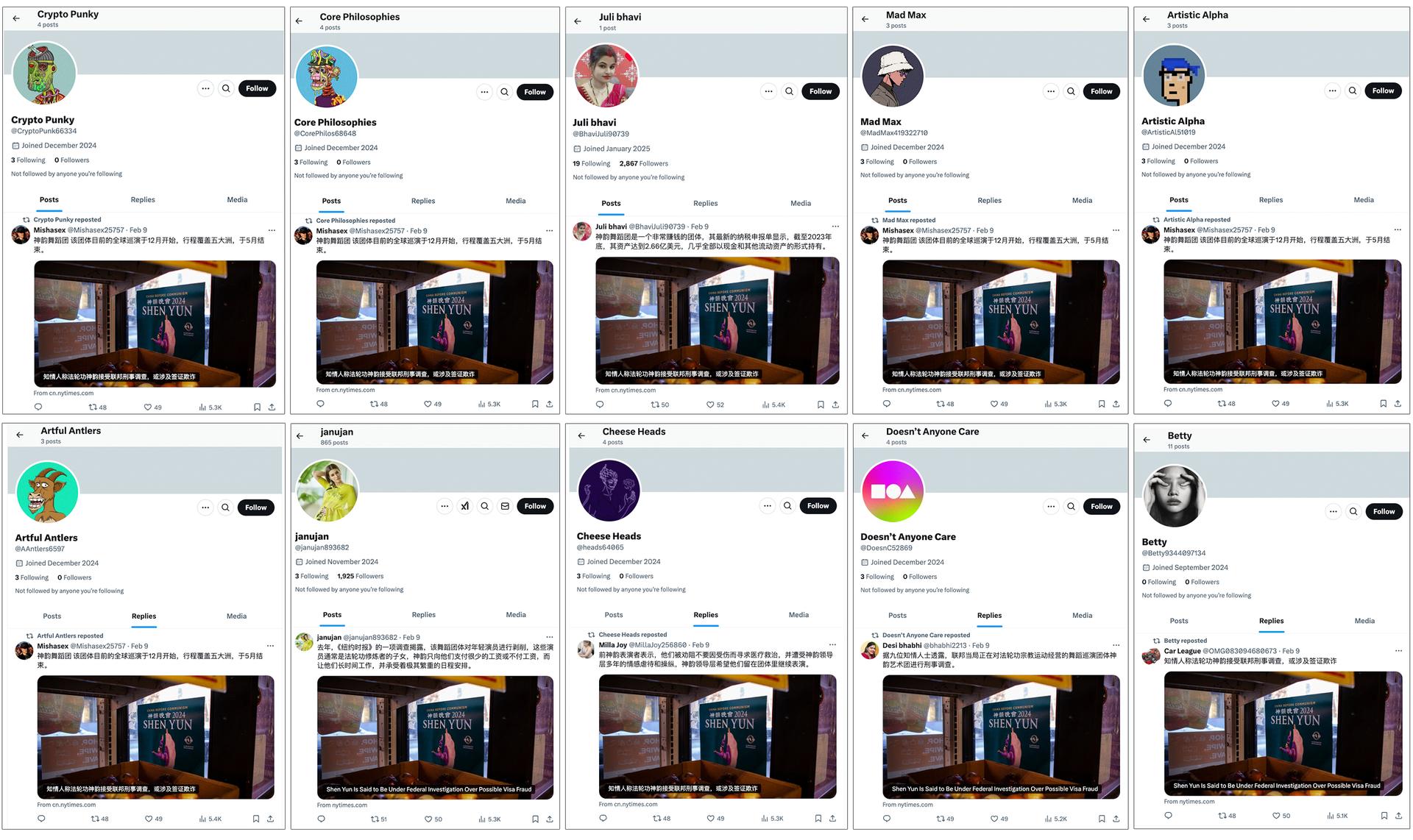
Artificial intelligence has become a major tool of the CCP in streamlining the production of sophisticated fake accounts, multiple experts previously told The Epoch Times.
In recent years, Beijing appears to be more adept at roping in non-Chinese influencers and producing English-language content.
Typical themes include glorification of CCP’s communist system and governance, usually through touting state-sponsored infrastructure and planned hi-tech projects as well as claims of low crime rates in China; and on the other hand portraying America’s system of governance as dysfunctional by highlighting issues such as crime and homelessness, and sewing division among Americans.
Currently, pro-CCP influencers appear to be especially focused on inflaming divisions over the Israel–Hamas war.
.
What's Your Reaction?
 Like
0
Like
0
 Dislike
0
Dislike
0
 Love
0
Love
0
 Funny
0
Funny
0
 Wow
0
Wow
0
 Sad
0
Sad
0
 Angry
0
Angry
0













Comments (0)